

Compensation influences nurse turnover and job satisfaction, but it rarely prevents the emotional exhaustion that defines clinical burnout on its own. Research consistently shows that wages affect whether nurses stay at a job or seek another, yet once workload, staffing ratios, and work environment are accounted for, pay explains far less of the burnout picture than most administrators assume. The World Health Organization classifies burnout as an occupational phenomenon driven by chronic, unmanaged workplace stress, and peer-reviewed studies in PMC confirm that work environment and staffing consistently outweigh wage effects on emotional exhaustion. Understanding this distinction is the first step toward doing something about it.
- When pay helps: Higher base wages and transparent pay structures reduce intent to leave, support recruitment, and address perceived inequity, all of which lower turnover risk.
- When pay won't fix the problem: Emotional exhaustion and moral injury, the core of clinical burnout, are driven by unsafe staffing, excessive workload, and systems that prevent nurses from delivering quality care. A raise does not change those conditions.
- What you can do now: Benchmark your compensation by specialty and state using verified salary data, prepare a negotiation backed by market evidence, and pair any compensation ask with a concrete proposal for staffing or scheduling improvements.
Table of Contents
- Why nurse burnout links to compensation: what the research actually shows
- How compensation affects nurses: the causal pathways you should understand
- When pay reduces burnout: conditions that make compensation more or less effective
- How COVID-19 reshaped the pay–burnout relationship
- What actually works for employers and policymakers
- Practical steps RNs can take with compensation data
- Limits of current evidence and open questions
- Key Takeaways
- The case for pairing pay advocacy with operational reform
- HighPaidRN gives you the salary data to negotiate with confidence
- Useful sources and further reading
Why nurse burnout links to compensation: what the research actually shows
The evidence base on pay and burnout is substantial, but the findings are more nuanced than headlines suggest. Across systematic reviews, large surveys, and mediation analyses, a consistent pattern emerges: compensation matters most at the recruitment and retention stage, while work environment and staffing ratios carry more weight once a nurse is already in a role.
A widely cited PMC study using cross-sectional data across multiple U.S. states found that wage was associated with job dissatisfaction and intent to leave, but that work environment and staffing had significantly stronger effects on burnout itself. That finding has been replicated in different settings and populations. A 2025 umbrella review published in BMC Nursing synthesized multiple systematic reviews and meta-analyses, concluding that nurse burnout has widespread prevalence with organizational and psychological contributors that go well beyond pay, including workload, moral injury, and inadequate institutional support.
A 2023 PMC study examining post-COVID burnout found that nurses reported higher job burnout and lower job satisfaction than other healthcare workers after the pandemic, and that better-staffed, better-environment hospitals showed lower burnout independent of pay levels. A mediation analysis focused on frontline nursing during COVID-19 found that burnout had a significant direct effect on nurses' desire for additional compensation, with coping strategies and social support only partially mediating that relationship. In other words, burnout can drive the perception that pay is inadequate, not just the reverse.
A 2020–2025 systematic review on burnout causal factors concluded that overload, area of activity, and inadequate working conditions directly impact burnout and performance, with causality remaining difficult to establish in most studies. A cross-sectional survey of physicians in Taiwan published in BMJ Open found that productivity-only compensation models were associated with higher burnout compared with mixed salary structures, a finding with direct relevance to nursing compensation design.
| Study / Source | Scope | Year | Headline Finding |
|---|---|---|---|
| PMC — Wage, Work Environment, Staffing | Multi-state U.S. cross-sectional | — | Wage linked to dissatisfaction/intent to leave; staffing/environment stronger predictors of burnout |
| BMC Nursing umbrella review | Global systematic reviews and meta-analyses | 2025 | Widespread burnout prevalence; multifactor organizational and psychological causes |
| PMC — Post-COVID burnout comparison | Healthcare workers, post-pandemic | 2023 | Nurses had higher burnout than peers; better-staffed hospitals showed lower burnout regardless of pay |
| PMC — Frontline nursing COVID mediation | Frontline RNs, pandemic period | 2023 | Burnout directly increased desire for more compensation; coping/support partially mediated |
| PubMed systematic review | 2020–2025 literature | 2025 | Overload and poor conditions directly predict burnout; causality under-studied |
| BMJ Open — Physician compensation survey | Nationwide Taiwan cross-sectional | 2020 | Productivity-only pay linked to higher burnout vs. mixed salary models |
| ANA professional guidance | U.S. nursing workforce | Ongoing | Burnout is workplace-driven; systemic prevention requires more than compensation changes |
| JMDH — Frontline nursing perception | Frontline RNs, COVID-19 context | 2023 | Nurses view pay as recognition for personal cost of care, not just income |
Key finding: Across the strongest studies, wage effects on burnout are real but modest once staffing and work environment are controlled. Pay's clearest impact is on turnover intention, not emotional exhaustion.
How compensation affects nurses: the causal pathways you should understand
The connection between pay and burnout is not a single straight line. Several distinct mechanisms run in parallel, and each has different implications for what nurses and employers can actually change.
-
Financial strain increases stress. When a nurse's income does not cover basic living costs, financial stress compounds the psychological demands of clinical work. This is especially acute in high cost-of-living states where nominal wages look competitive but purchasing power is limited. Financial stress is a recognized occupational stressor that reduces cognitive resources available for patient care and recovery.
-
Perceived inequity leads to demoralization. Nurses who believe their pay is unfair relative to peers, whether in the same unit, a neighboring hospital, or a comparable specialty, experience a form of chronic dissatisfaction that erodes engagement. This perceived inequity is not just about the dollar amount; it signals that the organization does not value their contribution. Research on compensation inadequacy during the COVID-19 pandemic shows nurses view pay as both financial and symbolic recognition for the personal cost of frontline care.
-
Productivity-based pay structures drive overwork. When compensation is tied primarily to output metrics, nurses face an implicit incentive to take on more patients or shifts than is safe or sustainable. The BMJ Open physician survey found that productivity-only compensation correlated with higher burnout compared with mixed salary models. The same logic applies in nursing: RVU-style or shift-volume incentives without a stable base wage can push nurses toward unsustainable workloads.
-
One-off and unpredictable pay offers limited protection. Sign-on bonuses and hazard pay create short-term financial relief and can shift a nurse's decision about where to work. They do not, however, change the daily conditions that generate emotional exhaustion. A nurse who accepts a $15,000 sign-on bonus at a facility with a 1:8 nurse-to-patient ratio will still face the same workload stress once the bonus is spent.
-
Burnout itself increases the perceived need for more pay. The mediation analysis published in PMC found that burnout had a direct effect on nurses' desire for additional compensation. This creates a feedback loop: poor working conditions generate burnout, burnout increases the sense that pay is inadequate, and inadequate pay reinforces dissatisfaction. Breaking the loop requires addressing both sides.
Pro Tip: When raising compensation concerns with a manager, frame the conversation around patient safety and staffing data, not just personal finances. Saying "our unit's nurse-to-patient ratio exceeds the evidence-based threshold, and that's contributing to turnover that costs the facility more than a wage adjustment would" is harder to dismiss than "I need more money."
When pay reduces burnout: conditions that make compensation more or less effective
Pay does not operate in isolation. Its effect on burnout and retention depends heavily on what else is happening in the work environment. Several factors determine whether a compensation change actually moves the needle.
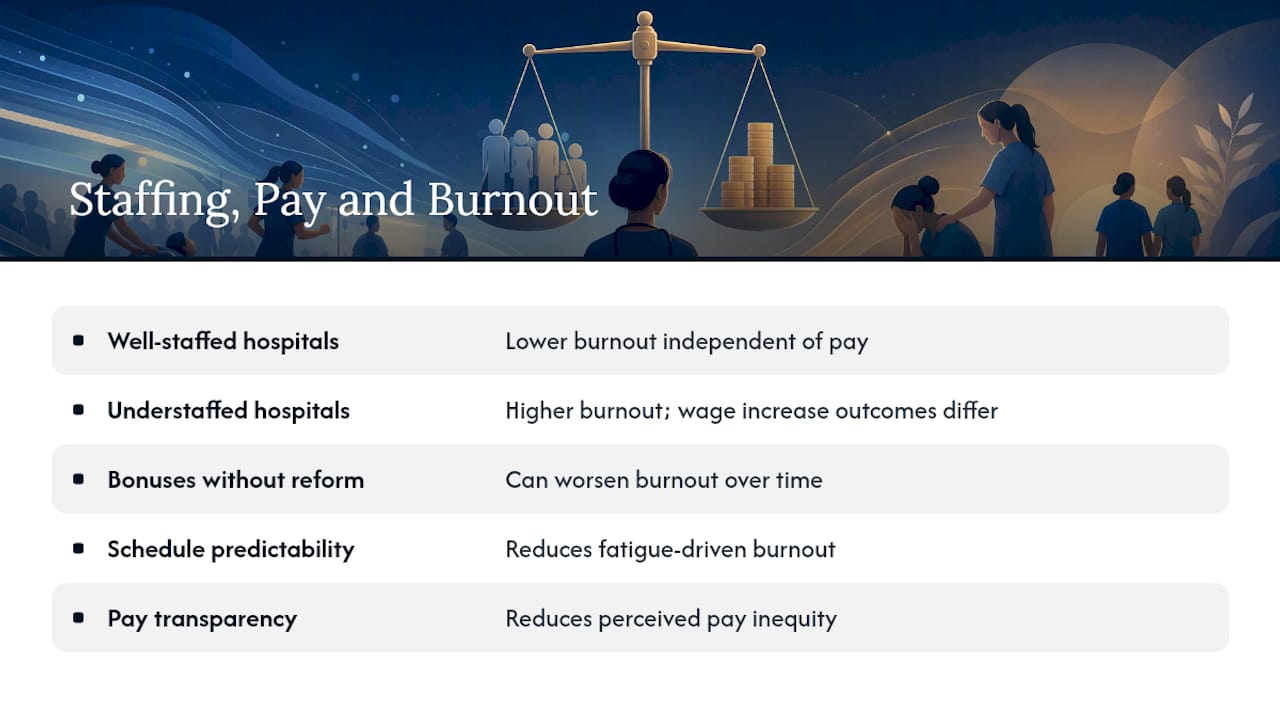
Staffing ratios are the most powerful moderator. Hospitals with adequate nurse-to-patient ratios consistently show lower burnout, lower turnover, and higher job satisfaction, even when their wages are not the highest in the market. The post-COVID PMC study confirmed that better-staffed, better-environment hospitals had lower burnout independent of pay. A wage increase at a chronically understaffed facility produces a different outcome than the same increase at a well-staffed one.
Supervisory support and leadership quality matter. Nurses who report strong support from their direct supervisors show greater resilience to workload stress. Leadership that acknowledges clinical complexity, advocates for resources, and responds to safety concerns creates a buffer that pay alone cannot replicate.
Schedule predictability and shift length limits reduce fatigue-driven burnout. Unpredictable scheduling, mandatory overtime, and extended shift lengths are independent predictors of emotional exhaustion. Compensation that comes with scheduling chaos is a poor trade. Facilities that offer schedule control, advance notice, and limits on consecutive shifts see better retention outcomes even at comparable pay rates.
Benefits access shapes the total compensation picture. Health insurance quality, paid leave, retirement contributions, and access to mental health resources are components of total compensation that nurses often underweight when comparing offers. A facility offering $5,000 more in base salary but minimal mental health benefits may deliver less real value than one with a lower base and comprehensive support.
Pay transparency reduces perceived inequity. When nurses can see how their pay compares to peers in similar roles, the sense of hidden unfairness diminishes. Transparent pay structures, including published salary bands and clear criteria for advancement, are associated with higher trust and lower intent to leave. Resources like nursing salary transparency guides explain how this works in practice.
Productivity-tied bonuses or one-off hazard pay that arrive without any change to staffing levels or workload can actually worsen burnout over time. Nurses may initially feel recognized, but when the bonus period ends and conditions remain unchanged, the contrast between the temporary financial acknowledgment and the ongoing daily reality deepens the sense of inequity. Employers who use financial incentives as a substitute for operational reform should expect diminishing returns on each successive bonus cycle.
How COVID-19 reshaped the pay–burnout relationship
The pandemic compressed years of workforce stress into a short window and forced a rapid, often improvised response from health systems. Understanding what happened between 2020 and 2024 clarifies both what pay can accomplish and where its limits are sharpest.
In 2020, hospitals and health systems deployed hazard pay and emergency sign-on bonuses as the primary tools to attract and retain nurses during acute staffing crises. These measures worked in a narrow sense: they moved nurses between facilities and kept some from leaving the profession entirely in the short term. What they did not do was reduce the emotional exhaustion accumulating from unprecedented patient loads, moral injury from resource scarcity, and grief from patient deaths.
By 2021 and into 2022, the travel nurse market expanded dramatically. Nurses who could command two to three times their base salary through agency contracts did so, and many did. This created a two-tier workforce: agency nurses earning premium rates alongside staff nurses earning standard wages for identical or heavier work. The perceived inequity this generated among staff nurses was a significant driver of additional turnover, not a stabilizing force.
The 2025 BMC Nursing umbrella review documented widespread burnout prevalence with multiple organizational contributors, and the post-COVID PMC study found that nurses showed higher burnout and lower job satisfaction than other healthcare workers even after the acute phase of the pandemic ended. Many nurses who received hazard pay or bonuses during 2020–2021 still reported that compensation felt inadequate relative to the personal cost of frontline care during that period.
Workforce data point: Post-pandemic workforce analyses consistently show that short-term financial incentives accelerated movement between employers and specialties but did not uniformly reduce emotional exhaustion. Nurses who moved for higher pay often found similar or worse staffing conditions at the new facility.
By 2023–2024, many health systems began pulling back on sign-on bonuses as financial pressures mounted, even as burnout and turnover remained elevated. The lesson from this period is that financial incentives can buy time and movement, but they cannot substitute for the structural changes, staffing ratios, workload limits, and leadership investment, that address burnout at its source.
What actually works for employers and policymakers
Raising wages is a necessary but insufficient response to nurse burnout. The evidence points to a ranked set of interventions that, when combined with fair compensation, produce measurable reductions in burnout and turnover.
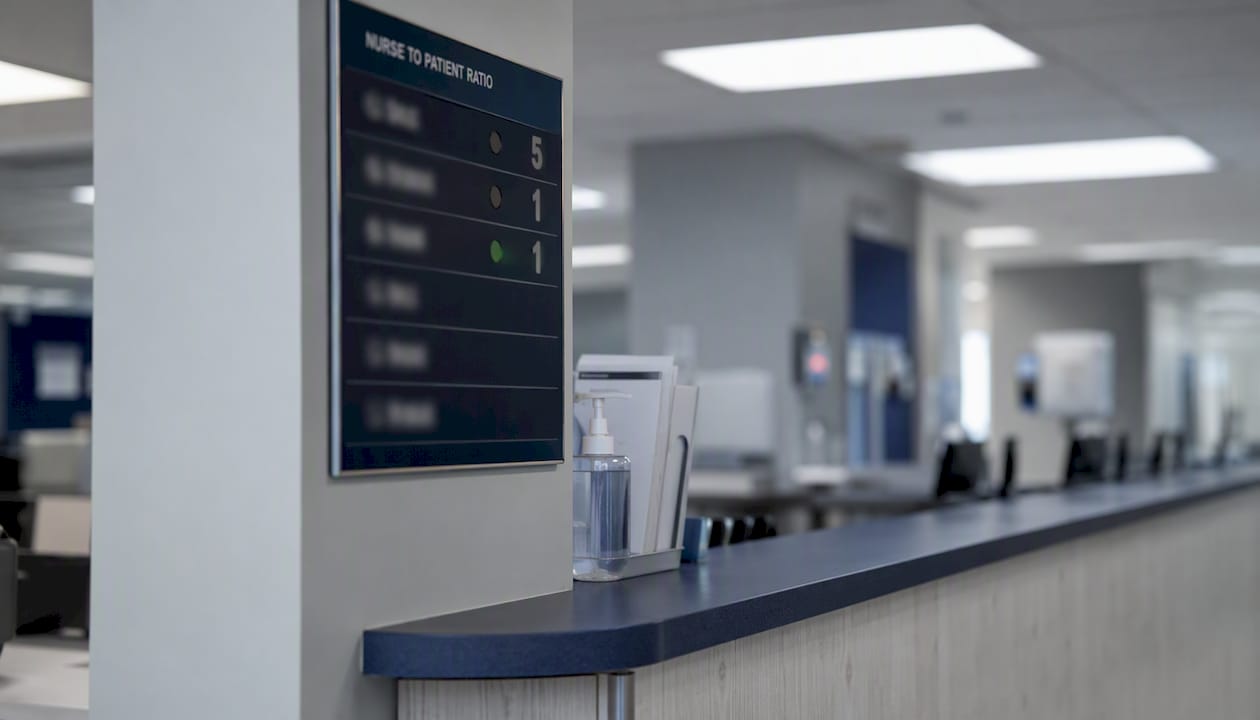
1. Safe staffing ratios. California's mandatory nurse-to-patient ratio law remains the most studied example of a staffing intervention in the U.S., and research consistently associates it with lower burnout and better patient outcomes. Facilities that proactively adopt evidence-based ratio targets, even in states without mandates, see retention benefits that compound over time. Administrators who want to reduce burnout should treat staffing as the first lever, not the last resort.
2. Work environment and leadership quality. The ANA's guidance on nurse burnout prevention emphasizes that burnout is a workplace phenomenon requiring systemic prevention. Magnet-designated hospitals, which meet rigorous standards for nursing leadership and work environment, consistently show lower burnout rates. Investing in nurse manager development and shared governance structures pays dividends in retention.
3. Schedule predictability and shift length limits. Policies that give nurses advance notice of schedules, limit mandatory overtime, and cap consecutive shift lengths address a direct driver of fatigue-based burnout. These changes cost less than sign-on bonuses and have more durable effects.
4. Fair and transparent compensation frameworks. Salary bands, clear criteria for advancement, and regular market-rate reviews reduce the perceived inequity that drives dissatisfaction. Strategies for improving nursing compensation equity include publishing pay ranges, auditing for unexplained pay gaps, and tying raises to transparent criteria rather than manager discretion.
5. Mental health and respite resources. Employee assistance programs, peer support networks, and dedicated mental health days are not luxuries. They address the emotional exhaustion component of burnout that compensation cannot reach. Facilities that integrate these resources into standard operations, rather than offering them as crisis responses, see stronger long-term retention.
Pro Tip: Track two metrics alongside any compensation change: 30-day and 90-day turnover rates by unit, and a brief monthly burnout screen using a validated tool like the Maslach Burnout Inventory. If turnover drops but burnout scores stay high, the pay change is helping retention without addressing the underlying problem, and additional operational changes are needed.
Practical steps RNs can take with compensation data
Knowing the research is useful. Knowing what to do with it is better. Here is a step-by-step approach for using verified salary data to evaluate your current position, negotiate effectively, and advocate for the structural changes that actually reduce burnout.
-
Benchmark your pay by specialty, state, and employer type. Generic salary averages are not useful for negotiation. You need data segmented by your specific specialty (ICU, ED, OR, med-surg), your state, and your employer type (academic medical center, community hospital, long-term care). HighPaidRN's salary database lets you filter by all of these variables using verified, nurse-contributed data, giving you a market-rate reference that holds up in a negotiation conversation. Start by checking signs your nursing salary may be below market to establish your baseline.
-
Compare total compensation, not just base wage. Base hourly rate is one number. Shift differentials, overtime policies, health insurance quality, retirement match, paid time off, and tuition reimbursement all affect your real compensation. A facility offering $3/hour less in base pay but a 6% retirement match and full mental health coverage may be the better financial choice over a three-year horizon.
-
Identify pay gaps by employer and geography. Compensation varies significantly by employer type and location, often in ways that are not obvious from job postings. Understanding why nurse wages differ by employer and why nursing wages vary by state gives you the context to evaluate whether a gap reflects cost-of-living differences or genuine underpayment.
-
Prepare a data-backed negotiation. When asking for a raise, bring specific market data, not a general sense that you deserve more. A script that works: "Based on verified salary data for [specialty] RNs in [state], the median hourly rate for my role and experience level is $X. My current rate is $Y. I'd like to discuss closing that gap." For more negotiation framing, the guide on ways to ask for a higher nurse salary offers adaptable scripts for different situations.
-
Pair compensation asks with staffing and scheduling proposals. A compensation request paired with a concrete operational proposal is harder to refuse and more likely to produce lasting change. If your unit is running above safe nurse-to-patient ratios, document it. If mandatory overtime is adding to your hours, quantify it. Presenting both the pay gap and the workload data together reframes the conversation from "I want more money" to "here is what the evidence says about sustainable staffing and fair pay in this specialty."
-
Know when to escalate. If direct negotiation with your manager does not produce results, the next steps are HR, your union representative if applicable, or department leadership. Collective salary sharing with peers, done anonymously through platforms like HighPaidRN, builds the data foundation for unit-level or facility-level advocacy.
-
Evaluate new job offers against the full picture. A sign-on bonus is a one-time payment. Before accepting an offer with a large bonus, ask about nurse-to-patient ratios, mandatory overtime policies, and turnover rates on the unit. A facility with a high sign-on bonus and a 40% annual turnover rate is telling you something important about what working there is actually like.
Limits of current evidence and open questions
The research on pay and burnout is growing, but it has real gaps that affect how confidently any recommendation can be made.
Most studies are cross-sectional. They capture a snapshot in time, which means they can show that low pay and high burnout co-occur, but they cannot prove that low pay causes burnout or that raising pay will reduce it. The 2020–2025 systematic review explicitly flags causality as under-studied, noting that overload and poor conditions are consistent predictors but that the directional relationships remain difficult to establish.
Burnout is measured inconsistently across studies. Some use the Maslach Burnout Inventory, others use single-item screens, and others use proxy measures like intent to leave or job satisfaction. This makes direct comparison across studies difficult and inflates apparent inconsistencies in findings.
Confounding by work environment is common. Studies that do not control for staffing ratios, supervisor quality, or scheduling practices may attribute to pay what is actually explained by those factors. The PMC wage study is notable precisely because it did control for these variables and found that work environment effects dominated.
Longitudinal mediation analyses are rare. The mediation analysis in the frontline nursing COVID study is a methodological step forward, but it covers a specific, crisis-period population. Whether the same mediation pathways hold in stable, non-crisis settings is an open question.
Research gap: No large-scale, controlled longitudinal study has tracked what happens to burnout scores when nurses receive sustained wage increases alongside unchanged workloads versus wage increases paired with staffing improvements. That study would answer the most practically important question in this field.
Open questions for nurses and managers:
- Which specific pay structures (base wage vs. shift differential vs. productivity bonus) have the strongest effect on emotional exhaustion versus turnover intention?
- Does pay transparency alone reduce perceived inequity enough to affect burnout, or does it require accompanying pay equity corrections?
- How do compensation effects on burnout differ across specialties with different baseline stress levels (ICU vs. outpatient vs. long-term care)?
Key Takeaways
Compensation affects nurse turnover and recruitment clearly, but emotional exhaustion and moral injury require staffing, leadership, and operational changes that pay alone cannot deliver.
| Point | Details |
|---|---|
| Pay affects turnover, not exhaustion | Wages reduce intent to leave and support recruitment, but work environment and staffing ratios are stronger predictors of emotional burnout. |
| Productivity-only pay raises burnout risk | Compensation tied solely to output metrics is associated with higher burnout; mixed salary structures with a stable base perform better. |
| Combined approach works best | Pairing a fair base wage with safe staffing ratios, schedule predictability, and mental health resources produces more durable retention gains than pay increases alone. |
| Evidence has real limits | Most studies are cross-sectional; causality between pay and burnout remains difficult to establish, and longitudinal controlled research is still limited. |
| HighPaidRN supports data-backed negotiation | Use HighPaidRN's verified salary database, filtered by specialty, state, and employer type, to benchmark your pay and build a market-evidence case before any compensation conversation. |
The case for pairing pay advocacy with operational reform
The evidence is clear enough to act on, even with its limitations. Pay matters. Nurses who are underpaid relative to their market face a real and compounding disadvantage: financial stress, perceived inequity, and the signal that their institution does not value their work. All of those factors contribute to the conditions in which burnout takes hold. Advocating for fair compensation is not separate from advocating for better working conditions. It is the same argument made from two angles.
What the research also shows, consistently, is that pay advocacy without operational reform tends to produce temporary relief. A nurse who negotiates a $6/hour raise at a facility running chronic short-staffing has addressed one stressor while leaving the larger one untouched. The most effective approach combines a documented, market-rate compensation case with a concrete proposal for the staffing or scheduling change that would actually reduce the daily workload driving exhaustion.
Collect your data. Talk with peers about what they are earning, using anonymous platforms where that conversation is safe and structured. Know your market rate by specialty and state. And when you bring a compensation ask to your manager or HR, bring the workload data alongside it. That combination is harder to dismiss and more likely to produce the kind of change that actually reduces burnout over time.
HighPaidRN gives you the salary data to negotiate with confidence
Knowing you are underpaid is one thing. Proving it with verified, specialty-specific market data is what makes a negotiation conversation land. HighPaidRN is built specifically for registered nurses who need more than a generic salary average: the platform lets you filter by state, specialty, hospital type, and employment condition, so the number you bring to your manager reflects your actual market, not a national average that obscures wide regional and specialty variation.
Nurses who contribute their own salary data anonymously help build a collective benchmark that strengthens the entire profession's negotiating position. Whether you are preparing for a raise conversation, evaluating a new job offer, or trying to identify a pay gap in your current role, HighPaidRN's salary database gives you the evidence to make that case clearly. Compensation data is a tool, not a cure for burnout on its own, but it is the right starting point for any nurse who wants to address both the financial and operational conditions driving exhaustion. Check your market rate today and pair what you find with the staffing and scheduling data that completes the picture.
Useful sources and further reading
| Source | Type | What to look for |
|---|---|---|
| Wage, Work Environment, and Staffing: Effects on Nurse Outcomes (PMC) | Cross-sectional analysis | How wage, staffing, and environment each independently predict burnout and turnover intention |
| The Cost of Frontline Nursing: Compensation Inadequacy During COVID-19 (PMC) | Mediation analysis | How burnout drives perceived compensation inadequacy; role of coping and social support |
| Global Prevalence and Contributing Factors of Nurse Burnout (BMC Nursing) | Umbrella review of systematic reviews | Prevalence estimates and the range of organizational and psychological contributors |
| Systematic Review on Burnout Causal Factors 2020–2025 (PubMed) | Systematic review | Overload and working conditions as direct burnout predictors; causality limitations |
| Nurse Burnout: What Is It and How to Prevent It (ANA) | Professional guidance | ANA's framework for burnout prevention; emphasis on systemic and workplace-level interventions |
| Physician Compensation and Burnout: Productivity vs. Mixed Models (BMJ Open) | Nationwide cross-sectional survey | How compensation structure (productivity-only vs. mixed) relates to burnout risk |
| Increased Job Burnout and Reduced Job Satisfaction Post-COVID (PMC) | Post-pandemic comparative study | Nurse burnout vs. other healthcare workers; role of staffing and environment vs. pay |
| The Cost of Frontline Nursing: Compensation Perception (JMDH/Dove Press) | Practitioner-level qualitative insight | How nurses frame pay as recognition for personal cost of care, not just income |