

If other employers are offering you more money, your paycheck barely covers local living costs, or you're clocking overtime just to break even, your nursing salary is likely below market. Many nurses report feeling underpaid, and that gut feeling often has a factual basis. The immediate next step: benchmark your effective hourly rate against BLS state-level data and a specialty-filtered source like HighPaidRN to see exactly where you stand.
The clearest red flags for nursing wages include:
- Competing employers in your area are offering higher base pay for the same role and experience level
- Your take-home pay doesn't cover local housing, transportation, and basic expenses without side income
- You only hit a livable income by working overtime or a second job
- You haven't received a meaningful raise in two or more years
- Your benefits package is thin — low retirement match, minimal PTO, no shift differentials
- The BLS median for your state and specialty is noticeably higher than your current base
Any two of these together is a strong signal. Three or more means it's time to act.
Table of Contents
- What are the signs your nursing salary is low?
- How do you benchmark your nursing pay accurately?
- How do you calculate how far below market your pay is?
- What should you do if your nursing pay is below market?
- Key Takeaways
- Why asking for fair pay is a professional responsibility
- HighPaidRN gives you verified data to negotiate with confidence
- Reliable U.S. sources for nursing salary data
What are the signs your nursing salary is low?
Pay problems in nursing rarely show up as a single obvious number. They show up as patterns. Recognizing those patterns early is what separates nurses who negotiate from nurses who wait.
Competing offers are higher. When a recruiter from a nearby hospital or a travel agency quotes you a rate that's meaningfully above your current pay for the same specialty and shift, that's not a coincidence. It's the market telling you something your employer hasn't. Salary variation by state and specialty can run into the tens of thousands of dollars, so a single competing offer can reveal a significant gap.
Your base pay sits below the state median. Recent reports indicate the national median RN salary is substantial, though it varies widely by state and specialty. If your base is well below that figure and you're working in a mid-to-high cost-of-living area, you're likely underpaid relative to your peers. State medians vary considerably, so check your specific state's figures rather than the national number alone.
You rely on overtime to make ends meet. Overtime pay masks a low base. If your standard 36- or 40-hour paycheck doesn't cover your monthly obligations, the base salary itself is the problem. Overtime is not a compensation strategy; it's a workaround.
- No raises or promotions in two-plus years. Annual raises that don't keep pace with inflation are effectively pay cuts. If your employer hasn't moved you up the clinical ladder or offered a market-correction adjustment, your real purchasing power has declined.
- Poor benefits and missing differentials. A low or absent retirement match, no evening or weekend shift differential, minimal PTO, and no tuition reimbursement all reduce your total compensation below what comparable roles offer. These gaps compound over time just as salary gaps do.
- Chronic unit turnover and staffing shortages. High turnover is a proxy signal. When nurses leave a unit at an above-average rate, it often reflects pay that can't compete with nearby employers. If you're absorbing the workload of unfilled positions without additional pay, your effective compensation per unit of work is falling.
Nearly half of nurses report that dissatisfaction with salary policies harms their mental health, according to the 2026 Nurse Salary and Work-Life Report. Pay isn't just a financial issue; it's a signal of how an institution values its clinical staff.
How do you benchmark your nursing pay accurately?
Benchmarking is the process of comparing your actual compensation to what the market pays for your role, specialty, and location. Done right, it gives you a defensible number to bring into any negotiation.

Step 1: Gather your documents. Pull your three most recent pay stubs, your most recent offer letter, your benefits summary, and any records of shift differentials, bonuses, or PTO accrual rates. You need the full picture, not just your base salary line.
Step 2: Compute your effective hourly rate. Add your annual base salary, average annual overtime pay, and any recurring bonuses. Divide by your actual hours worked per year. Then add the dollar value of recurring benefits: your employer's retirement match, the cash value of your PTO days, and any tuition reimbursement you use. This gives you a true compensation figure for an apples-to-apples comparison.
Step 3: Find credible comparators. Match your data to sources that reflect your specific situation. The BLS Occupational Employment and Wage Statistics program publishes state-level RN data. State labor department websites often carry more granular figures. Crowd-sourced platforms like Glassdoor and PayScale are useful but can skew toward extremes; they work best as a cross-check rather than a primary source. HighPaidRN filters by state, specialty, hospital type, and employment condition, which makes it particularly useful for specialty nurses who need a precise peer group. For specialty-specific pay differences, a filtered database will always outperform a national average.
Step 4: Adjust for cost of living. A $75,000 salary in rural Mississippi and a $75,000 salary in San Francisco are not equivalent. Use a cost-of-living index to convert your pay to a comparable baseline before drawing conclusions. Geographic drivers of nursing wage variation are substantial enough to change the entire picture.
Step 5: Record your benchmark fields.
| Field | Your Data | Market Comparator |
|---|---|---|
| Annual base salary | $____ | BLS/state median |
| Effective hourly rate | $____ | Peer group median |
| Estimated benefits value | $____ | Typical employer match |
| Regional cost-of-living index | ____ | National baseline = 100 |
| Target percentile | — | Based on experience/specialty |
Pro Tip: A credible comparator matches your licensure level (RN vs. APRN), your specialty (ICU, ED, med-surg), and your facility type (community hospital vs. academic medical center vs. outpatient). A general average that mixes all three will understate or overstate your true market rate.
When benchmarking, matching full-time to full-time and hourly to hourly matters. Part-time figures pulled from aggregate data will produce a misleading comparison if you work full-time.
How do you calculate how far below market your pay is?
Once you have your effective hourly rate and a reliable market median, the math is straightforward.
Percent shortfall formula:
(Market median − Your effective pay) ÷ Market median × 100 = % below market
Annual dollar shortfall:
Market median annual pay − Your annual effective pay = Dollar gap
Worked example. Suppose the BLS state median for RNs in your state is $90,000 annually, and your effective annual compensation (base plus overtime plus benefits value) is $82,000.
- Percent shortfall: ($90,000 − $82,000) ÷ $90,000 × 100 = 8.9% below market
- Annual dollar shortfall: $90,000 − $82,000 = $8,000 per year
That $8,000 gap looks manageable in isolation. Over a career, it isn't. A commonly cited calculation shows that a modest raise today can compound to a significant sum over a full nursing career., accounting for percentage-based annual raises, higher retirement contributions, and increased overtime rates. An $8,000 gap compounds even further.
The long-term cost of a small, persistent pay gap is the most underestimated number in nursing finance. Most nurses focus on the monthly difference; the career-level difference is what should drive urgency.

For a step-by-step walkthrough of identifying your specific gap, the nurse pay gap identification guide covers the full methodology.
What should you do if your nursing pay is below market?
Knowing your shortfall is step one. Acting on it is step two. Here's a practical sequence.
-
Build your BATNA before you say a word. BATNA stands for Best Alternative to Negotiated Agreement. It means knowing exactly what you'll do if your employer says no. Gather competing offers, market data by specialty and state, and any certifications that move your clinical ladder placement. Using BATNA in nursing negotiation shifts the conversation from a subjective request to a market-backed case.
-
Request a compensation review with your manager or HR. Frame it as a market-correction conversation, not a complaint. A direct script: "I've reviewed BLS data and specialty benchmarks for my role and experience level. My current compensation is approximately X% below the market median for this specialty in our region. I'd like to discuss a market adjustment."
-
Negotiate non-base elements when base is constrained. Hospital pay scales are often tiered, but most systems will negotiate sign-on bonuses, PTO accrual, tuition reimbursement, and clinical ladder placement even when the base salary band is fixed. Sign-on bonuses commonly range from $3,000 to $15,000, and tuition assistance is often available up to the $5,250 federal tax-free annual limit. These are real dollars.
-
Pursue specialty certification or a clinical ladder promotion. Both typically trigger a pay adjustment within existing employer systems and strengthen your negotiating position externally. Certifications in high-demand specialties (CCRN, CEN, CNOR) carry documented pay premiums.
-
Consider travel nursing or a targeted external search. If your employer can't or won't move, the external market will. Travel nursing rates often run significantly above staff nurse rates for the same specialty. A targeted search at academic medical centers or health systems in higher-paying states can close a large gap quickly.
-
Explore collective options. If your unit has a union, a formal market-correction request through collective bargaining is a structured path. If it doesn't, organizing with colleagues to present aggregate market data to administration carries more weight than individual requests.
Pro Tip: When an employer resists raising base pay, ask them to convert the gap into total compensation instead. Present the dollar value of what you're requesting as a retirement contribution increase, additional PTO days, or a shift differential adjustment. Employers often have more flexibility in those line items than in base salary bands.
For full negotiation scripts and a detailed BATNA preparation checklist, the nursing salary negotiation guide covers each scenario in depth.
Key Takeaways
Your nursing salary is likely below market if two or more objective signs match your situation, and a $5,000 annual gap can cost roughly $600,000 over a 40-year career.
| Point | Details |
|---|---|
| Benchmark with specifics | Match your effective hourly rate to BLS state data and a specialty-filtered source like HighPaidRN. |
| Compute the real shortfall | Use the percent and dollar formulas; a small annual gap compounds significantly over a 40-year career. |
| Total compensation counts | Include retirement match, PTO value, shift differentials, and tuition reimbursement before concluding you're underpaid. |
| Prepare BATNA before negotiating | Gather competing offers and market data; a market-backed case outperforms a subjective request every time. |
| HighPaidRN for verified data | Filter by state, specialty, and hospital type to get a peer-group benchmark, then use it as evidence in your negotiation. |
Why asking for fair pay is a professional responsibility
Nurses are trained to advocate for patients. Advocating for themselves is the same skill applied differently, and it matters just as much.
A considerable share of nurses intend to leave their roles within a year citing inadequate compensation. That's not a personal failure; it's a systemic one. When nurses don't negotiate, they don't just accept a lower salary. They set a lower baseline for every raise that follows, reduce their retirement contributions, and signal to institutions that the current rate is acceptable. That signal shapes what the next nurse gets offered.
The compounding math makes silence expensive. A $5,000 raise negotiated today is worth roughly $600,000 over a 40-year career, as commonly cited in salary negotiation guides. Most nurses who don't negotiate aren't avoiding conflict; they're simply unaware of that number. Once you know it, staying quiet becomes the harder choice to justify.
Using market data from the BLS and a verified platform like HighPaidRN doesn't make a negotiation aggressive. It makes it objective. You're not asking for more because you want more; you're asking because the market says you've earned it. That framing changes the entire dynamic of the conversation, and it's one that nursing as a profession benefits from when more nurses adopt it.
HighPaidRN gives you verified data to negotiate with confidence
Most salary conversations stall because one side has data and the other doesn't. HighPaidRN closes that gap.
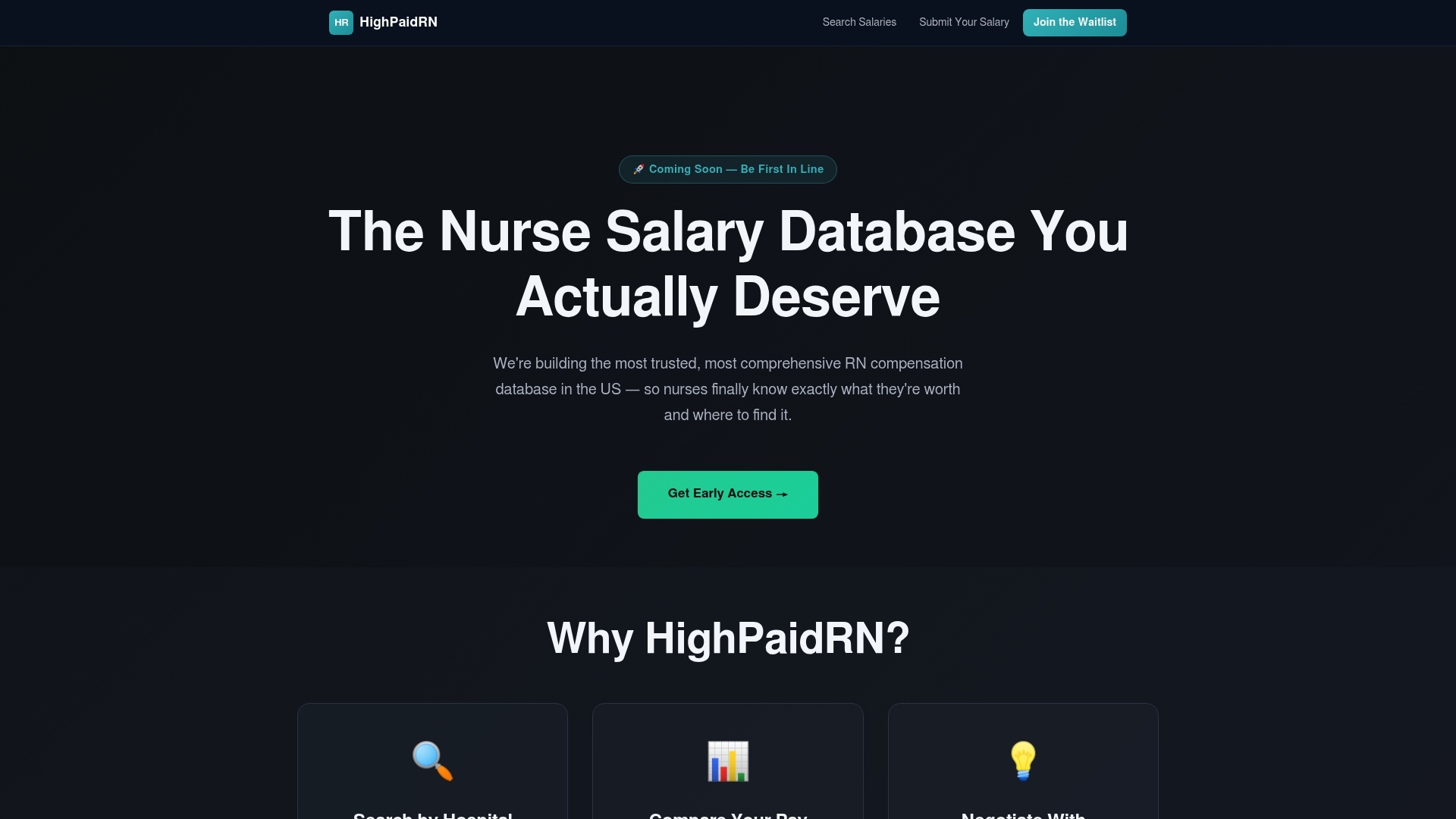
The platform collects anonymous, verified salary reports from RNs across the U.S. and lets you filter by state, specialty, hospital type, and employment condition. That means an ICU nurse in Texas gets a peer-group benchmark, not a national average that includes med-surg nurses in rural states. A travel nurse gets travel-specific figures. The result is a compensation snapshot you can actually use in a negotiation, not a number you have to explain away.
When you're preparing for a pay review, pull your HighPaidRN benchmark, note the percentile your current pay falls in, and bring that figure to the conversation. It shifts the discussion from "I feel underpaid" to "the verified market data shows I'm at the 35th percentile for my specialty and state." That's a different conversation entirely.
Your salary data stays anonymous when you contribute it, and every submission strengthens the database for every nurse who comes after you. Start benchmarking your nursing salary at HighPaidRN and walk into your next negotiation with the numbers to back your ask.
Reliable U.S. sources for nursing salary data
Not all salary data is equally useful. Here's where to look and what each source does well.
- BLS Occupational Employment and Wage Statistics (OEWS): The most authoritative public source for RN pay by state and metropolitan area. Use it first to establish a credible baseline. It lags real-time market conditions by about a year but carries the most statistical weight in a formal negotiation.
- State labor department wage surveys: Many states publish their own wage data more frequently than the BLS cycle. These are especially useful in high-cost states like California, New York, and Washington, where state-level figures diverge significantly from national medians.
- HighPaidRN: Best for specialty-specific and hospital-type-specific benchmarks. The filtering by state, specialty, and facility type makes it the most precise tool for nurses who need a peer-group comparison rather than a broad occupational average. New grads benefit from the entry-level filters; experienced specialty nurses benefit from the advanced filters.
- Glassdoor and PayScale: Useful as a cross-check. Both platforms aggregate self-reported data, which can skew toward higher earners or specific employer types. Treat them as supporting evidence rather than a primary benchmark, and always filter by location and job title before drawing conclusions.
- NursingLicenseMap and Nurse.com salary reports: These publish annual salary surveys with specialty and state breakdowns. The 2026 Nurse Salary and Work-Life Report is a useful annual reference for trend data, with a reported median nursing salary of $80,000 overall and $85,000 for registered nurses, as well as satisfaction metrics alongside raw pay figures.
Which source to check first: If you're a new grad or a generalist RN, start with BLS state data to establish your floor. If you're a specialty nurse (ICU, OR, ED, NICU), go to HighPaidRN first for a filtered peer-group figure, then cross-reference with BLS. If you're evaluating a specific employer, add Glassdoor as a third data point. For deeper research methodology, the nursing compensation research guide walks through how to combine these sources without double-counting or misreading the data.
This article is general information for educational purposes. For advice specific to your employment situation, consult a compensation specialist, a union representative, or a licensed employment attorney.