

What does the U.S. nursing compensation landscape actually look like?
The median annual wage for registered nurses in the U.S. reached $93,600 as of May 2024, according to the Bureau of Labor Statistics. That figure sits well above the national median for all workers, which landed at $49,500 the same year. But the spread is wide: the lowest 10% of RNs earned under $66,030, while the top 10% cleared more than $135,320. Any serious guide to nursing compensation research has to start with that range, because the gap between floor and ceiling tells you more than the median alone.
$93,600 — the 2024 BLS median annual wage for registered nurses, with the top 10% earning more than $135,320.
Nursing pay is rarely just a base salary. Total compensation typically includes several components that vary by employer, unit, and contract type:
- Base hourly or annual pay: The fixed rate tied to your role, experience, and market band
- Shift differentials: Evening, night, and weekend premiums that can add meaningfully to gross income
- Specialty and certification pay: Additional per-hour or annual stipends for credentials like CCRN or CEN
- Bonuses: Sign-on, retention, and performance bonuses, which fluctuate with market demand
- Benefits: Health insurance, retirement contributions, paid time off, and tuition reimbursement
- Stipends (travel nurses): Housing and meal allowances that are non-taxable when structured correctly
Five factors drive most of the variation you see across those components: nursing role and specialty, years of experience, level of education, certifications held, and geographic location. Legal and regulatory factors, including the Fair Labor Standards Act overtime rules and state-level pay transparency laws, set the floor and shape how facilities structure their pay bands.
What recent nursing salary research reveals about pay trends
The picture that emerges from recent nursing salary reports is one of steady wage growth paired with growing attention to non-financial priorities. Nurses consistently rank work-life balance, staffing ratios, and unit culture alongside salary when evaluating positions. That shift has pushed compensation researchers and hospital administrators to look beyond base pay when benchmarking.
Key findings from current nursing salary studies include:
- Salary growth has continued across most specialties, with critical care and perioperative nurses commanding some of the highest premiums
- Work-life balance has become a top priority for nurses evaluating offers, often outweighing modest pay differences between employers
- AI tools and digital workflow changes are beginning to appear in compensation discussions, as facilities weigh productivity gains against staffing needs
- Job satisfaction correlates more strongly with staffing ratios and unit leadership than with salary alone
- Nurses who actively research salary transparency benefits report stronger negotiating outcomes and greater long-term career satisfaction
Evaluating a nursing position purely on hourly wage misses the full picture. Intangible factors like nurse-to-patient ratios, nurse councils, and unit culture are often as crucial as base pay for long-term career satisfaction.
The most credible salary research draws from large, verified datasets rather than self-reported surveys with small samples. Reports that segment data by specialty, facility type, and geography give nurses and administrators the granular benchmarks needed for real decisions, not just headline averages.

How pay disparities break down across nursing roles and specialties
The gap between the lowest and highest-paid nursing roles is substantial, and it is not random. Education level, specialty certification, seniority, and facility type each contribute to where a nurse lands within the pay distribution.
| Nursing Role / Specialty | Approximate Median Annual Pay Range |
|---|---|
| Licensed Practical Nurse (LPN) | — |
| Registered Nurse (RN), general | ~$93,600 (BLS 2024 median) |
| ICU / Critical Care RN | — |
| Nurse Practitioner (NP) | — |
| Certified Registered Nurse Anesthetist (CRNA) | — |
| Travel RN (blended rate) | Varies widely by contract and location |
Note: Ranges reflect general market data and vary by state, facility type, and experience level.
Facilities set pay bands partly to maintain internal equity, which means a nurse with ten years of ICU experience may hit the top of a hospital's band faster than the market would otherwise allow. Internal equity constraints limit negotiation room on base salary, but they rarely apply to shift differentials or certification stipends, which often come from separate budget lines.
Shift differentials and specialty certification pay are often more flexible than base salaries because they draw from separate budget allocations, making them effective negotiation levers for nurses and administrators alike.
Geographic location compounds these disparities significantly. A staff RN in California or Massachusetts typically earns far more than a counterpart in the rural South, even within the same specialty. Understanding why nursing wages vary by state is not optional for anyone doing serious pay analysis. Facility type matters too: academic medical centers, for-profit hospital chains, and critical access hospitals each operate under different financial structures that directly shape their pay scales.
How to build a competitive nursing pay structure for your facility
Administrators who build pay structures reactively, adjusting only when nurses leave, consistently lose ground to facilities that benchmark proactively. A well-researched pay framework starts with local market data and works outward from there.
Step-by-step approach:
- Gather localized salary data first. National medians are a starting point, not a benchmark. Pull data segmented by your state, metro area, specialty mix, and facility type before setting any pay band.
- Map your role hierarchy clearly. Define pay grades for LPNs, staff RNs, charge nurses, and advanced practice roles, then anchor each grade to verified market percentiles rather than internal history alone.
- Build in differential structures from the start. Night, weekend, and holiday differentials should be codified in your pay policy, not negotiated ad hoc. Nurses compare these figures across employers.
- Account for certification and specialty premiums. Decide which credentials earn additional pay, set the dollar amount per credential, and apply it consistently. Inconsistency here creates internal equity complaints.
- Factor in legal compliance. The Department of Labor's overtime rules under the Fair Labor Standards Act apply directly to nursing staff. State-level pay transparency laws in states like Colorado and California add additional disclosure requirements.
- Balance base pay with total compensation. Sign-on bonuses attract candidates but do not retain them. Competitive benefits, tuition reimbursement, and scheduling flexibility often matter more to experienced nurses than a slightly higher base rate.
- Run an internal equity audit annually. Compare pay across nurses with similar experience and credentials within the same role. Unexplained gaps create legal exposure and erode trust.
Pro Tip: When reviewing travel nurse contracts, never accept an all-inclusive hourly rate without a clear breakdown of taxable wages and non-taxable stipends. An undivided blended rate is a known IRS red flag and can jeopardize a nurse's tax home status during an audit.
For travel nurse offers specifically, the blended take-home rate combining taxable pay and stipends gives a far more accurate comparison than weekly gross pay alone. Administrators building contracts and nurses evaluating them both benefit from understanding that distinction.
How HighPaidRN gives you sharper data for compensation decisions
Generic salary surveys aggregate data across too many variables to be useful at the unit level. What nurses and administrators actually need is data filtered by specialty, state, hospital type, and employment condition. That is the specific problem HighPaidRN was built to solve.
The platform collects anonymous, nurse-submitted salary data and makes it searchable across multiple dimensions. Because the data comes directly from working nurses rather than employer-reported figures, it captures real-world pay including differentials, stipends, and bonuses that aggregate surveys often miss.
Key ways nurses and administrators use HighPaidRN for compensation research:
- Specialty-level benchmarking: Filter by specialty to see what ICU nurses, OR nurses, or labor and delivery nurses actually earn in your target market, not just what RNs earn on average
- State and metro-level filtering: Compare pay in your specific state or metro area rather than relying on national figures that may not reflect local conditions
- Hospital type comparison: See how pay differs between academic medical centers, community hospitals, and for-profit systems, which is critical context for administrators setting competitive rates
- Employment condition breakdowns: Separate staff, per diem, and travel nurse pay to understand the full market picture for each contract type
Transparent, nurse-sourced salary data empowers professionals to negotiate more fairly and benchmark their value accurately, because it reflects what nurses are actually paid rather than what employers choose to report.
Nurses preparing to negotiate can use HighPaidRN to walk into a conversation with specific, verifiable figures rather than general market claims. Administrators can use the same data to validate their pay bands against real market rates. The HighPaidRN platform makes that level of specificity accessible without requiring access to expensive proprietary compensation surveys.
One practical note on timing: salary discussions belong with recruiters or HR, not hiring managers during interviews. Knowing when to raise compensation in the hiring process, and having the right data ready when you do, determines how much ground you can actually gain.
What methodologies do nursing compensation researchers actually use?
Nursing salary analysis draws from several distinct research methods, and understanding which one produced a given figure helps you judge how much weight to give it.

Occupational Employment and Wage Statistics (OEWS) surveys are the backbone of federal data. The BLS collects employer-reported wage data across industries and geographies, producing the median figures most commonly cited in policy and planning. The OEWS is authoritative but lags real-time market conditions by roughly 12–18 months.
Self-reported salary databases collect data directly from nurses, capturing total compensation more completely than employer surveys. The tradeoff is potential self-selection bias: nurses who feel underpaid or overpaid may be more likely to submit data. Platforms that aggregate large volumes of submissions and segment carefully by specialty and location reduce this risk substantially.
Academic and clinical research uses methods like regression analysis to isolate the effect of specific variables, such as education level or union membership, on wages while controlling for others. Studies published in journals like Nurse Education Today and indexed in PubMed provide peer-reviewed evidence on pay disparities, including the documented gap between nursing faculty and clinical nurses in comparable specialties.
Market compensation surveys conducted by healthcare consulting firms survey hospitals directly about their pay structures, differentials, and benefit packages. These surveys are expensive to access but give administrators the most direct peer-to-peer benchmarking data.
Job posting analysis scrapes active listings to track advertised pay ranges in real time. This method captures market movement faster than any survey, though posted ranges often differ from actual offers and rarely include the full compensation picture.
The most reliable nursing salary analysis combines at least two of these methods. A BLS median anchors the baseline; a specialty-filtered, nurse-sourced database like HighPaidRN adds the granularity that national figures cannot provide.
Where is nursing compensation headed through 2026 and beyond?
Several forces are reshaping nursing pay in ways that will play out over the next several years. Understanding them helps both nurses and administrators make better long-term decisions.
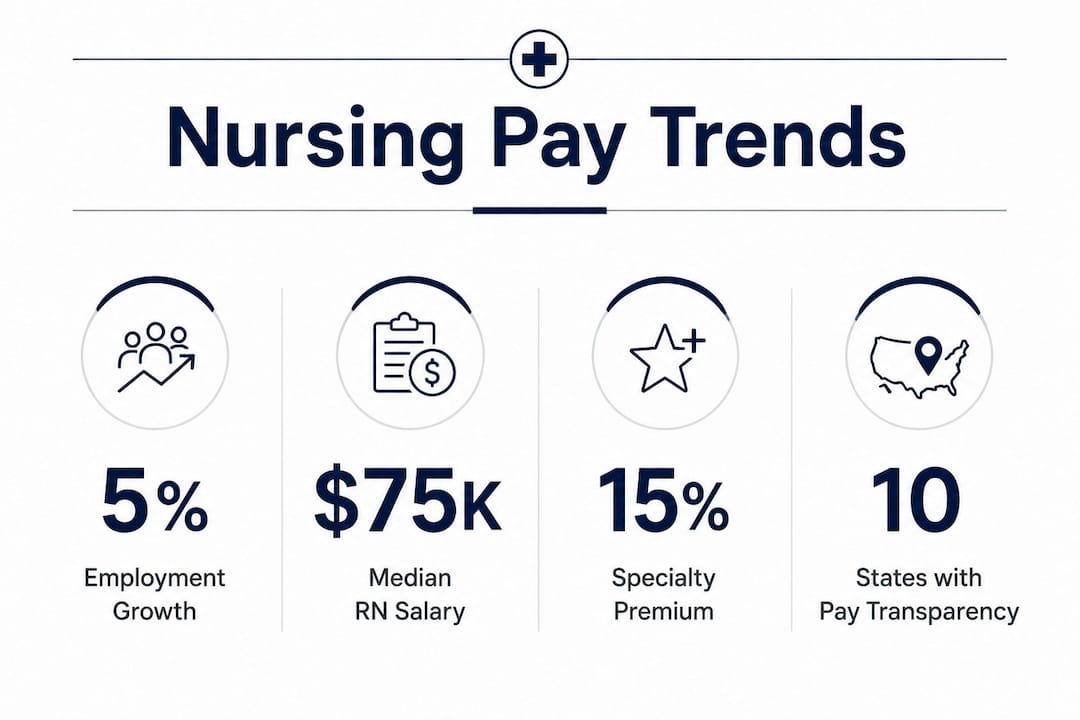
Continued demand growth is the most straightforward driver. The BLS projects 5% employment growth for registered nurses between 2024 and 2034, adding roughly 166,100 positions. That pace, faster than the average for all occupations, sustains upward pressure on wages in most markets.
Geographic pay divergence is likely to widen. States with strong union presence, pay transparency laws, and minimum nurse-to-patient ratio mandates, primarily California and several northeastern states, will continue to pull ahead of markets without those protections. Nurses willing to relocate or take travel assignments can capture that differential directly.
Specialty premiums will grow unevenly. Critical care, perioperative, and psychiatric nursing face the sharpest staffing shortages, which translates into stronger wage growth for those specialties relative to general med-surg. Certifications in high-demand areas will carry more negotiating weight as facilities compete for a limited pool of qualified nurses.
AI and technology integration is beginning to affect staffing models. Facilities investing in clinical decision support and documentation automation may adjust nurse-to-patient ratios over time, which could affect how pay is structured for certain roles. The compensation implications are still emerging, but nurses in technology-forward environments should track how workflow changes affect their workload and pay.
Pay transparency legislation is expanding. More states are requiring employers to post salary ranges in job listings, which gives nurses better data before they ever speak to a recruiter. That transparency tends to compress the lowest pay offers and raise the floor across markets where it takes effect.
For nurses and administrators doing nursing job market analysis, tracking these trends alongside current salary benchmarks produces a more complete picture than any single data point can provide.
Key Takeaways
Effective nursing compensation research combines verified national benchmarks with specialty-filtered, locally sourced data to produce figures that actually support negotiation and pay structure decisions.
| Point | Details |
|---|---|
| National median as baseline | The 2024 BLS median for RNs is $93,600, with a range from under $66,030 to over $135,320. |
| Total compensation over base pay | Shift differentials, certification stipends, and benefits often matter more than base salary alone. |
| Specialty and location drive disparity | CRNAs and NPs earn far more than staff RNs; state and facility type compound those gaps further. |
| Blended rate for travel offers | Taxable pay plus non-taxable stipends gives a more accurate comparison than weekly gross pay. |
| Nurse-sourced data adds precision | Specialty-filtered databases capture real-world pay that employer-reported surveys frequently miss. |