

Nursing pay scale progression is defined as the structured movement through incremental salary steps and pay bands, driven by experience, competency milestones, and career advancement. How nursing pay scales progress depends on two forces working together: automatic time-based increases within a pay band and deliberate career moves that push you into higher bands or specialty roles. In the U.S., specialty certifications like the CCRN and CEN create pay premiums that can add thousands of dollars annually. In the UK, the NHS Agenda for Change system governs band-by-band progression with formal gateway requirements. Understanding both models gives you a clear map for building real salary growth throughout your career.
How nursing pay scales progress: the core components
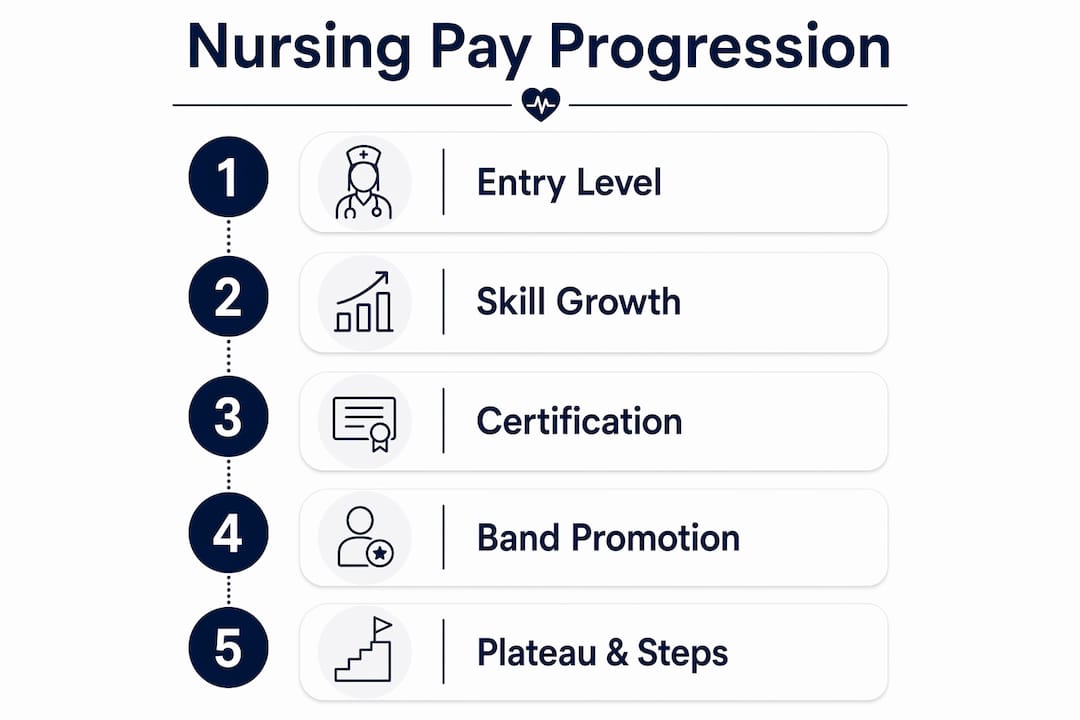
Nursing wage scale progression is built on four distinct mechanisms. Each one works differently, and knowing which applies to your situation tells you exactly where your next pay increase will come from.
- Incremental step increases: Most pay systems award automatic annual raises within a band, provided you meet performance standards. These steps are time-based but not unconditional. A satisfactory appraisal is required to move forward.
- Gateway competency requirements: At certain points within a pay band, you must demonstrate specific clinical competencies before advancing. These gateways exist to tie pay to skill, not just seniority. Missing a gateway delays your progression until the next review cycle.
- Band-to-band promotions: Moving from one pay band to the next requires a formal role change, new qualifications, or a competitive application. This is the most significant pay jump available and typically requires deliberate planning.
- Specialty certification premiums: Certifications like the CCRN (Critical Care Registered Nurse) and CEN (Certified Emergency Nurse) add direct dollar value on top of your base pay. Specialty certifications earned within the first five years boost salary by 12–18%, with the CCRN adding $8,200 annually and the CEN adding $6,800.
That $8,200 figure is not a rounding error. It represents a permanent base pay increase that compounds with every future raise you receive.
Pro Tip: Earn your first specialty certification before year five. The salary premium compounds over your entire career, making early certification one of the highest-return investments you can make as a nurse.

How does pay growth differ between early and later career stages?
The trajectory of nursing salary growth is not linear. It follows a steep early curve that flattens significantly after about eight years.
Nurses experience their steepest growth during the first seven years, averaging approximately 8.7% annual increases. After the ten-year mark, that rate drops to around 4.1% per year. The early acceleration comes from rapid skill acquisition, completing certifications, and moving through the lower steps of your starting pay band quickly.
The plateau arrives around year eight. At that point, annual raises drop sharply from 6–8% to 2–3% without promotions or specialty moves. Many nurses interpret this as normal. It is not inevitable. It is a structural feature of pay band systems that rewards movement, not just tenure.
The practical implication is significant. A nurse who reaches the top of their pay band at year eight and stays in the same role will see raises that barely keep pace with cost of living. A nurse who pursues a band promotion or adds a specialty certification at that same point resets the growth curve.
| Career stage | Approximate annual salary growth | Primary driver |
|---|---|---|
| Years 2–7 | ~8.7% | Skill acquisition, certifications, step increases |
| Years 8–10 | 6–8% declining | Approaching band ceiling |
| Years 10+ | ~4.1% | Incremental steps, COLA adjustments |
Pro Tip: Treat year seven as a planning deadline, not a milestone. Map your next band promotion or certification target before your growth rate starts to slow.
How does the NHS Agenda for Change pay system work?
The NHS Agenda for Change framework is the clearest example of a structured nursing pay scale in operation. It applies to the majority of NHS nurses in the UK and provides a transparent model that illustrates how pay band systems function in practice.
The system organizes nursing roles into numbered bands, with registered nurses typically starting at Band 5. Each band contains multiple pay points. Progression through those points is automatic, provided the nurse receives a satisfactory annual appraisal. Band 5 nurses reach the top of their band in approximately four years. Band 7 nurses take approximately five years to reach their band ceiling.
Gateway requirements add a competency layer to this timeline. At specific pay points within a band, nurses must provide evidence of clinical competency before advancing. Incremental progression requires 12 months at a step and a satisfactory appraisal, while gateway points require documented competency evidence. A nurse who cannot demonstrate the required competency at a gateway point waits until the next review cycle.
The steps to progress through the Agenda for Change system follow a clear sequence:
- Complete 12 months at your current pay point with a satisfactory appraisal.
- At gateway points, submit competency evidence to your line manager for review.
- Once the gateway is cleared, advance to the next pay point automatically.
- When you reach the top of your current band, apply formally for a role in the next band.
- Band promotions require a competitive application and often additional qualifications.
NHS incremental progression is automatic with appraisal and time, but promotion to higher bands requires formal application and qualification. That distinction matters because many nurses assume reaching the top of Band 5 triggers an automatic move to Band 6. It does not.
What factors influence nursing pay progression in the U.S.?
U.S. nursing pay does not follow a single national framework. Instead, it is shaped by a combination of specialty, geography, employment setting, and union status. Understanding these factors is the foundation of any serious salary negotiation.
- Specialty role: ICU nurses average $89,750 with 15–20% shift differentials. Emergency and psychiatric nursing also command premiums above general medical-surgical rates. High-demand specialties are projected to see annual growth of 5–9% through 2027–2028 due to ongoing shortages.
- Geographic location: State and regional pay differences are substantial. Geographic mobility increases earnings by 22% over 15 years compared to staying in one location. Nurses in California and New York consistently earn above the national median.
- Union vs. non-union employment: Union contracts create predictable step increases for 12–15 years but impose ceilings at approximately step 15. After that ceiling, merit raises or promotions are the only path to further growth.
- Hospital type and ownership: Academic medical centers and large health systems typically offer higher base pay and more defined progression structures than community hospitals or outpatient settings.
- Market demand: Nursing turnover runs at approximately 17% with the average RN age at 51. That combination creates leverage for experienced nurses to negotiate above standard cost-of-living adjustments.
For a detailed breakdown of how geography shapes your earning potential, the nursing wages by state analysis covers regional pay differences with current data.
How can nurses maximize their pay scale progression?
Passive tenure is the slowest path to higher pay. The nurses who build the strongest salary trajectories treat their careers as active projects, not automatic progressions.
- Earn specialty certifications early. The CCRN and CEN add measurable dollar amounts to your base pay and signal clinical expertise to future employers. Certifications earned before year five compound over the longest possible career window.
- Plan strategic job changes. Long-term loyalty to a single employer often yields diminishing salary returns. Changing employers at the right career stage frequently delivers a larger pay increase than waiting for the next annual increment.
- Negotiate beyond the standard offer. Most employers expect negotiation. Arriving with verified market data from a source like HighPaidRN gives you a specific number to anchor the conversation, rather than a vague sense that you deserve more.
- Pursue leadership or advanced roles. Charge nurse, clinical educator, and nurse manager positions access higher pay bands and often include additional compensation for on-call or administrative responsibilities.
- Account for inflation. Inflation has outpaced nurse wage growth since 2020, eroding real purchasing power. A 3% nominal raise in a 4% inflation environment is a pay cut in real terms. Negotiating with inflation-adjusted benchmarks protects your actual standard of living.
For specific language and tactics, the guide on asking for a higher salary covers negotiation approaches that work in real clinical settings.
Key takeaways
Nursing pay scale progression rewards nurses who combine structured step increases with deliberate career moves, certifications, and informed negotiation.
| Point | Details |
|---|---|
| Early career growth is steepest | Annual raises average 8.7% in years 2–7, making early certifications the highest-return investment. |
| Plateaus are structural, not inevitable | Pay growth drops to ~4.1% after year 10 without a promotion or specialty shift. |
| Certifications add direct dollar value | CCRN adds $8,200 annually; CEN adds $6,800, compounding over the full career. |
| Geography and union status shape ceilings | Moving states can increase earnings 22% over 15 years; union steps cap around year 15. |
| Inflation erodes nominal raises | Real wage gains require negotiating above cost-of-living adjustments, especially post-2020. |
What I've learned watching nurses leave money on the table
The most consistent pattern I see is nurses who understand their clinical role deeply but treat their pay structure as someone else's responsibility. They accept the annual increment, assume it reflects their market value, and move on. That assumption costs real money over a career.
The salary plateau around year eight is not a mystery. It is a predictable outcome of reaching the top of a pay band without a plan for what comes next. Nurses who hit that ceiling and stay in the same role are not being underpaid by accident. They are being underpaid by default, because the system has no mechanism to reward tenure beyond its own ceiling.
What actually works is treating the pay structure as a map, not a conveyor belt. The map shows you where the ceilings are, where the gateways sit, and which certifications open new pay ranges. Nurses who read that map in year three or four arrive at year eight with a promotion already in progress or a certification already earning its premium.
The inflation point deserves more attention than it gets. A 3% raise sounds reasonable until you check what inflation did that year. Since 2020, nominal wage growth in nursing has not kept pace with purchasing power erosion in most markets. That means many nurses who received raises every year are actually earning less in real terms than they were five years ago. Negotiating with inflation-adjusted data is not aggressive. It is accurate.
The nurses I see building the strongest long-term compensation are not necessarily the most senior or the most credentialed. They are the ones who know their number, know the market, and ask for what the data supports.
— RN
HighPaidRN gives you the data to negotiate with confidence
Knowing how your pay should grow is only useful if you know where you actually stand relative to the market. HighPaidRN is a nurse salary transparency platform built specifically for registered nurses, with verified salary data segmented by specialty, state, hospital type, and employment condition.

Whether you are an ICU nurse preparing for a contract renewal or a new graduate mapping your first five years, HighPaidRN's salary database gives you the specific numbers your employer already has. You can filter by specialty, location, and experience level to see exactly what nurses in comparable roles are earning. Nurses who contribute their own salary data anonymously strengthen the database for everyone. The result is a resource built by nurses, for nurses, with the depth needed to support real negotiations.
FAQ
How do nursing pay scales progress over a career?
Nursing pay scales progress through automatic annual step increases within a pay band, followed by band promotions that require new roles or qualifications. Growth is fastest in years 2–7, averaging approximately 8.7% annually, then slows to around 4.1% after year 10.
What is the NHS Agenda for Change pay system?
The NHS Agenda for Change system organizes nursing roles into numbered pay bands, each with incremental pay points. Progression requires a satisfactory annual appraisal, and gateway points within bands require documented clinical competency before advancing.
Which nursing specialties offer the fastest pay progression?
ICU, emergency, and psychiatric nursing offer the fastest pay progression due to high demand and shift differentials. ICU nurses average $89,750 with 15–20% shift premiums, and high-demand specialties are projected to grow 5–9% annually through 2027–2028.
Do union contracts help or limit nursing pay growth?
Union contracts provide predictable step increases for 12–15 years, which benefits early and mid-career nurses. After approximately step 15, union pay ceilings require merit raises or promotions to achieve further growth.
How can a nurse break through a salary plateau?
The most effective strategies are earning a specialty certification, applying for a higher-band or leadership role, or changing employers. Geographic mobility also increases long-term earnings, with relocation adding approximately 22% over 15 years compared to staying in one location.