

Nursing wages vary by state because of a layered mix of cost of living, local labor market conditions, state regulations, and individual qualifications. The salary gap between states exceeds $100,000 annually, with California RNs averaging around $113,240 and South Dakota RNs earning about $59,540. That gap is not random. It reflects real differences in housing costs, hospital competition, union contracts, and the credentials nurses bring to the table. Understanding why nursing wages differ gives you the foundation to evaluate offers accurately and negotiate from a position of knowledge.
Why nursing wages vary by state: the core drivers
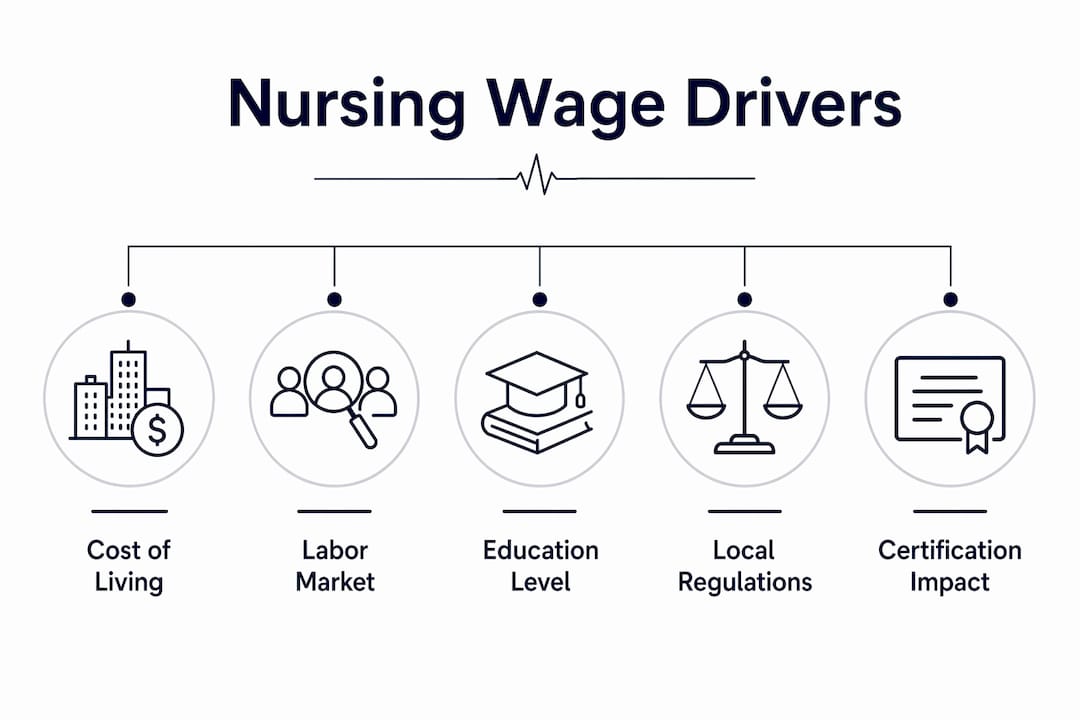
Nursing wage disparities across the U.S. come down to four primary forces: cost of living, labor market dynamics, education and specialty credentials, and state-level regulations. No single factor explains the full picture. A California RN earning $113,240 may take home less in real purchasing power than a Texas RN earning $80,000, once housing, taxes, and transportation costs are factored in. Statewise nursing salary comparisons only make sense when you account for all four forces together.
The Bureau of Labor Statistics tracks nominal wages, but nominal figures alone mislead nurses who are weighing relocation or negotiating a raise. Real compensation requires adjusting for what your paycheck actually buys in a given market. That adjustment is where most salary conversations go wrong.
How does cost of living affect nursing wages?
Cost of living is the most misunderstood factor in regional nursing pay rates. High-wage states like California, Hawaii, and New York offer larger paychecks on paper. The reality is more complicated.
High state income taxes create a hidden erosion effect on gross salary. New York salaries need to be roughly 40% higher than Florida salaries just to deliver the same take-home pay. That is a significant threshold that most nurses never calculate before accepting an offer.
States like Texas and Nevada present a different picture. Both have no state income tax, and purchasing power in Texas and Nevada often exceeds that of California or Hawaii nurses despite lower nominal wages. A nurse earning $85,000 in Austin may keep more of that income than a nurse earning $105,000 in San Francisco after rent, taxes, and transportation.
The concept that captures this best is Purchasing Power Parity, or PPP. PPP adjusts a salary for what it can actually buy locally. When applied to nurse salaries, PPP rankings often flip the conventional wisdom about which states pay best.
| State | Nominal RN Salary | Cost of Living Index | Adjusted Pay Rank |
|---|---|---|---|
| California | ~$113,240 | Very High | Lower than nominal rank |
| Texas | ~$80,000 | Moderate | Higher than nominal rank |
| Nevada | ~$82,000 | Moderate | Higher than nominal rank |
| New York | ~$98,000 | Very High | Lower than nominal rank |
| South Dakota | ~$59,540 | Low | Moderate adjusted rank |
Pro Tip: Before comparing offers across states, calculate your estimated take-home pay using each state's income tax rate and a cost-of-living index. Your gross salary and your real income are two different numbers.
Understanding the impact of student loans on net income adds another layer to this calculation, especially for nurses who relocated for a degree program.
Do education and certifications change nursing pay by state?
Education level and specialty certifications directly shift where a nurse lands within any state's wage range. These factors explain why two RNs in the same hospital can earn very different salaries.
- ADN to BSN upgrade: A BSN degree adds approximately $8,000 annually over an ADN. Many hospital systems now require a BSN for clinical advancement, making the degree a practical necessity in competitive markets.
- MSN and advanced practice: An MSN can add $20,000 to $40,000 annually over a BSN, depending on the specialty and state. Nurse practitioners and clinical nurse specialists with MSN credentials access a separate, higher wage tier entirely.
- Specialty certifications: Certifications in areas like acute care, psychiatric nursing, or anesthesia add $2,000 to $8,000 per year. These premiums reflect genuine market demand for advanced competencies that not every nurse holds.
- Experience multiplier: Salary scales upward by 10% to 60% over entry-level pay as nurses accumulate years of clinical experience. The steepest gains typically come in the first five to ten years.
The interaction between these factors and state wages is significant. A newly licensed ADN nurse in California may earn less than an experienced BSN nurse in Texas, even though California's baseline is higher. State averages mask this individual variation entirely. Reviewing nurse career level salary benchmarks by experience stage gives a clearer picture of where you stand relative to the market.
Specialty certification is one of the most undervalued drivers of wage growth. Nurses who hold certifications in high-demand specialties can negotiate above the standard pay scale in almost any state, because the credential signals a competency that the employer cannot easily replace.
How do local labor markets shape nursing salaries?
State averages are useful starting points, but local labor markets determine what you actually get paid. The nursing compensation across states picture fragments significantly at the metro and hospital level.

Hospital competition and academic medical center presence create wage pockets that run 10–20% above rural or statewide averages. A nurse working at a major academic medical center in Houston earns more than a nurse at a rural community hospital in the same state, often by a substantial margin. The hospital's budget, patient volume, and competitive pressure to attract talent all feed into that gap.
Union presence reshapes the entire wage structure in states where it is strong. Union contracts provide clearer wage progression and raise wage floors compared to non-union environments. Nurses in unionized facilities benefit from standardized pay scales tied to experience, which removes much of the ambiguity from salary negotiations. California, New York, and Massachusetts have strong nursing union presence, which partially explains their higher baseline wages.
Key local market factors that affect nursing pay:
- Nurse-to-patient ratios: States with mandated ratios, like California, require more nurses per shift, which tightens the labor supply and pushes wages up.
- Hospital type: Academic medical centers and Level I trauma centers typically pay more than community or critical access hospitals.
- Urban vs. rural location: Dense metro areas consistently pay more than rural settings within the same state.
- Federal employment: VA hospitals and federally qualified health centers follow federal pay scales, which differ from private sector rates.
- Shift differentials: Night, weekend, and holiday shifts increase income by 25–40% over base pay. These premiums can substantially close wage gaps between states.
Pro Tip: When evaluating a job offer, ask specifically about shift differential rates, weekend premiums, and holiday pay. A base salary of $75,000 with strong differentials can outperform a $85,000 base with no premium pay.
Local labor markets are fragmented, and nurses benefit from understanding hyper-local wage dynamics rather than relying on state-level summaries alone.
How should you compare nursing pay across states?
Raw salary comparisons mislead nurses who are making real career decisions. Effective statewise nursing salary comparison requires a structured approach that accounts for taxes, cost of living, and total compensation.
Start with median salary rather than mean. Means are pulled upward by high earners in specialties like CRNA or NP, which distorts the picture for staff RNs. Median figures reflect what the typical nurse in that market actually earns.
| Comparison Factor | High-Wage State (CA) | Moderate-Wage State (TX) |
|---|---|---|
| Nominal RN salary | ~$113,240 | ~$80,000 |
| State income tax | Yes (up to 13.3%) | None |
| Housing cost index | Very High | Moderate |
| Estimated take-home | Lower relative to gross | Higher relative to gross |
| Shift differential potential | High (union-driven) | Moderate |
Total compensation extends beyond base pay. Sign-on bonuses, relocation assistance, retirement contributions, health benefits, and scheduling flexibility all carry real dollar value. A hospital offering a $10,000 sign-on bonus and full benefits coverage is offering more than a competing facility with a higher base but minimal benefits.
Geographic micro-markets matter more than state labels. San Francisco, Sacramento, and Fresno are all in California, but their wage levels and living costs differ substantially. Evaluating the specific city and hospital type gives you a realistic expectation rather than a state average that may not apply to your situation.
HighPaidRN's salary database lets you filter by state, specialty, hospital type, and employment condition to benchmark your pay against verified market data. That level of specificity is what turns a salary conversation into a negotiation you can win. For practical guidance on making that case, the resource on how to ask for more covers negotiation strategies grounded in current market data.
Key Takeaways
Nursing wages vary by state because cost of living, labor market structure, education level, and local regulations each pull compensation in different directions. No single number tells the full story.
| Point | Details |
|---|---|
| State salary gaps are large | California RNs earn roughly $53,700 more than South Dakota RNs annually. |
| Nominal pay misleads | Adjust for state income tax and cost of living before comparing offers across states. |
| Education raises your floor | A BSN adds ~$8,000 annually; an MSN can add $20,000–$40,000 over a BSN. |
| Local markets matter most | Academic medical centers and union facilities pay 10–20% above state averages. |
| Total compensation is the real number | Shift differentials, sign-on bonuses, and benefits can add tens of thousands annually. |
What I've learned about reading a nursing salary offer
The biggest mistake I see nurses make is treating a salary number as the whole story. A $95,000 offer in New York City and a $78,000 offer in Dallas are not as far apart as they look. Once you run the numbers on state income tax, rent, and commute costs, the Dallas offer often wins on take-home pay.
Specialty certification is the lever most nurses underuse. The $2,000 to $8,000 annual premium for a recognized certification is not just about the money. It changes your negotiating position entirely. You are no longer asking for more pay as a favor. You are presenting a credential the market has already priced.
Union dynamics are worth understanding even if you work in a non-union facility. Knowing what unionized nurses in your market earn gives you a benchmark that is harder for an employer to dismiss than a salary survey. That information is publicly available in many states through collective bargaining agreements.
The nurses I have seen negotiate most effectively focus on total compensation, not just base pay. They ask about shift differential structures, retirement matching, and continuing education reimbursement in the same conversation as base salary. Each of those elements has a dollar value, and stacking them changes the outcome of the negotiation significantly.
Real financial security in nursing comes from understanding your paycheck power, not your gross salary. That means doing the math on what your income actually buys in your specific market, then using that analysis to make career decisions and negotiate with confidence.
— RN
HighPaidRN: salary data built for nurses who negotiate
Knowing why nursing wages differ is the first step. Knowing exactly where you stand in your specific market is what makes the difference at the negotiating table.

HighPaidRN gives you verified salary data filtered by state, specialty, hospital type, and employment condition. Whether you are a travel nurse weighing assignments or an ICU specialist preparing for a review conversation, the platform shows you what nurses in your exact role are actually earning. You can also contribute your own salary data anonymously, which strengthens the database for every nurse who uses it. Visit HighPaidRN to benchmark your pay and walk into your next salary conversation with real numbers behind you.
FAQ
Why do nursing wages differ so much between states?
The salary gap between states exceeds $100,000 annually, driven by differences in cost of living, state income tax, labor market competition, union presence, and staffing regulations. No single factor explains the full disparity.
Does a higher nursing salary always mean more take-home pay?
No. High state income taxes and elevated living costs can reduce real purchasing power significantly. A New York salary needs to be roughly 40% higher than a Florida salary to deliver equivalent net income.
How much does a specialty certification add to a nursing salary?
Specialty certifications add $2,000 to $8,000 annually, depending on the specialty and market demand. Certifications in acute care, psychiatric nursing, and anesthesia carry the strongest premiums.
Do shift differentials significantly affect total nursing compensation?
Yes. Night, weekend, and holiday shift differentials increase income by 25–40% over base pay. In some markets, differentials can close the wage gap between a lower-paying state and a higher-paying one.
What is the best way to compare nursing pay across states?
Use median salaries adjusted for cost of living and state income tax, then factor in total compensation including shift differentials, sign-on bonuses, and benefits. Filtering by specific city, hospital type, and specialty gives a far more accurate picture than statewide averages alone.