

Most nursing graduates repay their educational debt within 1.5 to 2 years of full-time employment, making nursing one of the strongest return-on-investment careers in healthcare. Understanding how student loans compare to nurse salary is the first calculation every nursing student and recent graduate needs to run before choosing a program, a specialty, or a state to work in. The numbers vary widely by degree level, institution type, and geography, but the core finding holds: nursing salaries support debt repayment at a pace most college graduates cannot match.
How student loans compare to nurse salary by degree type
Nursing education debt ranges from manageable to significant depending on the program you choose. Nurses carry balances from $23,000 to $185,000 depending on degree level and program type. That spread reflects the enormous difference between a two-year Associate Degree in Nursing (ADN) at a community college and a private accelerated BSN or graduate nursing program.
Here is how typical debt loads break down by program:
-
ADN (Associate Degree in Nursing): $10,000–$30,000 at public community colleges. Graduates become eligible for RN licensure and can enter the workforce quickly.
-
BSN at a public university: $30,000–$60,000. The most common path for hospital-based RN roles requiring a bachelor’s degree.
-
BSN at a private university: $60,000–$100,000. Higher tuition with limited additional salary benefit at entry level.
-
Accelerated BSN (ABSN): $50,000–$80,000. Designed for career changers; compresses training into 12–18 months.
-
MSN or DNP (graduate programs): $80,000–$185,000. Required for Nurse Practitioner, CRNA, and CNM roles.
Program type also determines how quickly you can start earning. ADN graduates enter the workforce roughly 18 months before BSN graduates. That head start on income matters when calculating the true cost of nursing education.
| Degree | Typical Debt Range | Time to Licensure |
|---|---|---|
| ADN | $10,000–$30,000 | 2 years |
| BSN (public) | $30,000–$60,000 | 4 years |
| BSN (private) | $60,000–$100,000 | 4 years |
| ABSN | $50,000–$80,000 | 1–2 years |
| MSN/DNP | $80,000–$185,000 | 6–8 years total |

One critical development in 2026 affects graduate nursing students directly. A proposed federal rule caps federal graduate nursing loans at $100,000. For programs costing $150,000 or more, that gap forces students toward private loans, which carry significantly higher interest rates and fewer borrower protections.
How do nurse salaries support loan repayment timelines?
Nurse salaries are strong enough to absorb loan payments without crippling a household budget, but the math depends on your role and your repayment strategy. The Bureau of Labor Statistics reports a median RN salary of roughly $66,000 to $79,000, while Nurse Practitioners earn a median closer to $111,000.
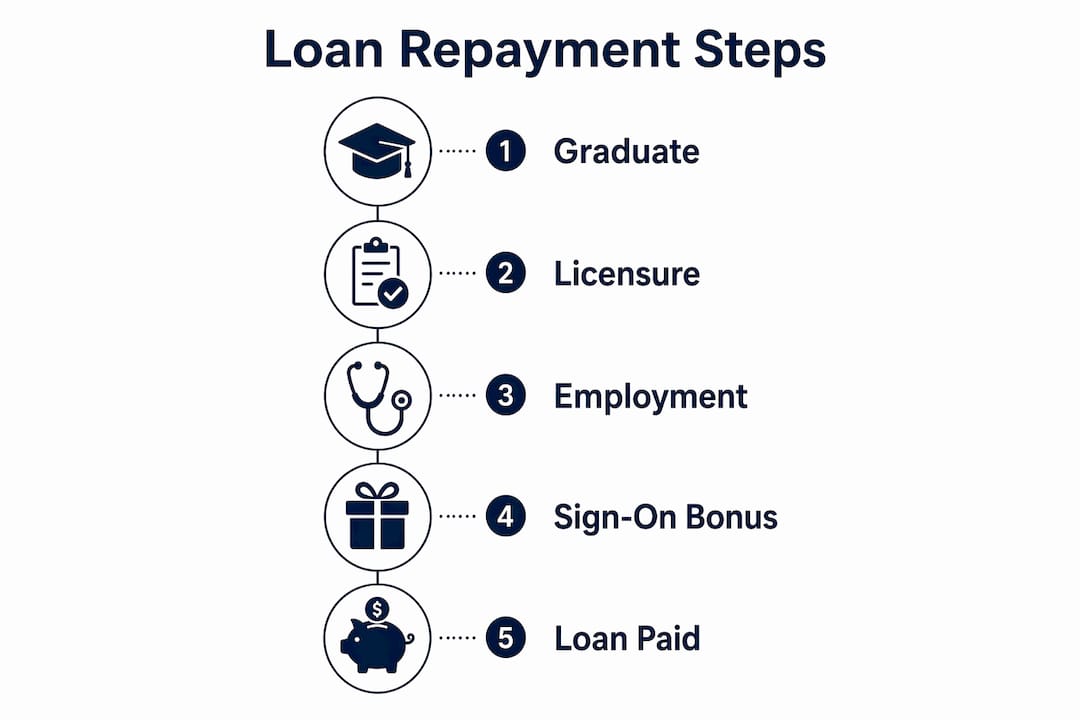
The standard repayment benchmark is allocating 15% of gross income toward loan payments. At a $75,000 RN salary, that equals $11,250 per year directed at debt. An ADN graduate with $25,000 in loans pays off in roughly 2 years at that rate. A BSN graduate with $55,000 in loans takes about 5 years. The math shifts dramatically for advanced practice nurses.
Here is how repayment timelines look across common nursing roles:
-
ADN graduate, $25,000 debt: Break-even in under 4 months of full-time work when accounting for total income versus debt ratio. Full repayment at 15% of income in approximately 2 years.
-
BSN graduate, $55,000 debt: Full repayment in 4–5 years at 15% of a $75,000 salary.
-
NP graduate, $120,000 debt: Full repayment in 5–6 years at 15% of a $111,000 salary. The higher debt is offset by the significantly higher income.
-
Private BSN, $95,000 debt: The longest repayment timeline for an entry-level RN role, potentially 8+ years without additional strategies.
Sign-on bonuses accelerate these timelines considerably. Bonuses ranging from $10,000 to $30,000 are common in high-demand markets, typically tied to 1 to 2 year employment commitments. Applying a $15,000 bonus directly to loan principal can shave 1 to 2 years off a standard repayment schedule. That is not a minor benefit. It is a structural financial advantage that nursing offers over most other degree paths.
Pro Tip: Apply sign-on bonuses entirely to loan principal in the first month of employment. Interest stops accruing on the paid-down balance immediately, saving more money than any investment return you could earn on that cash in the short term.
How do geography and specialty affect nurse salary vs student debt?
Location is the single most controllable variable in the nurse salary vs student debt equation. Geographic salary differences of up to $50,000 exist between states. California nurses earn $130,000 or more annually in many settings, while nurses in lower-wage states may earn closer to $70,000 for identical work.
That $60,000 annual gap compresses a 5-year repayment timeline into roughly 2 years for a nurse willing to relocate. Geographic mobility is one of the most underused financial tools available to new nursing graduates.
Specialty choice compounds the effect. Advanced practice roles carry salary premiums that change the nurse income versus student loans calculation entirely:
| Role | Median Annual Salary | Typical Debt Range | Estimated Repayment (15% income) |
|---|---|---|---|
| RN (entry-level) | $66,000–$79,000 | $30,000–$60,000 | 3–5 years |
| Nurse Practitioner (NP) | ~$111,000 | $80,000–$150,000 | 5–7 years |
| CRNA | $180,000+ | $100,000–$185,000 | 4–6 years |
| CNM | $120,000+ | $80,000–$130,000 | 4–6 years |
CRNAs carry the highest debt loads of any nursing role, but their salaries make repayment faster than most BSN graduates face. The financial outlook for nurses in advanced practice is strong, provided they borrow within federal limits and avoid excessive private loan exposure.
Pro Tip: Before accepting your first nursing job, use a nurse salary database filtered by state and specialty to identify the highest-paying markets for your role. A $15,000 salary difference in your first job compounds significantly over a 5-year repayment window.
What repayment options help nurses manage student loans effectively?
Federal repayment programs offer nurses meaningful relief, but they require deliberate planning from day one. Public Service Loan Forgiveness (PSLF) forgives remaining federal loan balances after 10 years of qualifying payments for nurses employed at nonprofit hospitals or government facilities. For a nurse with $80,000 in federal loans working at a qualifying employer, PSLF can eliminate tens of thousands of dollars in debt.
Income-driven repayment (IDR) plans cap monthly payments at 10%–20% of discretionary income. These plans extend repayment timelines but reduce monthly cash flow pressure during early career years when salaries are lower. Nurses planning to pursue PSLF should enroll in an IDR plan immediately after graduation to maximize the forgiveness benefit.
Private loans complicate this picture significantly. Private nursing loans carry interest rates up to 23%, compared to federal APRs of 6.39%–8.94%. Private loans also lack IDR options, PSLF eligibility, and deferment protections. Nurses forced into private borrowing due to the new federal loan caps face a materially harder repayment path.
Employer-sponsored programs provide another layer of support. Tuition reimbursement programs at hospitals commonly provide $2,500 to $10,000 per year for continuing education and loan repayment. Over a 5-year period, that adds up to $12,500–$50,000 in direct debt reduction without touching your paycheck.
Key steps to manage nursing student loans effectively:
-
Enroll in PSLF immediately if working at a nonprofit or government hospital. Submit your Employment Certification Form annually.
-
Choose federal loans over private loans whenever possible. The protections and lower rates are worth the borrowing limits.
-
Negotiate employer loan repayment as part of your hiring package. Many hospitals offer it but do not advertise it prominently.
-
Apply bonuses to principal. Every dollar applied to principal reduces the interest accruing on your remaining balance.
-
Reassess annually. Salary increases, job changes, and policy updates all affect which repayment strategy serves you best.
Pro Tip: If your employer offers both tuition reimbursement and a sign-on bonus, treat the reimbursement as your loan payment fund and the bonus as a principal reduction payment. Separating the two mentally prevents lifestyle inflation from absorbing both.
Key takeaways
Nursing education debt compares favorably to nurse salaries when graduates choose their degree, location, and repayment strategy with intention.
| Point | Details |
|---|---|
| Repayment timeline | Most nursing graduates repay loans within 1.5–2 years using 15% of gross income. |
| Debt range by degree | Nursing debt spans $23,000 to $185,000 depending on program type and institution. |
| Geographic salary gap | State salary differences of up to $50,000 can cut repayment timelines in half. |
| Federal loan cap risk | The proposed $100,000 federal cap forces some graduate students into high-rate private loans. |
| Employer benefits | Tuition reimbursement of $2,500–$10,000 per year and sign-on bonuses of $10,000–$30,000 accelerate payoff significantly. |
What the data actually tells new nurses about debt and career choices
The numbers on nursing debt look alarming until you put them next to the salary data. I have spent years watching nurses make career decisions based on fear of debt rather than the actual math. The reality is that nursing offers one of the clearest debt-to-income ratios of any professional degree in the country.
What concerns me more than the debt itself is the 2026 federal loan cap situation. Capping federal graduate nursing loans at $100,000 while program costs routinely exceed that figure does not reduce debt. It shifts debt from manageable federal loans to high-interest private loans with no IDR protections and no PSLF eligibility. That is a worse outcome for nurses and for the healthcare system that depends on them.
High student loan debt already prevents many nurses from accepting lower-paying academic or public health roles. Nursing faculty shortages are worsening partly because experienced nurses cannot afford the salary cut that teaching positions require. Loan caps that push more debt into private markets will deepen that problem.
My advice: treat geographic flexibility as a financial asset, not an inconvenience. A nurse willing to work in California or Washington for 3 years can repay debt that would take 7 years to clear in a lower-wage state. That is not a minor difference. That is the difference between financial freedom at 30 and financial stress at 35.
Nursing is still a financially sound career. The debt is real, but so is the salary. Run the math for your specific degree and your target state before you decide anything.
— John
Salary data that makes loan planning concrete
Knowing your debt load is only half the equation. The other half is knowing exactly what nurses in your specialty and state actually earn.

Highpaidrn is a nurse salary transparency platform built specifically for registered nurses in the United States. It lets you filter salary data by state, specialty, hospital, and employment type, so you can see what nurses in your target market actually earn before you accept an offer or sign a loan. For nurses calculating whether a $90,000 debt load is manageable on an ICU salary in Texas versus California, that data is not optional. It is the foundation of a sound financial plan. Visit Highpaidrn to compare verified salary data and build a repayment plan grounded in real numbers.
FAQ
How long does it take a nurse to repay student loans?
Most nursing graduates repay their loans within 1.5 to 2 years of full-time employment when directing 15% of gross income toward debt. ADN graduates with lower debt loads can break even in under 4 months.
What is the average student loan debt for a nursing degree?
Nursing graduates carry balances ranging from $23,000 to $185,000 depending on degree level. ADN programs at community colleges produce the lowest debt; DNP and CRNA programs produce the highest.
Does the nursing salary justify the cost of education?
Yes, for most degree paths. RN salaries of $66,000–$79,000 and NP salaries near $111,000 support repayment timelines that compare favorably to most other professional degrees requiring similar education lengths.
What is Public Service Loan Forgiveness and do nurses qualify?
PSLF forgives remaining federal loan balances after 10 years of qualifying payments for nurses employed at nonprofit hospitals or government facilities. Nurses must enroll in an income-driven repayment plan and submit annual employment certification to qualify.
How do the new federal loan caps affect nursing students in 2026?
The proposed federal cap limits graduate nursing borrowing to $100,000. Students in programs costing more than that are pushed toward private loans, which carry interest rates up to 23% and lack the income-driven repayment and forgiveness options available on federal loans.