

Nurse career level salary benchmarks are defined as the verified compensation ranges tied to a nurse's experience, specialty, and location, used to assess fair pay and plan career advancement. The median RN annual wage sits at $93,600 as of 2026 per the Bureau of Labor Statistics, with the full range spanning $66,030 to $135,320 depending on experience. Nurse Practitioners earn approximately $137,300 and Certified Registered Nurse Anesthetists reach about $248,320, illustrating the dramatic earning potential across a nursing career. Understanding where you fall within these ranges is the first step toward negotiating pay you have actually earned.
1. What are nurse career level salary benchmarks?
Salary benchmarking is the industry term for comparing your compensation against verified market rates for your role, experience level, and location. For nurses, this practice replaces guesswork and anecdotal pay data with real numbers. Benchmarking replaces anecdotal pay data with verifiable market-rate information, which is especially critical in a profession with high turnover and persistent wage gaps.
The practical value is direct. A nurse who knows the 75th percentile wage for an ICU RN in her metro area walks into a salary review with facts, not feelings. Without that data, many nurses accept offers below market rate simply because they have no reference point.

2. Common nurse career levels and their salary ranges
The nursing career path moves through several distinct levels, each with its own compensation band. Entry-level RNs with under two years of experience typically earn near the lower end of the BLS range, around $66,030 annually. Mid-career RNs with three to seven years of experience generally land near the median of $93,600. Experienced RNs with eight or more years often reach the upper quartile, approaching $120,000 or more in competitive markets.
Advanced practice roles represent a separate tier. Staff RNs average about $101,420 annually, while Nurse Practitioners earn approximately $137,300 and CRNAs earn about $248,320. That progression represents a substantial increase in earning potential over a full career.
| Career Level | Experience | Approximate Annual Salary |
|---|---|---|
| Entry-level RN | 0–2 years | $66,030–$80,000 |
| Mid-career RN | 3–7 years | $80,000–$101,420 |
| Experienced RN | 8–15 years | $101,420–$120,000 |
| Senior RN | 15+ years | $120,000–$135,320 |
| Nurse Practitioner | Advanced practice | ~$137,300 |
| CRNA | Advanced practice | ~$248,320 |
Pro Tip: Track your salary against BLS percentile data each year, not just at hire. Nurses who benchmark annually are better positioned to identify when their pay has fallen behind market rate.
3. How nursing specialties impact salary benchmarks
Specialty choice is one of the most powerful levers a nurse has over lifetime earnings. Top-paying specialties include CRNA at $248,000, Nurse Practitioner at $137,000, and Nurse Midwife at approximately $137,000, with CRNA salaries sometimes exceeding $300,000 in opt-out states where anesthesiologists are not required to supervise.
Education and certification requirements drive much of that pay gap. A BSN-prepared RN earns about $8,000 more annually than an ADN-prepared RN. Achieving a specialty certification or an advanced degree for NP or CRNA can result in salary increases exceeding 80%, making the investment in further education financially defensible for most nurses.
Key considerations by specialty:
- CRNA: Highest earning potential in nursing; requires a master's or doctoral degree and typically two or more years of ICU experience before admission to a nurse anesthesia program.
- Nurse Practitioner: Strong demand across primary care, psychiatry, and acute care; salary varies significantly by NP specialty and state prescriptive authority.
- Nurse Midwife: Competitive pay with growing demand; scope of practice varies by state.
- ICU/Critical Care RN: Premium pay within staff RN roles due to acuity and required certifications like CCRN.
- Travel RN: Travel nurses earn about $113,000 annualized, above the staff RN average, though tax-free stipends and housing allowances are a significant part of that total compensation picture.
Pro Tip: Before committing to a specialty for salary reasons alone, research the certification costs, program length, and job market in your target state. The financial return is real, but the timeline matters.
4. Geographic and facility factors that influence RN pay
Location is the single biggest variable in nursing compensation outside of specialty. California RNs earn around $140,330 annually, while nurses in states like South Dakota earn considerably less. That gap reflects both cost of living and state-level supply and demand for nurses.
Facility type also shapes pay. Government-employed nurses and those at large academic medical centers typically earn more than nurses at small community hospitals or outpatient clinics. Union presence adds another layer. Unionized nurses earn an average of 18.8% more than non-union nurses, translating to roughly $33.50 per hour versus $28.20 per hour.
| Region / Facility Type | Approximate Annual RN Salary |
|---|---|
| California (top-paying state) | ~$140,330 |
| National median | $93,600 |
| South Dakota (lower-paying state) | Below national median |
| Large academic medical center | Above median |
| Small community hospital | Near or below median |
| Government facility | Competitive; often includes strong benefits |
Cost of living adjustments matter when comparing offers across states. A $110,000 salary in San Francisco buys less than $85,000 in Nashville. Always calculate purchasing power alongside the nominal figure.
5. How to use salary benchmarks to negotiate pay and plan your career
The most common mistake nurses make in salary negotiations is citing national averages. Local or metropolitan salary data is more reliable and relevant than national figures, which can be skewed by high-paying outlier regions like California and New York. Use your city or metro area as the reference point, not the country.
A practical negotiation sequence looks like this:
- Gather current data. Pull salary ranges for your specific role, specialty, and metro area from verified sources. HighPaidRN filters by state, specialty, hospital, and employment type, giving you the most relevant comparison.
- Identify your percentile. Determine whether your current or offered salary falls at the 25th, 50th, or 75th percentile for your market. Anything below the median for your experience level is a negotiation opportunity.
- Document your value. Certifications, specialty training, charge nurse experience, and low turnover record all justify pay above the median. Bring specifics, not generalities.
- Make a specific ask. Name a number based on the 60th to 75th percentile for your role and location. Vague requests for "more money" are easy to deflect.
- Revisit annually. Salary benchmarking is not a one-time event. Markets shift, and your experience grows. Nurses who benchmark annually catch pay compression before it becomes a multi-year problem.
Pro Tip: If your employer says your pay is competitive, ask them to show you the data. A confident request for the salary survey they used is entirely professional and often reveals that their benchmark is outdated.
6. Emerging trends and future outlook for nurse salaries
Nursing salaries are growing faster than general inflation. RN annual salary growth approximates 4.2% year over year, outpacing consumer price inflation. That rate signals financial stability in the profession compared to many other public sector careers.
Several forces are driving that growth:
- Nurse shortage: Demand for RNs continues to outpace supply in most U.S. markets, pushing wages upward, particularly for experienced nurses and those in high-acuity specialties.
- Advanced practice expansion: NP and CRNA roles are among the fastest-growing in healthcare. Demand-driven competition for these providers keeps their salaries well above the staff RN baseline.
- Credential premiums: Specialty certifications like CCRN, CEN, and CNOR consistently command pay differentials above base RN wages at most hospital systems.
- Union activity: Labor organizing in nursing has increased in recent years. Unionized nurses earning 18.8% more than non-union peers represents a measurable financial incentive for collective bargaining.
- Travel nurse market stabilization: Post-pandemic travel nurse rates have moderated from their 2021–2022 peaks, but travel RN pay still exceeds staff RN averages in most markets.
The long-term outlook for nursing compensation is positive. Nurses who invest in advanced credentials and stay informed about market rates are best positioned to capture the gains.
Key takeaways
Nurses who use verified, location-specific salary benchmarks by career level and specialty are the most effective advocates for their own compensation.
| Point | Details |
|---|---|
| Benchmarks vary by level | Entry-level RN salaries start near $66,030; CRNA salaries reach $248,320 or higher. |
| Specialty drives major gains | Advancing to NP or CRNA can increase earnings by more than 80% over a staff RN baseline. |
| Location matters most | California RNs earn $140,330 on average; always use metro-level data in negotiations. |
| Union membership adds pay | Unionized nurses earn 18.8% more per hour than non-union nurses on average. |
| Annual benchmarking prevents pay compression | Reviewing your salary against market data each year catches underpayment before it compounds. |
Why I think most nurses leave money on the table
Most nurses I have spoken with over the years share one habit: they accept the first offer. Not because they lack confidence, but because they lack data. When you do not know what the 60th percentile looks like for an ICU RN in your metro area, it is genuinely hard to push back. That is not a personal failing. It is a structural problem in how compensation information has historically been distributed in healthcare.
The nurses I have seen negotiate most effectively treat salary research the same way they treat clinical preparation. They show up with specifics. They know their percentile. They know whether their facility is above or below market. They know what a BSN premium looks like in their state. That level of preparation changes the entire dynamic of a salary conversation.
The other thing I have noticed is that nurses underestimate the compounding effect of accepting a below-market offer early in their career. A $5,000 gap at year one becomes a $50,000 gap over a decade once you factor in raises calculated as percentages of a lower base. Starting from the right number matters more than most new nurses realize.
My honest recommendation is to benchmark before every major career move, not just when you feel underpaid. Knowing your market value when you are satisfied with your job gives you the clearest picture of where you actually stand.
— RN
HighPaidRN: salary data built for nurses, by nurses
Knowing your market value is only useful if you have access to current, verified data specific to your role and location.
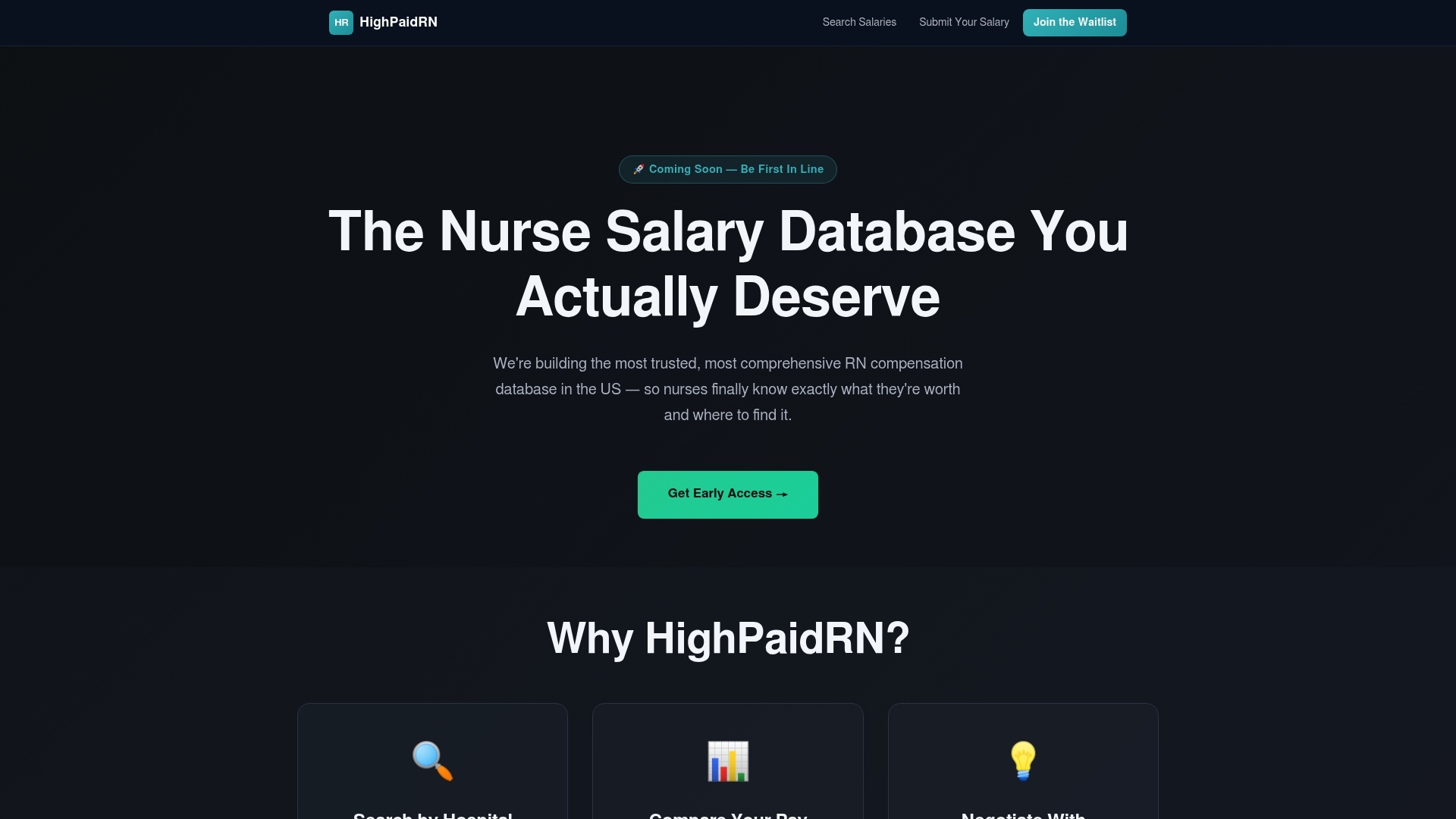
HighPaidRN is a nurse-focused salary transparency platform built to solve exactly that problem. You can filter by state, specialty, hospital, and employment type to see what nurses in your specific situation actually earn. The database is community-driven, meaning nurses submit their own salary data anonymously, which keeps the numbers current and relevant. Whether you are a new grad researching entry-level RN compensation or an experienced nurse preparing for a contract negotiation, HighPaidRN gives you the verified market data you need to advocate for fair pay with confidence.
FAQ
What is nurse salary benchmarking?
Nurse salary benchmarking is the process of comparing your compensation to verified market rates for your role, experience level, specialty, and location. It replaces anecdotal pay information with data-driven reference points used in negotiations and career planning.
What is the entry-level RN salary in the U.S.?
Entry-level RN salaries start near the 10th percentile of the BLS wage distribution, around $66,030 annually. Pay increases significantly with experience, specialty certification, and location.
How do nursing salaries compare to other careers?
RN salary growth approximates 4.2% year over year, outpacing consumer price inflation and many comparable public sector roles. Advanced practice nurses like CRNAs earn about $248,320, placing them among the highest-paid professionals in healthcare.
Does location really change how much an RN earns?
Yes, significantly. California RNs earn around $140,330 annually while nurses in lower-paying states earn well below the national median of $93,600. Always use metro-level data rather than national averages when benchmarking for a negotiation.
How often should nurses check their salary benchmarks?
Nurses should benchmark their salary at least once a year and before any major career move, contract renewal, or job offer. Annual reviews catch pay compression early and keep your negotiation position current with market conditions.