

Nurse salary negotiation is the process of formally requesting and justifying better compensation based on market data, clinical credentials, and documented performance. The most effective ways to ask for a higher nurse salary combine evidence-based market research with confident, respectful communication. Nurse compensation is often treated as a standardized expense by hospital systems, which means individual negotiation is one of the few tools that shifts that default. Platforms like Highpaidrn give nurses access to verified, specialty-specific salary data that transforms a vague request into a grounded business case.
What preparation is required before asking for a higher nurse salary?
Preparation is the single factor that separates a successful pay request from an awkward conversation. Nurses who walk in with documented evidence get better outcomes than those who rely on general frustration or tenure alone.
Research market rates first. Salary averages vary significantly by specialty, state, and facility type. Use sources like the Bureau of Labor Statistics and community-driven databases such as Highpaidrn to identify what nurses in your role, location, and specialty actually earn. Knowing the verified range gives you a number to anchor the conversation.

Build a “brag file.” Highly effective negotiators keep an organized, ongoing record of clinical achievements, certifications, patient outcomes, and commendations. This file turns your pay request from an emotional ask into an objective business case. Include ACLS or CCRN certifications, charge nurse experience, preceptor roles, and any quality improvement contributions.
Understand your full compensation package. Base pay is one piece of a larger picture. Before any negotiation, map out your current bonuses, paid time off (PTO), tuition reimbursement eligibility, shift differentials, and retirement contributions. Knowing what you already have tells you exactly where the gaps are.
Know your employer’s pay structure. Some facilities use rigid pay bands or union-negotiated scales. Others have more flexibility, especially for new hires or high-demand specialties. Understanding whether your employer operates on a clinical ladder system or tiered pay scale tells you which levers are actually available to pull.
-
Research specialty and location salary benchmarks using verified databases
-
Document certifications, clinical outcomes, and leadership roles in a brag file
-
Map your full current compensation including PTO, bonuses, and differentials
-
Identify your employer’s pay structure and negotiation flexibility before the meeting
Pro Tip: Update your brag file every 90 days. Waiting until review season means you will forget half of what you accomplished.
How to use timing and approach to maximize success in nurse salary negotiations
Timing is not a minor detail in negotiating nurse pay. It determines how much leverage you hold before the conversation even starts.
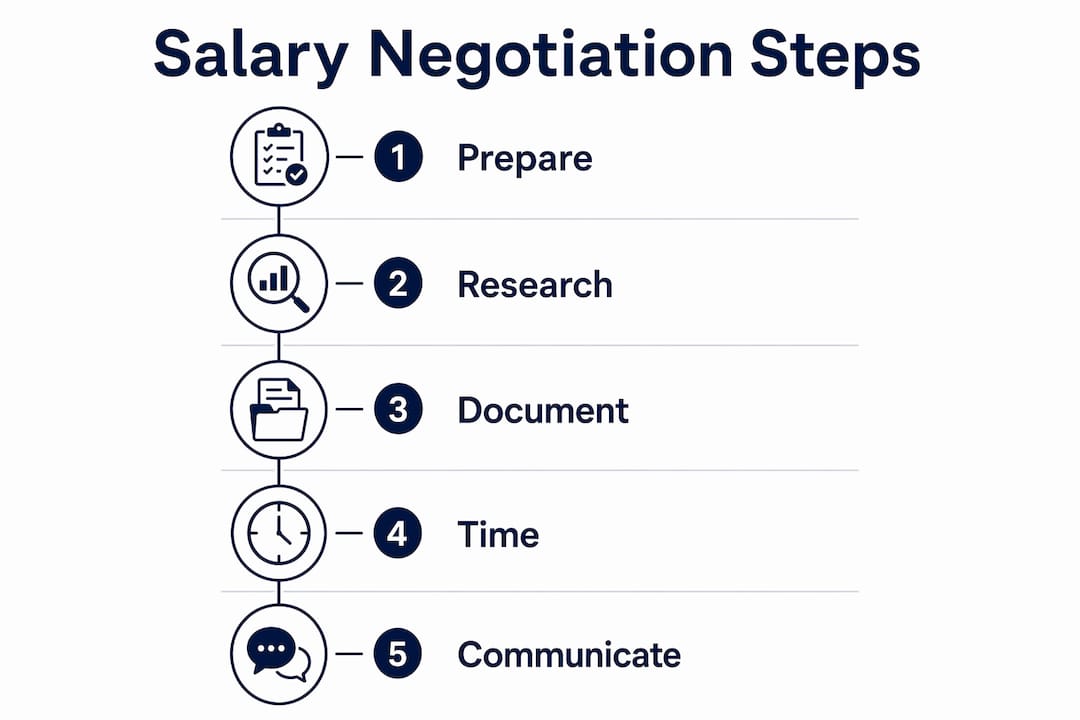
The optimal time to negotiate is right after receiving a formal job offer but before signing a contract. At that moment, the employer has already decided they want you. Your leverage is at its highest point. Negotiating too early, such as during an initial interview, signals poor judgment and can remove you from consideration.
For nurses already employed, the strongest timing windows are annual performance reviews, after completing a major certification, after taking on expanded responsibilities, or following a demonstrable improvement in unit outcomes. Requesting a meeting outside of these windows is not impossible, but it requires a stronger justification.
-
Wait for the formal offer. Never negotiate during the interview stage. The offer signals mutual commitment and creates the right context.
-
Request a dedicated meeting. Do not negotiate in a hallway or at the end of a shift. Ask for a scheduled conversation with your manager or HR representative.
-
Open with appreciation, then pivot to data. Acknowledge the offer or your current role, then present your market research and documented achievements.
-
State a specific salary range. Naming a range anchored at the top of your target gives the employer room to negotiate while keeping the floor where you need it.
-
Handle “What was your last salary?” professionally. Redirect with: “I am focused on the market rate for this role and my qualifications, which puts me in the range of X to Y.”
Pro Tip: Practice your opening two sentences out loud before the meeting. Nurses who rehearse their ask speak with noticeably more confidence when it counts.
What specific compensation components can nurses negotiate besides base pay?
Base salary is not the only number on the table. Large hospital systems often have tiered base salaries with limited flexibility, but they regularly negotiate on bonuses, PTO, shift preferences, and tuition reimbursement. Knowing this expands your options significantly.
Sign-on bonuses are one of the most negotiable elements in high-demand specialties. Sign-on bonuses for high-demand nursing specialties range from $3,000 to $15,000 in 2026, typically paid over 12 to 24 month commitments. ICU, emergency department, and labor and delivery nurses are most likely to qualify. If the base pay offer is firm, a sign-on bonus is often the fastest path to immediate financial gain.
Additional PTO carries real monetary value. Extra paid time off is worth $1,500 to $2,500 annually depending on your hourly rate. Requesting one to two additional PTO days is a low-cost concession for employers and a meaningful gain for you.
| Compensation Component | Negotiation Potential | Estimated Value |
|---|---|---|
| Sign-on bonus | High in ICU, ED, L&D | $3,000–$15,000 |
| Additional PTO | Moderate at most facilities | $1,500–$2,500/year |
| Tuition reimbursement | High at academic medical centers | Varies by program |
| Shift differential | Moderate for nights and weekends | Adds 10–15% to hourly rate |
| Clinical ladder placement | High with documented credentials | Tied to base pay band |
-
Tuition reimbursement and student loan repayment programs are especially valuable for nurses pursuing a BSN or MSN. Many facilities offer these but do not advertise them prominently. Ask directly.
-
Shift and schedule preferences matter for quality of life and can be negotiated at hire or during reviews. Locking in a preferred schedule in writing prevents future conflicts.
-
Future pay review commitments are worth requesting in writing. Ask for a formal salary reevaluation at six months if the initial offer is below your target.
What practical negotiation tactics and language help nurses advocate for higher pay?
Data-backed salary requests combined with professional communication maximize the chances of a positive outcome. The language you use matters as much as the number you name.
Lead with market data, not personal need. Saying “I need more money because of my expenses” positions you as a cost. Saying “Based on verified salary data for ICU nurses in this region, the market rate is EX to BY, and my credentials place me at the higher end” positions you as a professional making a factual case.
Use a salary range, not a single figure. Naming a range anchored above your actual target gives the employer a negotiating path while protecting your floor. If you want $85,000, open with a range of $85,000 to $92,000. This technique is standard in effective salary negotiation for nurses and prevents you from leaving money on the table.
“Based on my research into current market rates for nurses with my specialty and certifications in this area, I am targeting a salary in the range of $X to $Y. I would like to discuss how we can reach that together.”
Respond to counteroffers without accepting immediately. A pause and a phrase like “Thank you. I would like to review that and respond by end of day tomorrow” signals professionalism and gives you time to evaluate. Never accept or reject a counteroffer in the same breath.
Document every agreed term in writing. Verbal commitments about bonuses, PTO, or future reviews are not enforceable. Request a written summary of any negotiated changes before signing anything.
-
Lead with market data and documented achievements, not personal financial need
-
Name a salary range anchored above your target, not a single number
-
Respond to counteroffers with a brief pause and a professional follow-up timeline
-
Get every agreed term confirmed in writing before signing
How to handle obstacles when direct salary negotiation is limited
Some pay environments have real constraints. Union contracts, government pay scales, and rigid clinical ladder systems can limit base pay flexibility. Recognizing these limits early prevents wasted effort and redirects your energy toward what is actually negotiable.
-
Identify what is fixed and what is flexible. Ask HR directly: “Is the base pay for this role fixed, or is there flexibility?” This one question saves time and tells you where to focus.
-
Pivot to non-cash benefits. Experienced nurses who know base salary limits pivot successfully to non-cash benefit negotiations that carry substantial fiscal and quality-of-life value. PTO, professional development funding, and preferred scheduling are all on the table even when base pay is not.
-
Request documented benchmarks for future raises. If an employer says no to a salary increase, ask them to document the specific benchmarks you need to meet to qualify at the next evaluation. This converts a rejection into a roadmap.
-
Consider certification advancement. Earning a specialty certification such as CCRN, CEN, or CNOR directly increases your market value and often unlocks a higher pay band on a clinical ladder. This is one of the most reliable ways to increase nursing salary over a 12 to 18 month horizon.
-
Evaluate whether a job change is warranted. If a facility cannot meet market rate and has no flexibility on benefits, a move to a higher-paying employer or a travel nursing contract may be the most direct path to better compensation.
Key takeaways
Effective nurse salary negotiation requires market data, documented achievements, and confident communication delivered at the right moment.
| Point | Details |
|---|---|
| Preparation drives outcomes | Build a brag file with certifications and clinical results before any negotiation meeting. |
| Timing determines leverage | Negotiate after a formal offer or at a performance review, never during an initial interview. |
| Total compensation matters | Sign-on bonuses ($3,000–$15,000), extra PTO, and tuition reimbursement add significant value beyond base pay. |
| Language shapes perception | Lead with market data and a salary range, not personal need or a single fixed number. |
| Obstacles have workarounds | When base pay is fixed, pivot to non-cash benefits and request documented benchmarks for future raises. |
What I have learned from watching nurses negotiate
Nurses consistently underestimate how much preparation changes the outcome of a salary conversation. The nurses who get what they ask for are rarely the most experienced or the most credentialed. They are the ones who walked in with a printed salary range, a list of their accomplishments, and a clear number in mind.
The shift toward salary transparency in nursing is real and accelerating. Platforms like Highpaidrn are making it harder for employers to lowball offers because nurses now have access to verified, specialty-specific data. That changes the dynamic. A nurse who can say “the verified market rate for an ICU RN in this state is $X” is not making a personal request. She is stating a fact.
The other thing I have noticed is that nurses often apologize for negotiating. They frame the ask as a burden or an inconvenience. It is neither. Negotiation promotes pay equity across the profession and shifts market expectations over time. Every nurse who negotiates well makes it slightly easier for the next one.
My strongest advice: treat the salary conversation as a clinical assessment. Gather your data, form your case, and present it without apology. Professionalism and confidence are not opposites of humility. They are what the situation requires.
— John
Highpaidrn gives nurses the data to negotiate with confidence
Knowing your worth is the first step. Proving it with verified data is what closes the gap.
Highpaidrn is a nurse-built salary transparency platform that lets you filter compensation data by state, specialty, hospital, and employment type. Whether you are negotiating a new offer or requesting a raise at your current facility, you can walk into that conversation with real numbers behind you. Nurses who submit their own salary data anonymously also contribute to a community database that supports fair pay across the profession. Visit Highpaidrn to benchmark your compensation and build the case your next negotiation deserves.
FAQ
What is the best time to negotiate a nurse salary?
The best time is immediately after receiving a formal job offer but before signing a contract. For current employees, annual performance reviews and post-certification milestones are the strongest windows.
What should I say when asking for a higher nurse salary?
Lead with verified market data and a specific salary range. A strong opening sounds like: “Based on current market rates for my specialty and credentials in this region, I am targeting a range of $X to $Y.”
Can nurses negotiate more than just base pay?
Yes. Sign-on bonuses, additional PTO, tuition reimbursement, shift preferences, and clinical ladder placement are all negotiable, especially when base pay is fixed by a tiered scale or union contract.
How do I negotiate salary if my employer says the pay is non-negotiable?
Ask for documented benchmarks that qualify you for a raise at the next review cycle. Then pivot to non-cash benefits like PTO, professional development funding, or preferred scheduling.
Does negotiating salary actually make a difference for nurses?
Individual negotiation shifts market expectations and contributes to pay equity across nursing. Nurses who negotiate consistently earn more over the course of their careers than those who accept initial offers without discussion.