

The average registered nurse salary in the United States sits at approximately $102,730 annually, with significant variation by specialty, geography, and experience level. The nursing job market salary overview for 2026 shows a profession under pressure from structural shortages, an aging workforce, and surging demand for advanced practice roles. Nursing employment is projected to grow 6–7% through 2032–2034, outpacing the average for all U.S. occupations. Whether you are a staff RN evaluating your next move or a nursing student planning your specialty, understanding current compensation benchmarks is the foundation of every smart career decision.
What are the current salary ranges across nursing specialties?
Nursing salaries span a wide range depending on your specialty, credentials, and years of experience. The gap between a general staff RN and a Certified Registered Nurse Anesthetist (CRNA) is not marginal. It is transformative.
Here is how the major specialty tiers break down:
- CRNAs earn between $203,000 and $248,320 annually, making them the highest-paid nursing specialty in the country.
- Nurse Practitioners (NPs) average $126,260–$137,300 per year, reflecting both their advanced training and the clinical autonomy they carry.
- General staff RNs in medical-surgical settings typically earn $68,000–$90,000 annually, with pay rising sharply after five or more years of experience.
Experience compounds quickly in nursing. An RN with two years in a general med-surg unit earns meaningfully less than a colleague with ten years in a cardiac ICU. Specialty certifications, such as the CCRN for critical care or the CEN for emergency nursing, push base pay higher at most hospital systems. Hospitals use certification pay as a retention tool, so earning credentials is one of the most direct paths to a raise without changing employers.
Pro Tip: If you hold a specialty certification, verify that your employer's pay scale reflects it. Many nurses leave certification bonuses unclaimed simply because they never asked HR to update their pay tier.

| Nursing role | Annual salary range |
|---|---|
| CRNA | $203,000–$248,320 |
| Nurse Practitioner | $126,260–$137,300 |
| ICU / Critical Care RN | $85,000–$115,000+ |
| Medical-Surgical RN | $68,000–$90,000 |
The national mean of $101,420–$102,730 reflects a 5.3% compound annual growth rate over the past five years. That growth rate outpaces general inflation in most years, which means nursing compensation has gained real purchasing power at the national level.
How does geography affect nursing salaries and real purchasing power?
Location is the single biggest variable in nursing compensation outside of specialty. But nominal pay and real pay are two different numbers, and confusing them is a costly mistake.
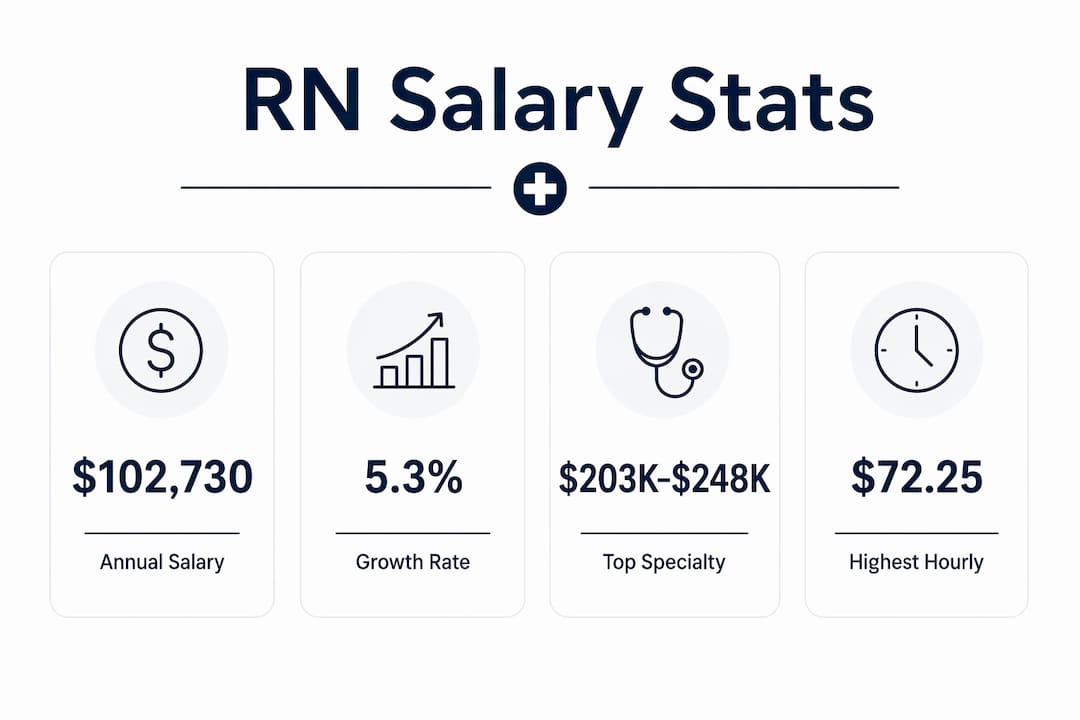
California posts the highest nominal RN hourly wage in the country at $72.25 per hour. After adjusting for cost of living, however, Oregon leads all states at $52.95 per hour, while California drops to $50.77 per hour. The difference matters because your rent, groceries, and taxes all come out of your adjusted wage, not your nominal one.
A few geographic patterns worth knowing:
- High nominal, high cost states like California, Hawaii, and Massachusetts offer top dollar on paper but deliver moderate real wages after living expenses.
- Mid-tier nominal, lower cost states like Texas, Tennessee, and Georgia often provide stronger purchasing power than their headline salaries suggest.
- Oregon, Washington, and parts of the Mountain West currently offer the best balance of adjusted wages and quality of life for many RNs.
Pro Tip: Before accepting a relocation offer, calculate your take-home pay after state income tax, housing costs, and commuting expenses. A $10,000 salary increase that moves you from Tennessee to San Francisco can leave you worse off financially.
Shift differentials, sign-on bonuses, and cost-of-living adjustments all affect total compensation beyond the base salary number. A hospital in a mid-tier state offering a $15,000 sign-on bonus and a 20% night differential may outperform a coastal offer with a higher base but no incentives. Evaluate the full package, not just the annual figure on the offer letter.
What factors are shaping the nursing job market and salary trends?
The forces driving current nursing salaries are structural, not cyclical. They will not resolve in a year or two.
The U.S. faces a projected shortage of 1.2 million nurses by 2030. That number reflects two converging pressures: a wave of retirements from an aging RN workforce and a pipeline constrained by limited nursing school faculty and clinical placement slots. The average age of a working RN is 51, which means a substantial portion of the current workforce will exit within the next decade.
- Workforce aging. With the average RN at age 51, retirements will accelerate through the late 2020s, tightening supply in every specialty.
- High turnover costs. Hospital turnover rates average 17% annually, with replacement costs per nurse exceeding $61,000. That financial pressure gives nurses real leverage in salary negotiations.
- Travel nursing normalization. Rates that peaked at $5,000–$10,000 per week in 2021–2022 have settled, but travel nursing pay remains 60–80% above pre-pandemic baselines. The premium is permanent, not temporary.
- NP demand surge. Nurse Practitioners face 45% projected employment growth through 2034, the fastest of any nursing specialty. That growth reflects both primary care gaps and expanded NP scope of practice laws in many states.
The nursing shortage is structural, driven by an aging workforce and limited nursing school capacity. This ensures continued upward salary pressure, especially in critical care and specialty areas, for the foreseeable future.
The normalization of travel nursing pay is a particularly important data point. Many hospitals assumed travel rates would return to 2019 levels. They have not. The new baseline reflects a lasting premium for temporary nursing labor, and it has reset salary expectations across the board.
How can nurses maximize their earning potential in the current market?
Knowing the market is one thing. Using that knowledge to your advantage is another. These steps translate salary data into real income gains.
-
Pursue specialty certifications. Certifications in critical care (CCRN), emergency nursing (CEN), or oncology (OCN) directly increase your market value. Most hospital systems pay a certification differential, and the credential strengthens your negotiating position when changing employers.
-
Use turnover costs as leverage. Hospitals spend more than $61,000 to replace a single nurse. When you negotiate a raise or a sign-on bonus, you are not asking for a favor. You are offering to save the hospital a significant expense. Frame it that way.
-
Consider travel nursing strategically. Travel contracts still pay 60–80% above pre-pandemic baselines. A 13-week assignment in a high-demand state can generate income that would take a year or more to accumulate in a staff position. Many nurses use travel stints to pay down student loans or build savings before returning to permanent roles.
-
Negotiate the full package. Base salary is one line item. Sign-on bonuses, shift differentials, relocation assistance, tuition reimbursement, and retirement matching all have real dollar value. A hospital that cannot move on base pay may have flexibility on bonuses or scheduling.
-
Track salary data continuously. The nursing job market moves fast. Salary benchmarks that were accurate 18 months ago may undervalue your skills today. Platforms that aggregate verified RN salary data by specialty, state, and hospital type give you the specific numbers you need to negotiate with confidence.
Pro Tip: When asking for a raise, bring a printed salary comparison showing what your specialty earns in your region. Specific numbers from verified sources carry far more weight than a general request.
Salary transparency helps nurses see the full compensation picture, including bonuses and shift incentives, not just base pay. Nurses who understand their total compensation package negotiate more effectively and accept offers that actually serve their financial goals.
Key Takeaways
The nursing job market rewards nurses who understand their specialty's value, their region's real wages, and the structural forces driving demand upward.
| Point | Details |
|---|---|
| National average salary | RNs earn approximately $102,730 annually, with a 5.3% compound annual growth rate over five years. |
| Specialty drives the biggest pay gap | CRNAs earn up to $248,320 while med-surg RNs start near $68,000; certifications close the gap faster than tenure alone. |
| Real wages differ from nominal wages | Oregon leads in cost-of-living adjusted pay at $52.95/hour, outperforming California's higher nominal rate. |
| Shortage creates negotiating power | A projected 1.2 million nurse shortage by 2030 and $61,000+ replacement costs give nurses real leverage at the table. |
| Total compensation beats base salary | Shift differentials, sign-on bonuses, and travel premiums can add tens of thousands beyond the base annual figure. |
What I have learned from watching the nursing salary market shift
The most persistent mistake I see nurses make is treating their salary as fixed. They accept an offer, settle in, and assume the market will reward loyalty over time. The data does not support that assumption.
Hospitals facing 17% annual turnover and $61,000 replacement costs are not holding back raises out of principle. They are holding back because nurses are not asking with the right information. The moment you walk in with a verified salary comparison showing what your specialty earns in your region, the conversation changes. I have seen nurses negotiate $8,000–$12,000 increases in a single conversation simply by presenting market data they had never bothered to gather before.
The geography question is equally misunderstood. Nurses chase California wages without running the numbers on California rent. Oregon's adjusted wage lead is not an accident. It reflects a state where pay is strong and living costs are not yet at coastal extremes. That calculation changes every year, which is why static advice about "move to California" is less useful than a current, location-specific salary comparison.
My honest advice: treat your salary like a clinical skill. Update it regularly, check your benchmarks against verified data, and never negotiate from a position of ignorance. The market is moving in your favor right now. Use it.
— RN
HighPaidRN: salary data built for nurses who negotiate
Nurses who negotiate with verified data earn more. HighPaidRN gives you the specific numbers to do exactly that.
HighPaidRN is a salary transparency platform built exclusively for registered nurses. You can filter salary data by state, specialty, hospital type, and employment condition, so you are never comparing your ICU pay to a general med-surg average. The platform draws from anonymously submitted, verified RN salary reports, which means the numbers reflect what nurses actually earn, not what job postings advertise. Whether you are a travel nurse evaluating your next contract or a staff RN preparing for a performance review, HighPaidRN's salary database gives you the market intelligence to negotiate from a position of strength.
FAQ
What is the average nurse salary in the U.S. in 2026?
The national mean annual wage for registered nurses is approximately $101,420–$102,730, reflecting a 5.3% compound annual growth rate over the past five years.
Which nursing specialty pays the most?
CRNAs are the highest-paid nursing specialty, earning between $203,000 and $248,320 annually. Nurse Practitioners follow at $126,260–$137,300 per year.
How does location affect nursing pay?
California has the highest nominal RN hourly wage at $72.25, but Oregon leads in cost-of-living adjusted pay at $52.95 per hour. Real purchasing power varies significantly by state.
Is there still a nursing shortage?
The U.S. faces a projected shortage of up to 1.2 million nurses by 2030, driven by an aging workforce and limited nursing school capacity. That shortage is expected to keep upward pressure on salaries through the decade.
Is travel nursing still worth it financially?
Travel nursing rates remain 60–80% above pre-pandemic baselines despite normalizing from their 2021–2022 peak. For nurses with flexibility, travel contracts continue to offer a significant income premium over permanent staff positions.