

Salary negotiation for nurses is the deliberate process of advocating for fair compensation by discussing base pay, bonuses, benefits, and other rewards with an employer. Most nurses accept the first offer they receive, yet negotiation is expected rather than exceptional in professional environments. The financial stakes are real: a single $5,000 raise compounds to roughly $600,000 over a 40-year career when you factor in compounding raises, retirement contributions, and overtime calculations. Understanding what is salary negotiation for nurses means recognizing it as a career skill, not a confrontation.
What is salary negotiation for nurses, and why does it matter?
Salary negotiation in nursing is the structured conversation between a nurse and an employer about total compensation, covering base hourly pay, shift differentials, sign-on bonuses, paid time off, and benefits like tuition reimbursement. The industry term used in human resources and nursing leadership is "total compensation negotiation," and it applies whether you are accepting a new position or requesting a raise in your current role.
Approximately 30% of nurses never negotiate salary at all, despite growing employer openness to these conversations. That statistic reflects a cultural pattern in nursing where advocating for pay can feel at odds with the caregiving identity. The result is a profession where many nurses leave significant money on the table year after year.

Negotiation also drives systemic change. When nurses advocate for fair pay, they challenge the long-standing norm of nurses undervaluing their own worth. Each successful nurse compensation discussion raises the floor for colleagues who follow.
Why do nurses need to negotiate beyond base salary?
Base salary in most hospital systems sits inside a rigid pay grid. Your starting tier is often fixed by years of experience and unit type, leaving little room to move the hourly rate up by a large amount. The real flexibility lives in the surrounding compensation package.
Nurses can negotiate several components that employers approve more readily than base pay increases:
- Sign-on bonuses: These range from $2,000 to $30,000+ depending on specialty and market demand. ICU, OR, and labor and delivery nurses command the highest figures.
- Tuition reimbursement: Federal tax law allows employers to provide up to $5,250 per year in tax-free education assistance. Many hospitals offer $3,000 to $5,250, but nurses must ask for it explicitly.
- Shift differentials: Evening, night, and weekend differentials vary widely by employer. Negotiating a higher differential rate or a guaranteed shift assignment adds real dollars to every paycheck.
- Extra paid time off: Employers often approve one to two additional PTO days when base pay is non-negotiable. Over a career, that time has measurable financial and personal value.
- Certification reimbursement and paid study time: Certifications like CCRN and CEN add $2,000 to $7,000 per year in value, yet many nurses never ask for the employer to cover exam fees or study time.
Understanding your pay scale structure before you negotiate tells you exactly which levers are available. Salary grids, union contracts, and clinical ladder placements all contain hidden opportunities that most nurses miss.
Pro Tip: Before your negotiation meeting, list every non-salary benefit you currently receive and assign a dollar value to each. This total compensation picture shows you where the gaps are and gives you specific items to request.
How can nurses prepare effectively for salary negotiation?
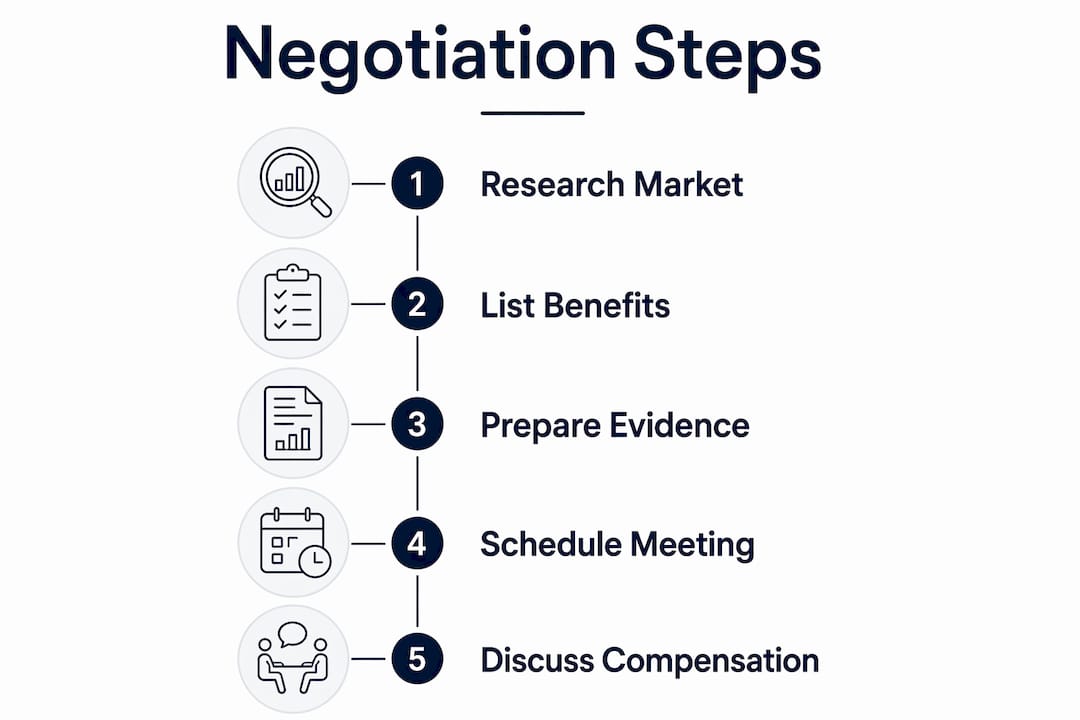
Preparation is the single biggest factor in negotiation outcomes. Nurses who walk in with data get better results than nurses who rely on gut feeling alone. Here is a practical nurse salary negotiation checklist to guide your preparation:
-
Research market rates. Use verified salary databases filtered by state, specialty, and hospital type. Geographic pay differences are significant. A med-surg RN in California earns far more than the same role in Mississippi, and your ask must reflect your specific market. HighPaidRN provides specialty salary data filtered by location and employer type so you can build a data-backed case.
-
Calculate your total compensation value. Add up base pay, differentials, PTO cash value, health insurance premiums, retirement match, and any bonuses. This number is your baseline. Knowing it prevents you from accepting a higher hourly rate that actually delivers less total value.
-
Document your contributions. Gather your certifications, continuing education credits, patient satisfaction scores, charge nurse experience, and any committee work. Concrete achievements give you specific talking points that justify a higher number.
-
Understand your BATNA. BATNA stands for Best Alternative to a Negotiated Agreement. It is the outcome you accept if the negotiation fails. Knowing your BATNA, whether that is staying in your current role, accepting a competing offer, or pursuing a travel contract, keeps you grounded and prevents you from accepting a poor deal under pressure.
-
Practice your opening statement. Negotiation scripts that focus on value-add examples and market data increase success rates for raises and sign-on bonuses. Rehearse out loud until the words feel natural.
Pro Tip: Frame your request around market data and your contributions, not personal financial need. "Based on my CCRN certification and the current market rate for ICU nurses in this region, I am requesting $X" lands better than "I need more money because my rent went up."
What negotiation strategies work best at different career stages?
Nursing pay negotiation strategy looks different depending on where you are in your career. A new graduate faces different constraints than a 10-year ICU veteran or a travel nurse negotiating a contract rate.
New graduate nurses
New graduates usually face fixed starting tiers with limited base pay flexibility. The smart move is to shift the conversation to surrounding benefits:
- Request a sign-on bonus. Bonuses for in-demand specialties commonly range from $3,000 to $15,000 for new graduates.
- Ask for your preferred shift or unit assignment in writing. Getting the night differential from day one adds meaningful income.
- Negotiate a tuition reimbursement agreement before you sign, especially if you plan to pursue a BSN or MSN.
- Request an earlier performance review date, such as six months instead of twelve, so you reach the next pay tier faster.
Experienced RNs
Experienced nurses hold stronger leverage than they often realize. Replacing a nurse costs hospitals $40,000 to $80,000 when you account for recruiting, onboarding, and productivity loss. That number is your negotiating power. Use it by:
- Presenting a competing offer or verified market data showing your current pay is below the regional median.
- Citing your clinical ladder placement, specialty certifications, and charge nurse experience as justification for a raise above the standard grid increase.
- Requesting a specific percentage increase tied to documented contributions rather than a vague "adjustment."
Pro Tip: If your employer says the budget is frozen, ask for a one-time retention bonus, an accelerated step increase, or additional PTO instead. These often come from different budget lines than base salary.
Travel nurses
Travel nurses negotiate contract rates directly with staffing agencies. The base rate, housing stipend, meals and incidentals allowance, and completion bonuses are all negotiable. Research the nursing job market for your specialty and target state before accepting any agency's first offer. Agencies build margin into their initial quotes, and most expect a counteroffer.
How to apply salary negotiation in practice and follow up
Knowing the strategy is one thing. Executing the conversation is another. These steps move preparation into practice:
-
Choose the right moment. The best time to negotiate is after receiving a written offer, not during the initial interview. For raises, request a dedicated meeting rather than raising the topic at the end of a shift or during a performance review that has already concluded.
-
Open with a specific number. Vague requests get vague responses. State a specific figure or range based on your research. Anchoring the conversation with a number backed by market salary data sets the frame for the entire discussion.
-
Respond to objections calmly. If the employer says the offer is firm, ask which components are flexible. If they say the budget is limited, ask when the next budget cycle opens and request a written commitment to revisit the conversation then.
-
Evaluate the full offer before deciding. A lower hourly rate with a strong retirement match, generous PTO, and full tuition reimbursement may outperform a higher hourly rate with minimal benefits. Run the numbers before you respond.
"Salary negotiation is not a one-time event. Every performance review, contract renewal, and role change is an opportunity to reassess your compensation and advocate for what the market supports."
-
Document every agreement. Get sign-on bonuses, tuition reimbursement commitments, and shift guarantees in writing before your start date. Verbal promises do not survive manager turnover.
-
Set a benchmark for your next conversation. Note the date, the outcome, and the metrics you will use to justify your next request. Treat negotiation as an ongoing part of your career, not a one-time hurdle.
Key takeaways
Salary negotiation for nurses is a career-long skill that compounds in value every year you practice it, and nurses who negotiate consistently earn more, advance faster, and report higher job satisfaction than those who do not.
| Point | Details |
|---|---|
| Total compensation matters | Negotiate bonuses, PTO, differentials, and tuition reimbursement when base pay is fixed. |
| Data drives better outcomes | Use verified market data filtered by specialty and location to anchor every request. |
| Career stage shapes strategy | New graduates target bonuses and shift preferences; experienced RNs leverage certifications and competing offers. |
| Preparation is the key variable | A nurse salary negotiation checklist covering research, documentation, and scripted language improves results. |
| Negotiation is ongoing | Set benchmarks after every conversation and revisit compensation at every review cycle. |
Why I think nurses underestimate their negotiating power
The most common thing I hear from nurses is that they feel grateful just to have the job. That mindset is understandable, but it is also expensive. Hospitals spend $40,000 to $80,000 to replace a single nurse. You are not asking for a favor when you negotiate. You are having a business conversation about the market value of a skill that is genuinely hard to replace.
The fear of seeming "difficult" runs deep in nursing culture. But I have seen nurses with identical credentials earn $8,000 to $12,000 more per year simply because they asked. The nurse who did not ask is not less skilled. She is just less informed about what asking can accomplish.
The other thing worth saying plainly: negotiating for yourself helps the nurses who come after you. When you establish a higher baseline, you shift what employers consider a normal offer for your unit and specialty. That is not a small thing. It is how professional norms change over time.
My advice is simple. Build your nurse salary negotiation checklist, research your market, and make the ask. The worst outcome is a "no" that leaves you exactly where you started. The best outcome compounds for the next 40 years.
— RN
How HighPaidRN helps nurses negotiate with confidence
Knowing what to ask for requires knowing what the market pays. HighPaidRN is a nurse salary transparency platform built specifically for registered nurses in the U.S.
The platform lets you filter verified salary data by state, specialty, hospital type, and employment condition, giving you the exact market comparisons you need before any compensation discussion. Whether you are an ICU nurse preparing for a raise conversation or a nursing student building a salary research checklist before your first offer, HighPaidRN gives you the numbers to back your ask. Nurses who share their own salary data anonymously strengthen the database for every colleague who follows.
FAQ
What is salary negotiation for nurses?
Salary negotiation for nurses is the process of discussing and advocating for total compensation, including base pay, bonuses, shift differentials, and benefits, with a current or prospective employer. It applies to new job offers, annual reviews, and contract renewals.
Why do nurses avoid salary negotiation?
Approximately 30% of nurses never negotiate, most often because they fear damaging the relationship with their employer or feel that asking for more is unprofessional. Negotiation is a standard professional practice, and most employers expect it.
What should nurses negotiate beyond base salary?
Nurses can negotiate sign-on bonuses, tuition reimbursement up to $5,250 per year, extra PTO days, shift differential rates, certification reimbursement, and clinical ladder placement. These components often have more flexibility than the base hourly rate.
When is the best time for a nurse to negotiate salary?
The best time is immediately after receiving a written job offer, before signing. For raises, request a dedicated meeting tied to a performance review cycle or a documented achievement rather than raising the topic informally.
How do nursing students start salary research before their first job?
A nursing student salary research checklist should include reviewing verified salary databases filtered by specialty and state, identifying the typical sign-on bonus range for target units, and understanding the clinical ladder structure at target employers. HighPaidRN provides specialty and location-filtered data that supports this preparation.