

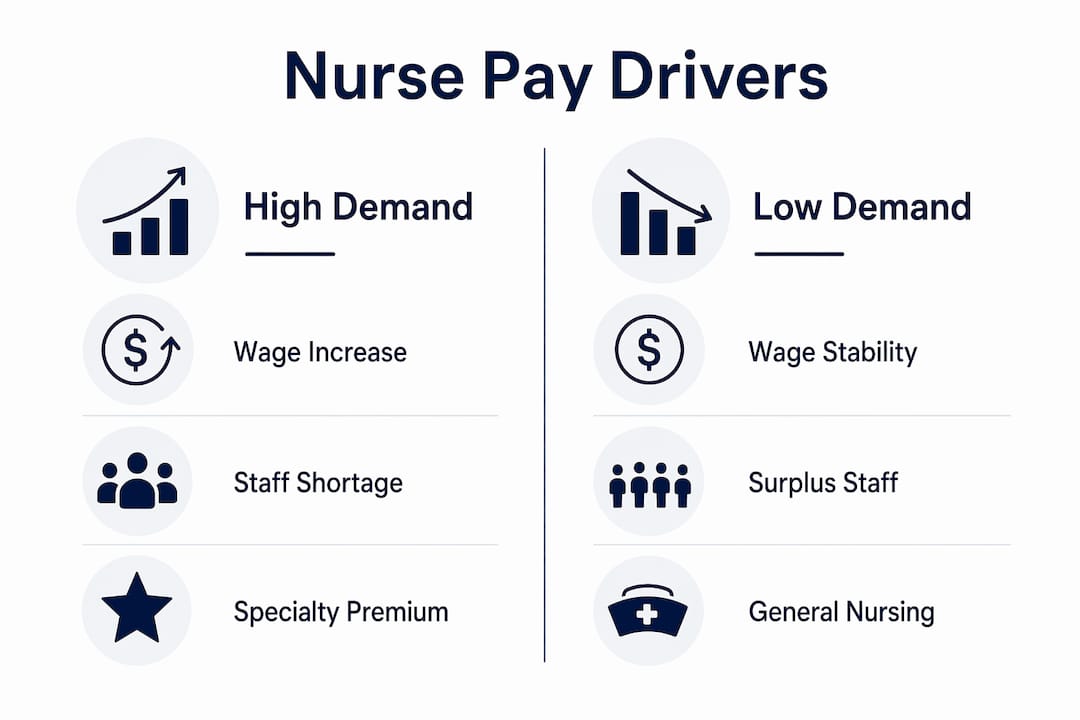
The role of supply and demand in nurse pay is the economic principle that nursing wages rise when demand for nurses exceeds available supply and stabilize when supply meets or surpasses demand. The U.S. currently faces a 10% RN shortage, with roughly 263,870 vacancies nationally in 2026. That gap pushes wages upward, particularly in high-demand specialties and regions where hospitals compete hardest for qualified nurses. Geographic location, specialty training, and experience all interact with this supply-demand balance to shape what you actually take home.
How does nurse supply shortage drive wage increases?
A shortage of nurses is the single most direct upward force on nursing wages. When hospitals cannot fill open positions, they raise pay to attract candidates. The U.S. currently has demand for 3,393,590 RNs against a supply of roughly 3,043,050. That gap of nearly 263,870 nurses creates real competition among employers.
Regional supply disparities make this even sharper. Idaho faces a 35% RN deficit while Wyoming reports a 103% supply adequacy. A nurse in Idaho holds far more negotiating leverage than a nurse in Wyoming, simply because of where they work.

Staffing ratio laws amplify this effect in specific states. California and Massachusetts mandate minimum nurse-to-patient ratios by law. Those mandates increase the number of nurses hospitals must employ, which tightens local supply and pushes wages higher. States without ratio laws face less structural pressure on wages.
Key factors that intensify shortage-driven wage pressure:
- High-acuity specialties: ICU, emergency, and perioperative roles face the steepest shortages and the highest pay premiums.
- Rural and underserved areas: Fewer nurses choose rural postings, so rural hospitals often pay more to compete.
- Aging workforce: A large share of experienced RNs are approaching retirement, shrinking the experienced supply faster than new graduates can replace them.
- Burnout-driven attrition: Nurses leaving the bedside reduce active supply without reducing patient demand.
Pro Tip: Specialty certifications in high-demand areas like critical care or emergency nursing directly reduce your substitutability. Hospitals cannot easily replace a certified ICU nurse, which gives you stronger wage leverage than a general floor nurse in the same market.
Why does nurse pay vary so much by location?
Geographic location is one of the strongest nurse salary determinants because supply-demand ratios differ dramatically from state to state. Cost of living significantly affects pay disparities between states, and high-cost areas like California maintain elevated wage demands even when nursing school output is strong. High demand combined with high cost of living drives wages up independently of the local supply pipeline.
The table below illustrates how supply-demand conditions and wages interact across selected states.
| State | Supply-demand condition | Wage trend |
|---|---|---|
| California | High demand, mandated ratios, high cost of living | Among the highest RN wages nationally |
| Idaho | 35% RN deficit | Strong upward wage pressure |
| Wyoming | 103% supply adequacy | Wages face downward or flat pressure |
| Massachusetts | Mandated staffing ratios, high cost of living | Above-average RN compensation |
| Rural Midwest states | Chronic undersupply, lower cost of living | Moderate wages with recruitment bonuses |
States with mandated staffing ratios create a structural floor under wages. Hospitals in California and Massachusetts must maintain set nurse-to-patient ratios regardless of budget pressure. That legal requirement keeps demand for nurses artificially elevated relative to supply, which sustains higher pay. You can read a deeper breakdown of these geographic forces in this 2026 state wage guide.
Supply surpluses do push wages down, but slowly. Hospitals resist lowering wages in surplus situations because of labor contracts and the cost of turnover. This wage asymmetry means nurses in surplus markets often see flat pay rather than outright cuts, which is cold comfort but better than a reduction.
Pro Tip: Before accepting a position, compare the local cost of living against the offered salary. A $90,000 salary in rural Mississippi buys more than a $110,000 salary in San Francisco. Use both numbers to evaluate the real value of any offer.
How do specialty and experience interact with supply and demand?
Specialty training concentrates demand in ways that general nursing does not. Demand concentrates in high-acuity specialties like ICU and emergency nursing, and nurses in these areas earn more than general floor nurses who face heavier burnout with slower wage growth. The economic logic is simple: fewer nurses can do the job, so employers pay more to secure those who can.
Experience compounds this effect. A nurse with five or more years in a critical care unit represents a combination of clinical skill and institutional knowledge that takes years to replace. Replacing one RN costs a hospital over $52,000 in productivity loss and orientation expenses. That replacement cost is the real source of your negotiating power as an experienced nurse. Hospitals know what losing you actually costs.
Specialty areas with the strongest wage premiums in 2026 include:
- Intensive care unit (ICU): High acuity, complex patients, and chronic understaffing drive premium pay.
- Emergency nursing: Unpredictable volume and high skill demands create persistent demand.
- Certified Registered Nurse Anesthetists (CRNAs): Advanced practice with limited supply commands the highest nursing wages.
- Operating room and perioperative nursing: Specialized technical skills with a narrow qualified candidate pool.
- Travel nursing in shortage regions: Short-term contracts in high-need areas carry significant pay premiums.
General floor nursing sits at the other end of this spectrum. Burnout rates are high, the candidate pool is larger, and wage growth is slower. Nurses who want to use supply-demand dynamics to their advantage need to move toward specialties where demand outpaces supply. Career-level salary benchmarks show how dramatically pay shifts with specialty and experience level.
Practical strategies to maximize pay in a supply-demand market
Understanding market dynamics only pays off when you act on that knowledge. The nurses who earn the most are not always the most experienced. They are the ones who understand their market position and negotiate accordingly.
-
Negotiate base salary, not just bonuses. Negotiating base salary yields more long-term value than accepting large sign-on bonuses tied to multi-year commitments. A higher base compounds into every future raise, overtime calculation, and retirement contribution. A one-time bonus does not.
-
Know your local supply-demand conditions. A nurse in a deficit region holds more leverage than one in a surplus market. Research vacancy rates, local hospital staffing challenges, and regional wage data before any negotiation. HighPaidRN provides verified salary data filtered by state, specialty, and hospital type so you can enter negotiations with real numbers.
-
Diversify your income streams. Combining staff positions with per diem or agency shifts raises effective annual pay without depending on a single employer's raise cycle. Per diem rates often reflect current market rates more accurately than staff salaries, which can lag behind market conditions.
-
Consider relocation to high-demand regions. Moving to a state with a significant RN deficit or mandated staffing ratios can produce a meaningful salary increase. Factor in cost of living carefully, but do not dismiss relocation as an option.
-
Avoid golden handcuff contracts. Long sign-on bonus repayment periods lock you into a position even if better opportunities emerge. Read the fine print on any bonus with a repayment clause before signing.
Pro Tip: Hospitals typically start offers at the low to mid salary range expecting negotiation. Nurses who accept the first offer leave real money on the table. Counter every offer with market data, not just a number you feel comfortable asking for.
For a step-by-step approach to salary conversations, the guide on asking for a higher salary covers specific language and timing strategies that work.
Key Takeaways
Supply and demand is the primary driver of nurse pay, and nurses who understand their market position negotiate significantly better compensation than those who do not.
| Point | Details |
|---|---|
| National shortage drives wages up | A 10% RN vacancy rate in 2026 creates direct upward pressure on nursing wages nationwide. |
| Location shapes your leverage | States with RN deficits or mandated staffing ratios consistently pay more than surplus states. |
| Specialty multiplies earning power | ICU, emergency, and CRNA roles command premiums because qualified supply is far below demand. |
| Replacement costs empower nurses | Hospitals spend over $52,000 to replace one RN, giving experienced nurses real negotiating leverage. |
| Base salary beats bonuses | Negotiating a higher base salary compounds over time and outperforms large one-time sign-on bonuses. |
What I've learned about nurse pay leverage in 2026
Most nurses I talk to underestimate how much power they actually hold right now. The shortage is real, the replacement costs are documented, and hospitals know exactly what it costs them when a nurse walks out the door. The leverage is there. The question is whether you use it.
The biggest mistake I see is nurses treating the first salary offer as a fixed number. Hospitals budget for negotiation. They expect it. When you accept the first offer, you are not being gracious. You are leaving money on the table that the hospital already allocated for you.
I also think the geographic piece gets underweighted. Nurses often stay in their home state out of habit or family ties, which is completely understandable. But a nurse in a 35% deficit state who relocates to fill a critical shortage position is not just getting a pay bump. They are stepping into a market where the hospital genuinely needs them and will pay to keep them.
The asymmetric wage adjustment finding matters too. Wages rise faster than they fall in response to supply-demand shifts. That means even if your region moves toward supply adequacy over the next few years, your negotiated salary is unlikely to drop. Locking in a strong base now protects you through any future market softening.
My honest advice: treat your nursing career like a business decision. Know your market, specialize where demand is highest, and negotiate every offer with data behind you.
— RN
HighPaidRN: salary data that puts you in control
Knowing that supply and demand drives nurse pay is one thing. Having the actual numbers to prove your market value in a negotiation is another.
HighPaidRN is a nurse salary transparency platform built specifically for registered nurses. It gives you verified salary data filtered by state, specialty, hospital type, and employment condition, so you can see exactly what nurses in your role and region actually earn. Whether you are an ICU nurse in California or a floor nurse considering a move to a deficit state, HighPaidRN salary data gives you the market intelligence to negotiate from a position of knowledge rather than guesswork. Nurses who contribute their own salary data also help build a collective benchmark that benefits the entire profession.
FAQ
What is the role of supply and demand in nurse pay?
Supply and demand in nurse pay means wages rise when the number of open nursing positions exceeds the available nurse workforce and stabilize or flatten when supply meets demand. The current U.S. 10% RN shortage is actively pushing wages upward in most markets.
Why do nurses in some states earn more than others?
State-level wage differences reflect local supply-demand ratios, cost of living, and staffing ratio laws. States like California and Massachusetts mandate minimum nurse-to-patient ratios, which increases structural demand and keeps wages higher than in states without such laws.
How does nurse specialty affect pay under supply-demand conditions?
Specialty training reduces the pool of qualified candidates for high-acuity roles, which concentrates demand and raises wages. ICU, emergency, and CRNA nurses consistently earn more than general floor nurses because their skills are harder to replace.
Does negotiating salary really make a difference for nurses?
Negotiating base salary makes a significant long-term difference because hospitals typically open with low to mid-range offers expecting a counteroffer. A higher negotiated base compounds into future raises, overtime rates, and retirement contributions in ways a one-time bonus does not.
How can nurses use supply-demand knowledge to earn more?
Nurses can use supply-demand data to identify high-deficit regions, pursue specialty certifications in undersupplied roles, negotiate base salary with market data, and diversify income through per diem or agency shifts. HighPaidRN provides verified salary benchmarks by state and specialty to support these decisions.