

A nursing specialty salary expectations guide is defined as a structured framework that maps registered nurse earnings to specialty, location, and credential level. The national median RN wage sits at $97,550, with a mean of $101,420, but those numbers tell only part of the story. Specialty choice, state of practice, and education credentials each shift your actual take-home pay by tens of thousands of dollars. This guide breaks down every major variable so you can set realistic salary targets and negotiate from a position of knowledge.
How nursing specialties influence salary expectations
Specialty is the single biggest lever nurses control when setting salary targets. The Bureau of Labor Statistics (BLS) classifies nursing pay by occupation rather than by unit label, which creates a gap between how nurses talk about their work and how salary data is reported. An ICU nurse and an ER nurse both appear under the same BLS Registered Nurse category (SOC 29-1141), while a Certified Registered Nurse Anesthetist (CRNA) falls under a separate, higher-paid classification.

Understanding that gap is the first step in using any specialty nursing pay guide accurately. The practical implication: unit-based specialty premiums show up in shift differentials, certifications, and float pool versus dedicated unit status, not always in the base job title salary.
Top nursing positions by annual mean wage
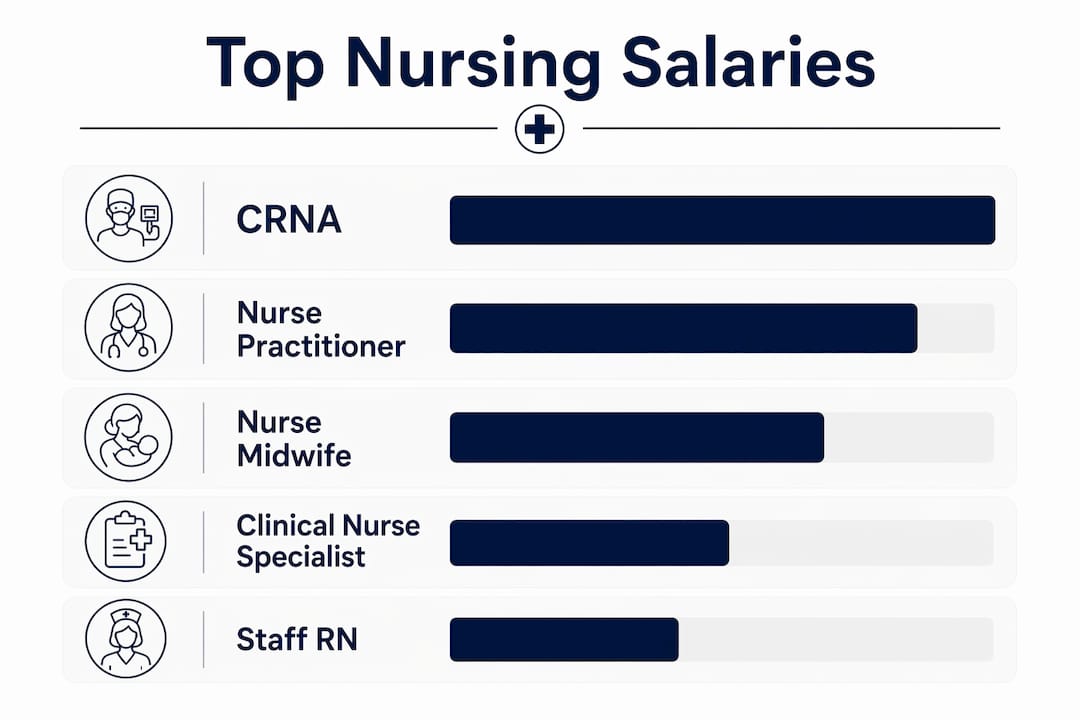
The pay spread across nursing occupations is dramatic:
- Nurse anesthetists (CRNAs): mean annual wage of $239,570, the highest among all nursing positions
- Nurse practitioners (NPs): approximately $138,000 mean annual wage
- Nurse midwives: approximately $138,000 mean annual wage
- Registered nurses (staff level): national mean of $101,420
CRNAs earn more than twice the staff RN mean. That gap reflects years of graduate-level training, clinical hours, and board certification requirements, not just a title change.
Pro Tip: When researching specialty pay, always check whether a salary figure reflects a dedicated unit RN, a float pool RN, or an advanced practice role. Each category carries a different pay structure, and mixing them distorts your benchmark.
Certifications add measurable pay on top of base wages. A CCRN (Critical Care Registered Nurse) credential or a CEN (Certified Emergency Nurse) designation typically commands a certification differential from employers, even within the same staff RN job classification. Shift differentials for nights, weekends, and holidays layer on additional earnings that rarely appear in headline salary figures.
| Nursing Role | Approximate Annual Mean Wage |
|---|---|
| Nurse Anesthetist (CRNA) | $239,570 |
| Nurse Practitioner (NP) | ~$138,000 |
| Nurse Midwife | ~$138,000 |
| Registered Nurse (staff) | ~$101,420 |
How does location affect nursing salary expectations?
Geography reshapes the salary picture more than most nurses expect. State median RN wages range from $77,020 in Alabama to $150,280 in California. That is a $73,260 gap on paper, but the real-world difference in purchasing power is narrower once cost of living enters the calculation.
California's high nominal wages are offset by housing, taxes, and daily expenses. Alabama's lower wages stretch further in a lower-cost environment. Cost-of-living-adjusted RN earnings show Alabama's median landing around $80,000 in price-adjusted terms, which closes the gap with many higher-wage states considerably.
New graduate starting salaries illustrate this regional spread sharply. The San Francisco Bay Area offers new RN base salaries in the $141,000–$162,000 range, while rural U.S. markets start closer to $54,000–$66,000. Both figures exclude shift differentials and sign-on bonuses, which can add meaningfully to either figure.
Pro Tip: Before accepting a position in a new state, run your offered salary through a cost-of-living calculator using your specific city, not just the state average. A $110,000 offer in San Francisco and a $78,000 offer in Nashville may deliver similar real purchasing power.
The nursing wages by state picture also shifts when you factor in union presence. States with strong nursing unions, such as California and New York, tend to have higher base wages, better nurse-to-patient ratios, and more transparent pay scales. Those structural factors matter as much as the headline number when you are comparing offers across state lines.
| State | Nominal Median RN Wage | Notes |
|---|---|---|
| California | $150,280 | High cost of living offsets nominal gains |
| Alabama | $77,020 | Price-adjusted ~$80,000; lower cost of living |
| San Francisco Bay Area (new grad) | $141,000–$162,000 | Excludes differentials and bonuses |
| Rural U.S. (new grad) | $54,000–$66,000 | Excludes differentials and bonuses |
Does your nursing degree affect your salary?
Education credentials directly affect both starting pay and long-term career access. BSN-prepared nurses typically earn roughly 4–8% more than ADN-prepared RNs at the staff level. That premium compounds over a career, particularly when it opens doors to charge nurse, clinical educator, and advanced practice roles.
The return on investment for a BSN is concrete. The median BSN cost runs approximately $44,200, with an average RN wage of $80,660 used as the baseline. The median payback period works out to roughly 1.8 years. That is a fast return for a professional degree.
"Magnet hospital status does not legally require all nurses to hold a BSN, but many Magnet hospitals internally prefer or require BSN credentials for hiring and advancement, indirectly affecting salary expectations." — Nevada State College, School of Nursing
Magnet designation matters because Magnet hospitals tend to pay more, offer better staffing ratios, and provide stronger career development programs. If a BSN credential is the price of entry at a Magnet facility in your area, the wage premium and career access justify the education cost quickly.
The education-to-salary ROI calculation changes significantly for advanced degrees. An MSN or DNP unlocks NP, CNS, and CRNA roles, each carrying substantially higher wages. The CRNA path requires a doctoral degree as of 2025, which means a longer and more expensive education investment, but the $239,570 mean wage reflects that commitment.
Key education milestones and their salary implications:
- ADN: Fastest path to RN licensure; lower starting wage; limited access to Magnet and leadership roles
- BSN: Preferred by most hospital systems; ~1.8-year payback period; opens charge and educator tracks
- MSN/DNP: Required for NP, CNS, CRNA, and CNM roles; highest earning potential in nursing
How to use salary data to negotiate your nursing pay
Effective salary negotiation requires more than knowing the national median. Specialty RN salary negotiation should focus on certifications, shift types, and whether the role is a dedicated specialty position or a float pool assignment. Those factors move pay more than job title alone.
A structured approach to gathering and using salary data:
- Collect offers by unit and shift, not just job title. A night-shift ICU RN and a day-shift med-surg RN may share the same job title on paper but earn very different total compensation packages.
- Factor in certifications. List every active credential you hold, such as CCRN, CEN, or CNOR, and ask specifically whether each carries a pay differential at the facility you are considering.
- Use cost-of-living-adjusted data as your anchor. Location-adjusted salary benchmarks give you a more honest comparison than nominal wages when evaluating offers across different markets.
- Benchmark against employer type. Magnet hospitals, for-profit systems, and government facilities each follow different pay structures. Knowing which category your employer falls into sets realistic expectations before you walk into the conversation.
- Ask about total compensation. Shift differentials, sign-on bonuses, tuition reimbursement, and retirement matching all add to your real earnings. A lower base wage with strong differentials can outperform a higher base at a facility with no shift premium.
Pro Tip: Request a written breakdown of shift differentials, on-call pay, and certification bonuses before comparing offers. Two positions with identical base salaries can differ by $10,000 or more in total annual compensation once those factors are included.
The nurse salary negotiation strategies that work best treat salary as a package, not a single number. Nurses who negotiate each component separately tend to secure better total outcomes than those who focus only on base hourly rate.
Key Takeaways
Specialty, location, education, and certification together determine nursing salary far more accurately than any single national average.
| Point | Details |
|---|---|
| National baseline | The median RN wage is $97,550; mean is $101,420, with wide state variation. |
| Specialty drives the ceiling | CRNAs earn $239,570 mean annually; staff RNs average $101,420. |
| Location requires adjustment | Nominal wages range $77,020–$150,280 by state; cost-of-living adjustment changes the real ranking. |
| BSN pays back fast | Median BSN cost of $44,200 yields a payback period of roughly 1.8 years. |
| Negotiate the full package | Certifications, shift type, and unit model affect total pay more than job title alone. |
What I've learned about nursing salary planning after years in the field
Most nurses underestimate how much their specialty unit assignment shapes their earning trajectory, not just their clinical skills. I have seen nurses with identical credentials and years of experience earn $15,000 or more apart annually, simply because one chose a dedicated ICU position with night differentials and a CCRN credential, while the other stayed in a float pool day-shift role.
The nursing career salary ladder from staff RN through specialty units, charge roles, and into advanced practice is real and predictable. The nurses who move up it fastest are the ones who treat each career step as a deliberate financial decision, not just a clinical preference. They research salary benchmarks before accepting positions, not after.
Geographic research is equally underused. Nurses often compare nominal wages across states without adjusting for cost of living, which leads to moves that feel like raises but deliver no real purchasing power gain. The data on price-adjusted salaries should be the starting point for any relocation decision.
My strongest advice: pursue certifications early, even before you feel ready. Employers pay differentials for credentials from day one of holding them. The CCRN, CEN, and CNOR each represent years of clinical experience compressed into a credential that immediately increases your market value. Waiting until you feel "experienced enough" costs you differential pay for every month you delay.
— RN
HighPaidRN: salary data built for nurses who negotiate
Knowing the national median is a starting point. Knowing what nurses in your specialty, at your hospital type, in your state actually earn is what gives you real negotiating power.

HighPaidRN is a nurse salary transparency platform built specifically for registered nurses who want verified, market-aligned salary data. You can filter by specialty, state, hospital type, and employment condition to find benchmarks that match your actual situation, not a generic national average. Nurses contribute their own salary data anonymously, which keeps the database current and grounded in real-world compensation. Whether you are a new graduate comparing your first offers or an experienced ICU nurse preparing to negotiate a raise, HighPaidRN gives you the numbers to back your ask.
FAQ
What is the average nursing specialty salary in the U.S.?
The national median RN wage is $97,550, with a mean of $101,420, but specialty and location shift that figure significantly. Advanced practice roles like CRNAs average $239,570 annually.
Which nursing specialties pay the most?
Nurse anesthetists (CRNAs) hold the highest mean annual wage at $239,570, followed by nurse practitioners and nurse midwives at approximately $138,000.
How much does location affect how much nurses make?
State median RN wages range from $77,020 in Alabama to $150,280 in California. Cost-of-living adjustments narrow that gap, so price-adjusted earnings often differ less than nominal wages suggest.
Does a BSN degree increase nursing salary?
BSN-prepared nurses typically earn roughly 4–8% more than ADN-prepared RNs, and the median BSN cost of $44,200 carries a payback period of approximately 1.8 years based on the wage premium.
What factors matter most when negotiating a nursing salary?
Certifications, shift type (nights vs. days), and dedicated unit versus float pool status affect total compensation more than job title alone. Always negotiate the full package, including differentials and bonuses.