

Why some nursing specialties pay more than others
Nursing specialties that command the highest pay share three common traits: they involve high-acuity patients, require skills that take years to build, and operate in markets where qualified nurses are genuinely hard to find. High-acuity specialty nurses like those in the ICU, OR, and Labor & Delivery earn $10,000 to $40,000 above the median RN wage, and that gap reflects real market pressure, not just credential differences.
Several forces drive nursing salary differences at once:
- Patient acuity and care complexity: Specialties managing critically ill or high-risk patients require faster clinical judgment and carry greater liability, which employers price into compensation.
- Supply and demand: When a specialty has fewer qualified nurses than open positions, hospitals raise pay to compete. A 2025 AMGA survey found nurse compensation relied more heavily on staffing needs and years of experience than on education or role complexity alone.
- Replacement costs: Hospitals that lose a high-acuity nurse face significant costs in recruitment, onboarding, and temporary coverage. That financial pressure gives experienced specialty nurses real leverage when negotiating pay.
- Certifications and advanced education: Credentials like CCRN, CNOR, and advanced practice degrees directly affect pay scales. CCRN certification can add $1.50 to $4.00 per hour, translating to thousands of dollars annually.
- Geographic location and workplace setting: A California RN earns a median salary of $133,990 versus $65,900 in Alabama for comparable roles. Hospital type, union presence, and whether a role is inpatient or outpatient all shift the number further.
Pro Tip: When evaluating a specialty's pay, always calculate total compensation, including shift differentials, certification bonuses, and overtime, not just the base hourly rate.
Top highest-paying nursing specialties in 2026
The specialties below represent the clearest salary premiums in U.S. nursing right now. Each one combines high clinical demand with limited supply of qualified nurses, which is exactly why the pay gap persists.
| Specialty | Average Annual Salary | Education/Certification Required | Typical Work Setting | Job Outlook |
|---|---|---|---|---|
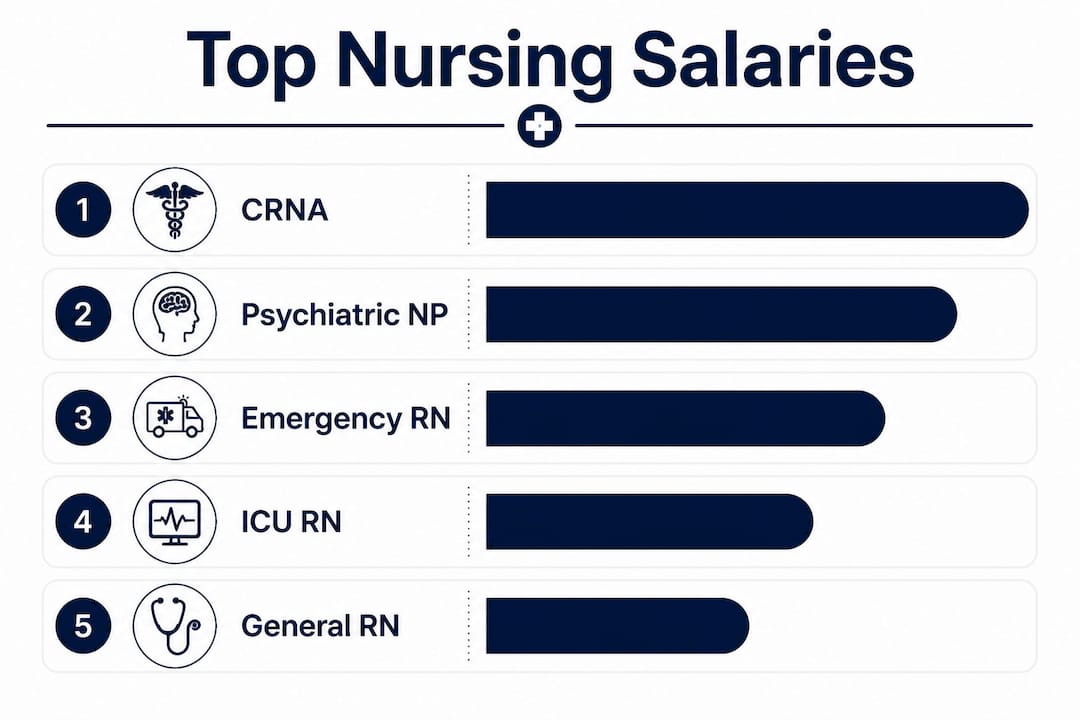
| Certified Registered Nurse Anesthetist (CRNA) | $223,210 | DNP or CRNA master's, NCCRNA certification | OR, surgical centers, pain clinics | Strong; physician anesthesia shortages drive demand |
| Nurse Practitioner (NP) | $129,210 | MSN or DNP, state NP licensure | Primary care, specialty clinics, hospitals | Very strong; primary care gap expanding |
| Nurse-Midwife | $129,210 | MSN, CNM certification | Hospitals, birth centers, OB clinics | Strong; rural access gaps create demand |
| Psychiatric Mental Health NP (PMHNP) | $129,210 | MSN or DNP, PMHNP-BC certification | Behavioral health, telehealth, inpatient psych | Very strong; mental health crisis driving hiring |
| Operating Room (OR) Nurse | ~$95,000–$110,000 | RN license, CNOR preferred | Surgical suites, ambulatory surgery centers | Stable; surgical volume growing with aging population |
| ICU/Critical Care Nurse | ~$90,000–$105,000 | RN license, CCRN preferred | Hospital ICUs, step-down units | Strong; high turnover keeps demand elevated |
| Travel Nurse | $100,000–$130,000+ | RN license, specialty experience | Hospitals, crisis-staffing facilities nationwide | Variable; tied to staffing shortages by region |
| Oncology Nurse | ~$85,000–$100,000 | RN license, OCN certification preferred | Cancer centers, infusion clinics, hospitals | Growing; cancer treatment volume increasing |
| Dialysis Nurse | ~$80,000–$95,000 | RN license, CNN preferred | Dialysis centers, hospital nephrology units | Steady; chronic kidney disease rates rising |
| Infection Control/Prevention Nurse | ~$85,000–$100,000 | RN license, CIC certification | Hospitals, public health agencies, long-term care | Growing; post-pandemic institutional investment |
A few things stand out in this comparison. CRNAs earn a median of $223,210 annually, reflecting both the doctoral-level training required and the critical nature of anesthesia administration. Nurse Practitioners and Nurse-Midwives cluster near $129,000, driven by their prescriptive authority and independent practice scope in many states. Travel nurses can exceed $130,000 in crisis-staffing situations, though that income is less predictable than a staff position.
The Psychiatric Mental Health NP role deserves particular attention right now. Demand for behavioral health services has outpaced supply for years, and PMHNPs with telehealth capabilities are being recruited aggressively across rural and underserved markets.
What actually drives salary differences across nursing specialties
Pay variation in nursing is not random, and it is not simply about who works harder. Several specific, measurable factors determine where a specialty lands on the pay scale.
Patient acuity and clinical complexity
Specialties that routinely manage unstable, critically ill, or high-risk patients require nurses to make faster, higher-stakes decisions. ICU nurses monitor patients on multiple drips, ventilators, and continuous cardiac monitoring simultaneously. OR nurses must anticipate surgical complications in real time. That level of clinical responsibility commands a premium because the cost of error is high and the skill set takes years to develop.

Supply, demand, and turnover
When a specialty has chronic staffing shortages, hospitals raise base pay and sign-on bonuses to compete for available nurses. High-turnover specialties like the ICU and ER see this effect most clearly. The supply and demand dynamics in nursing pay are well documented: when qualified nurses are scarce relative to open positions, salaries rise regardless of whether the role requires an advanced degree.
Certifications and shift differentials
- Specialty certifications like CCRN, CNOR, OCN, and CIC signal clinical expertise and often trigger hourly differentials or annual bonuses from employers.
- Shift differentials for nights, weekends, and holidays frequently add $5,000 to $15,000 or more to annual income in specialties like the ICU and ER.
- Clinical ladder placement rewards nurses who take on charge roles, preceptorships, or quality improvement projects with structured pay increases.
Education level
An associate degree RN and a BSN-prepared RN may start at similar hourly rates in some markets, but BSN completion often unlocks higher clinical ladder tiers and is a prerequisite for most APRN programs. Advanced practice degrees (MSN, DNP) open the door to APRN roles where salaries roughly double compared to staff RN positions.
Union membership and collective bargaining
Unionized nurses work under negotiated contracts that set base pay, step increases, and overtime rules. The structure provides predictability and protects against arbitrary pay cuts, but it also limits individual salary negotiation. Union pay scales fix the base rate, though schedules and overtime can sometimes be negotiated at the unit level.
Employer type and workplace setting
Hospitals generally pay more than outpatient clinics, home health agencies, or long-term care facilities, particularly for high-acuity specialties. Government-employed nurses (VA hospitals, public health agencies) often receive strong benefits packages that offset slightly lower base pay. For-profit hospital systems in competitive metro markets tend to offer the highest base rates to attract experienced staff.

Regional pay variation
Geography creates some of the largest salary gaps in nursing. The difference between the highest-paying and lowest-paying states can exceed $60,000 annually for comparable roles. California, Washington, and Hawaii consistently rank at the top, driven by high cost of living, strong union presence, and state-mandated nurse-to-patient ratios. Southern and rural states tend to sit at the lower end of the scale. Understanding why nursing wages vary by state is critical before accepting any offer, since a higher nominal salary in a high-cost state may deliver less purchasing power than a lower salary in a more affordable market.
How APRN pay compares to staff RN compensation
The pay gap between Advanced Practice Registered Nurses (APRNs) and staff RNs is substantial, and it reflects differences in scope of practice, legal authority, and the depth of training required.
Typical pay ranges:
- Staff RN: National median around $81,000–$90,000 annually, paid hourly in most hospital settings.
- Nurse Practitioner: Median salaries around $129,000 annually, typically salaried with productivity bonuses.
- CRNA: Median $223,210 annually, often with additional call pay and malpractice coverage.
- Nurse-Midwife: Median near $129,000, with compensation structures similar to NPs.
APRNs are almost always salaried rather than hourly, which changes how total compensation is structured. Many APRN contracts include relative value unit (RVU) bonuses tied to patient volume, continuing medical education (CME) allowances, and employer-paid malpractice insurance. These additions can push total compensation well above the base salary figure.
Staff RNs, by contrast, have more direct control over gross income through overtime, shift differentials, and per diem work. A staff ICU nurse working nights and weekends in California can realistically earn more than a salaried NP in a lower-cost state, which is a comparison worth running before committing to an advanced degree program.
Pro Tip: Before pursuing an MSN or DNP, calculate the full cost of the degree against the projected salary increase in your specific state and specialty. The return on investment varies widely depending on where you practice.
For staff nurses who want to increase pay without an advanced degree, the path runs through specialty certifications that boost pay, strategic shift selection, and clinical ladder advancement. These moves can add meaningful income without the time and tuition cost of a graduate program.
What the data says about nursing specialty compensation trends
Recent salary surveys and Bureau of Labor Statistics data consistently confirm that market forces, not just clinical skill, drive specialty nursing compensation. The BLS reports that APRN employment is projected to grow much faster than average, with demand particularly strong for NPs and CRNAs as the U.S. faces a widening physician shortage.
Certification return on investment is clearer than many nurses expect. According to the 2024 Nurse Salary and Work-Life Report cited by WGU, A significant portion of nurses reported that earning a certification has resulted in a direct salary increase. Employers frequently offer exam reimbursement, hourly differentials, or annual bonuses for certified staff, making the financial case for credentialing straightforward in most specialties.
Negotiation has a compounding effect that most nurses underestimate. A $5,000 raise secured at hire can compound to approximately $600,000 in additional lifetime earnings over a 40-year career, once raises, overtime, and retirement contributions are factored in. Nurses who negotiate on base rate, clinical ladder placement, and sign-on bonuses typically secure 5–15% more than the initial offer. Yet many nurses, particularly new graduates, accept the first number without a counteroffer.
Hospitals face real financial pressure to retain experienced specialty nurses. The cost of replacing a high-acuity nurse, when recruitment, temporary staffing, and onboarding are included, is substantial. That cost gives experienced specialty nurses genuine leverage, especially in markets where qualified candidates are scarce. Understanding that dynamic shifts how you approach a salary conversation.
How your pay can grow as you advance within a specialty
Career progression in nursing is not a single ladder. It branches depending on the specialty you choose, the credentials you pursue, and the employer structures available in your market.
Within staff RN roles, most hospital systems use a clinical ladder that ties pay increases to demonstrated competency, certifications, and leadership contributions. A nurse who earns a CCRN, takes on charge nurse responsibilities, and participates in unit-based quality projects can move through multiple pay tiers without changing employers or pursuing an advanced degree. Nurse career level salary benchmarks show that experienced specialty nurses at the top of a clinical ladder can earn significantly more than a newly hired NP in the same facility.
For nurses who do pursue advanced practice, the progression continues beyond the initial APRN credential. PMHNPs who add telehealth capabilities expand their patient panel and income potential. CRNAs who move into independent practice states or take on leadership roles in anesthesia departments command higher rates. NPs who specialize further, in cardiology, oncology, or pain management, typically earn more than those in general primary care.
Travel nursing offers a different kind of progression. Nurses who build experience in two or three high-acuity specialties become highly attractive to staffing agencies, which translates directly into higher contract rates and more assignment options. The tradeoff is income variability and the absence of traditional employer benefits, which requires careful financial planning.
Geographic mobility is an underused pay lever. A nurse willing to relocate to a high-demand state or take a contract in an underserved rural market can see immediate salary gains without any additional credentials. Pairing geographic flexibility with a specialty certification creates the strongest negotiating position available to staff RNs. Tools like HighPaidRN let you filter salary data by state, specialty, and hospital type so you can see exactly where your credentials are worth the most before making a move.
Key Takeaways
Nursing specialty pay differences come down to a predictable set of factors: acuity, market demand, credentials, location, and how well you negotiate your starting rate.
| Point | Details |
|---|---|
| Acuity drives the base premium | High-acuity specialties like ICU and OR pay $10,000–$40,000 above the median RN wage due to skill demands and replacement costs. |
| Market demand outweighs education alone | A 2025 AMGA survey found staffing needs and experience matter more to salary than education or role complexity. |
| Certifications add measurable pay | CCRN certification often adds $1.50 to $4.00 per hour, translating to $1,000 to $5,000 annually; many nurses in a recent survey reported a salary increase after earning a certification. |
| Location creates the largest variable | Median RN salary varies significantly between states, with California at $133,990 and Alabama at $65,900 for comparable roles. |
| Negotiation compounds over a career | A $5,000 raise at hire can compound to approximately $600,000 in additional lifetime earnings over a 40-year career. |