

Nurse wages differ by employer because pay structures reflect a combination of geographic location, employer type, nurse qualifications, and work conditions. The national median RN salary ranges from $98,430 to $101,420 in 2026, yet a California hospital RN can earn over $133,000 while a home health nurse in a rural Midwestern state earns significantly less. These gaps are not random. They follow predictable patterns tied to cost of living, union presence, shift differentials, and specialty certifications. Understanding why nurse salaries vary gives you the leverage to evaluate offers accurately and negotiate with confidence.
Why nurse wages differ by employer: the geographic factor
Geography is the single most visible driver of nursing wage disparities. States with high costs of living, such as California, New York, and Hawaii, set higher base wages because local labor markets demand it. California RNs earn an average above $133,000 annually, a figure that reflects both competitive hospital markets and the state's mandatory nurse-to-patient ratio law.
The headline salary, however, does not tell the full story. Regional Price Parities reveal that nurses earning less in mid-sized markets like Columbus, Ohio, or Raleigh, North Carolina, often hold stronger purchasing power than their coastal peers. A $90,000 salary in a low-cost metro can stretch further than $115,000 in San Francisco after accounting for housing, taxes, and transportation.
Rural versus urban pay gaps add another layer. Urban hospitals compete for nurses against multiple health systems, which drives wages up. Rural facilities often struggle to attract staff and may offer sign-on bonuses or loan forgiveness programs to compensate for lower base pay.
Key geographic factors that shape nurse pay differences include:
- State regulations: California's nurse-to-patient ratio law increases demand for nurses, which raises wages.
- Local competition: Dense hospital markets in cities like Chicago or Houston push employers to offer higher rates.
- Cost-of-living adjustments: Net purchasing power often favors mid-sized markets over high-salary coastal cities.
- Rural incentives: Federal and state loan forgiveness programs target underserved areas, adding non-salary value.
Pro Tip: Before accepting an offer based on salary alone, use a cost-of-living calculator to convert the number into real purchasing power for that specific city.
How does employer type affect nurse pay?
The type of employer you work for shapes your entire compensation structure, not just your base hourly rate. Hospital systems typically pay the highest wages and offer comprehensive benefits including health insurance, retirement matching, and paid time off. Outpatient clinics and physician offices generally pay less but offer more predictable schedules and lower physical demand.

Travel nursing sits at the top of the pay scale. Travel nurses earn premiums 50–100% higher than staff nurses in equivalent roles. That premium comes with trade-offs: limited benefits, no job security between contracts, and the cost of housing in unfamiliar cities. Nurses who manage their tax-free stipends carefully can build significant savings, but the financial picture requires careful planning.
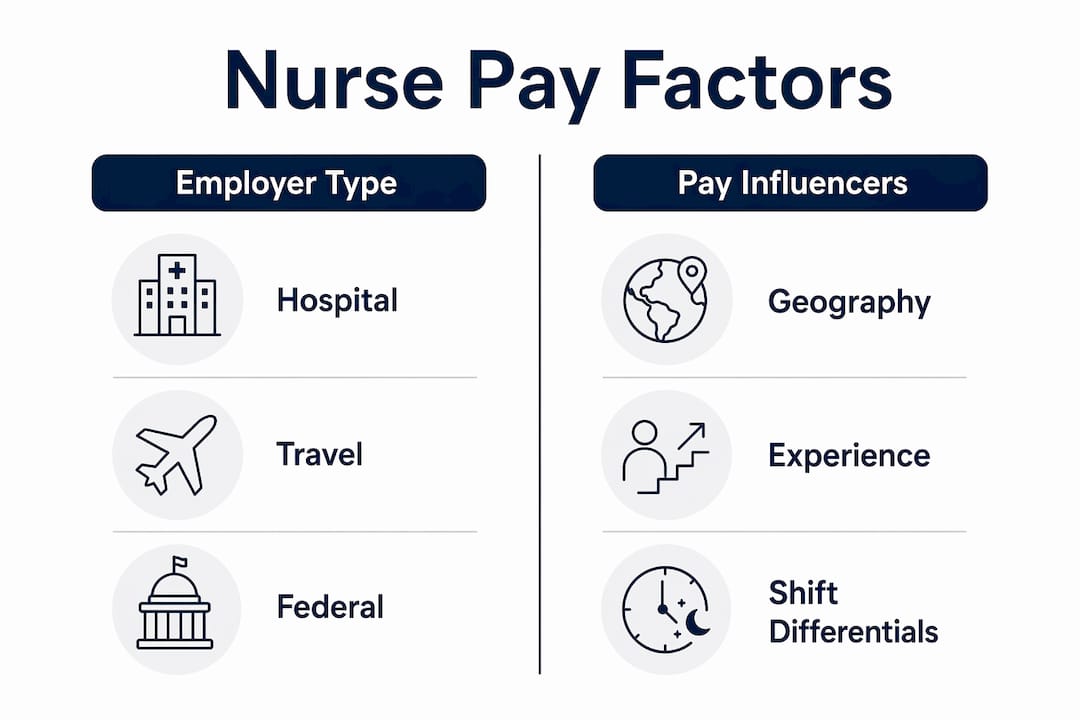
Federal employers, including the Department of Veterans Affairs, use the General Schedule pay system. This structure provides predictable step increases and strong retirement benefits, though base salaries may fall below top-tier private hospital rates. Home health agencies sit at the lower end of the pay range but often allow flexible scheduling that appeals to nurses with caregiving responsibilities.
Here is a breakdown of how employer type influences total compensation:
| Employer type | Typical pay level | Key benefit trade-off |
|---|---|---|
| Large hospital system | Highest base pay | Comprehensive benefits, shift differentials |
| Travel nursing agency | Highest total earnings | Limited benefits, no job security |
| Federal employer (VA) | Moderate base pay | Strong retirement, step increases |
| Outpatient clinic | Below hospital rates | Predictable schedule, lower stress |
| Home health agency | Lower base pay | Flexible hours, limited benefits |
Union presence also separates employers significantly. Union contracts add $8,000–$12,000 to annual compensation compared to non-union roles through structured step increases, guaranteed shift differentials, and stronger benefit packages. Non-union hospitals offer more flexibility in scheduling and role changes but fewer guaranteed pay protections.
Pro Tip: When evaluating a hospital offer, ask specifically about the union contract or pay grid. A structured step increase system can add tens of thousands of dollars over a five-year period.
How do experience, education, and certifications change nurse pay?
Qualifications are the most controllable factor in nurse pay differences. Experience alone can increase your salary substantially. Nurses with more than 10–15 years of experience earn up to 60% more than entry-level RNs in the same setting. That premium reflects both clinical competence and the reduced training burden a seasoned nurse places on an employer.
Education adds a direct dollar value to your paycheck. Advancing from an ADN to a BSN, MSN, or DNP adds between $5,000 and $40,000 to annual salary depending on the degree level and employer. Many hospital systems now require a BSN for hire or promotion, making the degree a practical necessity rather than just a pay booster.
Specialty certifications deliver a measurable return. Nurses holding credentials such as CCRN (critical care), CEN (emergency), or CNOR (perioperative) earn 10–15% more than uncertified peers in the same role. The certification signals clinical expertise and reduces liability for the employer, which justifies the pay premium.
Specialty roles command the highest wages across all employer types:
- CRNA (Certified Registered Nurse Anesthetist): Consistently among the highest-paid nursing roles, often exceeding $200,000 annually.
- Nurse Practitioner (NP): Advanced practice authority and prescribing rights translate to salaries well above staff RN rates.
- ICU and critical care nurses: High acuity settings pay more due to the complexity of patient care and required skill level.
- Charge nurses and float pool nurses: Taking on leadership or cross-unit flexibility typically earns a per-shift premium on top of base pay.
Investing in your credentials is the most direct path to higher pay regardless of which employer you choose.
How do shift differentials and union contracts affect real earnings?
Base salary is only part of what lands in your bank account. Shift differentials, overtime, and union-negotiated step increases can significantly alter your actual take-home pay. Night shift differentials range from 15–25% above base pay, while holiday shifts can pay 50–100% more than a standard weekday rate. A nurse working consistent nights and holidays can earn the equivalent of a full salary tier above their base rate.
The math matters. A nurse earning $40 per hour on days who picks up three night shifts per week at a 20% differential earns an effective rate of $48 per hour for those shifts. Over a year, that differential adds up to a meaningful income difference without any change in job title or employer.
Union contracts formalize these differentials and protect them from being reduced. Non-union employers can adjust differentials during budget cycles, which creates income uncertainty. Key shift and contract factors that affect nurse earnings include:
- Night shift differential: Typically 15–25% above base pay, applied to shifts starting after 3:00 PM or 7:00 PM depending on employer policy.
- Weekend differential: Often 5–15% above base, with some employers paying a flat weekend bonus.
- Holiday pay: Ranges from time-and-a-half to double time, with union contracts typically guaranteeing the higher rate.
- Step increases: Union contracts often include automatic annual increases tied to years of service, removing the need to negotiate each year.
- Overtime rules: Hourly RN positions qualify for overtime pay, making per diem and travel roles particularly lucrative for nurses willing to work extra shifts.
Pro Tip: If you are comparing two job offers with similar base salaries, ask each employer for a sample pay stub from a nurse in your target role. Real earnings including differentials tell a more accurate story than the posted rate.
Key Takeaways
Employer type, geography, qualifications, and shift structure collectively determine nurse pay, making base salary an incomplete measure of total compensation.
| Point | Details |
|---|---|
| Geography shapes the baseline | California RNs earn $133,000+ while mid-sized markets often offer better purchasing power after cost-of-living adjustments. |
| Employer type sets the structure | Travel nurses earn 50–100% more than staff nurses, but hospital systems offer the strongest benefits and job stability. |
| Certifications pay off directly | Specialty credentials add 10–15% to salary; experience over 10–15 years can increase pay by up to 60%. |
| Shift differentials change real earnings | Night and holiday differentials of 15–100% above base pay can equal a full salary tier over a year. |
| Union contracts protect compensation | Union roles add $8,000–$12,000 annually through guaranteed step increases, differentials, and benefit protections. |
What I've learned about evaluating nurse employer offers
Most nurses focus on the hourly rate when comparing employers. That instinct is understandable, but it misses most of what determines financial wellbeing over a career.
The offers that look modest on paper often outperform the headline numbers once you factor in shift differentials, retirement matching, and cost of living. I have seen nurses take a $10,000 pay cut to move from a high-cost coastal city to a mid-sized market and end up with more disposable income within six months. The salary number is a starting point, not a conclusion.
Union protections deserve more credit than they typically get. Nurses in non-union settings often have more scheduling flexibility, but they also carry the risk of differential reductions and merit increases that never materialize. A guaranteed step increase system removes the anxiety of annual performance reviews and builds income predictability into your career.
My strongest advice: negotiate everything, not just base pay. Sign-on bonuses, loan repayment assistance, shift differential guarantees, and continuing education reimbursement all carry real dollar value. Employers expect negotiation. Nurses who treat the first offer as final leave money on the table every time. Understanding the full picture of nurse wage transparency is the first step toward negotiating from a position of knowledge rather than guesswork.
— RN
HighPaidRN: see what nurses at your target employer actually earn
Knowing the factors that drive pay is valuable. Knowing the exact numbers at a specific hospital or employer is more valuable.
HighPaidRN is a salary database built specifically for registered nurses. It lets you filter pay by employer, state, specialty, and hospital type using verified, anonymously submitted data from working nurses. Whether you are evaluating a travel contract, comparing two hospital offers, or preparing for a salary negotiation, HighPaidRN gives you the real numbers behind the posted rates. Nurses who contribute their own salary data help build a more transparent compensation system for the entire profession.
FAQ
Why do nurses at the same hospital earn different salaries?
Pay differences within the same hospital reflect years of experience, specialty certifications, shift differentials, and whether a nurse holds a charge or float pool role. Union step increase systems also create structured pay tiers based on tenure.
Do travel nurses always earn more than staff nurses?
Travel nurses earn 50–100% more in total pay than staff nurses in comparable roles, but they typically receive fewer benefits and have no job security between contracts. Net earnings depend heavily on how well a nurse manages housing stipends and tax planning.
How much does a BSN add to a nurse's salary?
Advancing from an ADN to a BSN adds approximately $5,000 to $40,000 annually depending on the employer and degree level. Many hospital systems now require a BSN for hire or promotion, making the degree both a pay and career access factor.
Can shift differentials significantly change annual income?
Night shift differentials of 15–25% and holiday pay of 50–100% above base rate can add the equivalent of a full salary tier to annual earnings for nurses who consistently work those shifts.
How do I find nursing pay by employer before accepting a job?
HighPaidRN provides verified salary data filtered by employer, state, specialty, and hospital type. Reviewing that data before an interview gives you a factual baseline for negotiation rather than relying on posted salary ranges alone.