

The highest-impact ways to improve nursing compensation equity are: benchmark your pay against verified, specialty-specific data; document every component of your total compensation; build a structured negotiation packet; push your employer for transparent pay bands and regular audits; and, when individual routes stall, pursue collective options through the National Labor Relations Board (NLRB). Use HighPaidRN as your primary verified salary database, cross-reference with Bureau of Labor Statistics occupational data, and know that the NLRB governs your collective rights.
TL;DR — act on these within 72 hours:
- Pull your specialty and state benchmarks from HighPaidRN and BLS.
- Document base pay, shift differentials, overtime, and benefits in one spreadsheet.
- Request a copy of your current job description from HR in writing.
- Schedule a data-backed check-in with your manager within two weeks.
- If individual negotiation stalls, contact the NLRB or a labor representative.
Table of Contents
- What are the most practical ways to improve nursing compensation equity this week?
- How to measure whether a nursing pay gap exists
- How to use verified salary data to negotiate your pay
- What collective and legal routes address systemic pay inequities?
- What employer policy reforms should RNs push for?
- How to run a basic pay-equity analysis
- Which tools and data sources should you use for benchmarking?
- How to protect your privacy and avoid retaliation
- Key Takeaways
- The case for framing pay equity as a retention issue
- HighPaidRN gives you the verified data to make your case
- Useful sources and further reading
What are the most practical ways to improve nursing compensation equity this week?
Start with evidence, not emotion. Before any conversation with a manager, you need a paper trail.
- Gather your last three pay stubs and note base rate, shift differentials, overtime, and any bonuses separately.
- Pull state and specialty benchmarks from HighPaidRN, BLS, and Salary.com within 24 hours.
- Document your role scope — patient ratios, specialty certifications, charge responsibilities, and shift patterns.
- Request your official job description from HR in writing; misalignment between your actual duties and your job description is one of the most common drivers of underpayment.
- Save shift-differential evidence — screenshots, pay stubs, or scheduling records.
- Schedule a manager check-in framed as a career development conversation, not a complaint.
Pro Tip: Frame your initial manager conversation around market alignment and retention, not personal need. Saying "I want to make sure my compensation reflects current market rates for ICU nurses in this state" is far less likely to trigger defensiveness than "I feel underpaid."
Collecting peer salary data is legal, but keep it aggregate. Never share identifiable pay lines. Use anonymous summaries when presenting peer comparisons to leadership.
How to measure whether a nursing pay gap exists
Equitable nurse compensation, in practical terms, means pay that reflects your role, credentials, experience, and market conditions — not demographic factors. Measuring whether a gap exists requires the right data fields and the right comparisons.
Step 1: Collect the right data fields
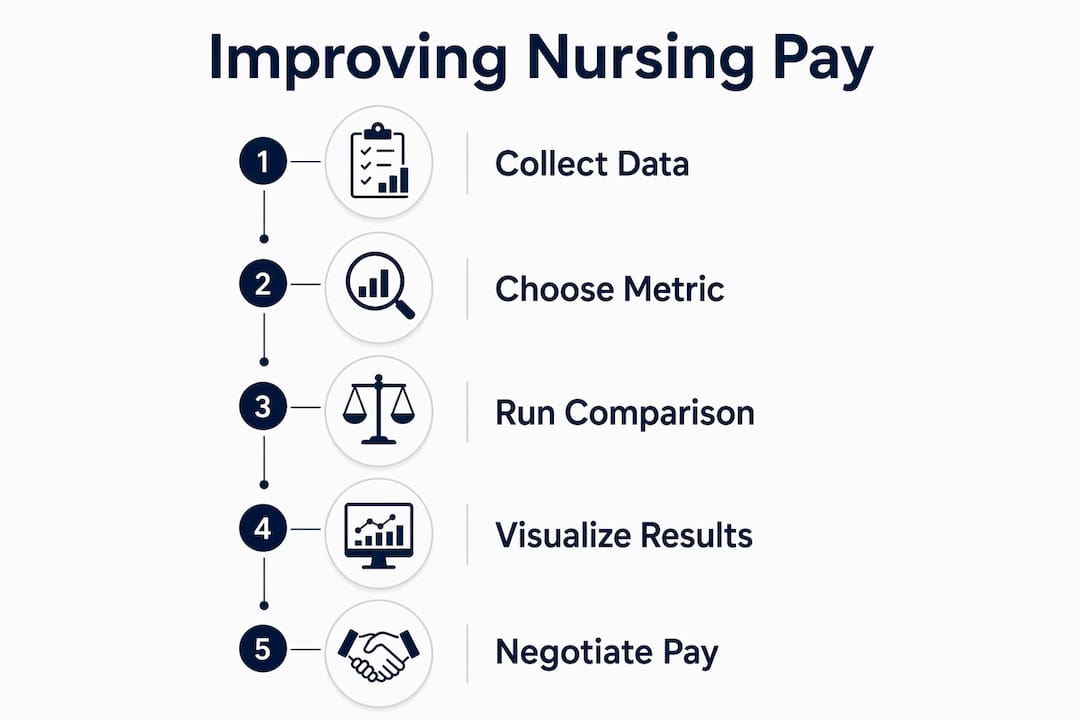
For each RN in your comparison group, record: base hourly rate, total annual compensation (base + shift differentials + overtime + bonuses + benefits value), FTE status, specialty (ICU, med-surg, ED, etc.), employer type (academic medical center, community hospital, for-profit system), years of experience, highest credential, and shift pattern.
Step 2: Choose your metric and adjust
Use median rather than mean when your sample is small or includes outliers. Adjust for experience, specialty, and hours before drawing conclusions. An unadjusted comparison that ignores the fact that male nurses are more concentrated in higher-paying specialties like ICU and OR will overstate the raw gap. Research using representative RN samples finds an observed wage gap after controlling for job-related characteristics; overtime pay explains a significant share of that gap among hospital workers.
Step 3: Run the comparison
Sort your dataset by specialty and employer type. Calculate the median hourly rate for each subgroup. Compute the percentage difference between the lowest and highest subgroup medians. A gap above 4% that persists after adjusting for experience and specialty warrants a formal conversation with HR.
Step 4: Visualize for leadership
A box plot shows the spread and outliers within each subgroup. A bar chart comparing subgroup medians is easier for non-statisticians to read in a meeting. Both are buildable in Excel or Google Sheets with no specialized software.
State pay-transparency laws give you additional leverage. California employers with 100+ employees must publish pay scales in job postings and maintain wage-history records; Colorado, Washington, and New York City have similar rules. Even if your facility hasn't adopted transparency voluntarily, you can legally use those public disclosures to benchmark your request.
How to use verified salary data to negotiate your pay
A negotiation packet turns your measurement into a persuasive, professional document. Include: a one-page role summary (your actual duties, specialty, credentials, and shift pattern), documented deviations between your pay and local/state medians, benchmarks from HighPaidRN, BLS, PayScale, Salary.com, and Glassdoor, and a clearly stated requested adjustment with a written rationale.
Timing matters:
- Annual performance review cycles are the most accepted moment to raise compensation.
- After completing a high-visibility project or earning a new certification, your leverage increases.
- After a market data update (HighPaidRN publishes verified data regularly), you have fresh evidence.
Sample script: "Based on current market data for [specialty] RNs in [state], the median total compensation is [figure]. My current rate is [X]% below that median after adjusting for my [years] of experience and [specialty certification]. I'd like to discuss bringing my compensation in line with market."
If your manager stalls, ask for a written rationale for the current rate, request a formal timeline for a compensation review, and escalate to HR with your documented packet. For deeper negotiation tactics, salary negotiation for nurses covers career-stage scripts in detail.
Pro Tip: Bring a printed one-page summary to the meeting. Managers who see a structured document treat the conversation as a formal process, not a personal grievance.
What collective and legal routes address systemic pay inequities?
When individual negotiation fails to close a structural gap, collective routes and legal channels are your next options.
NLRB organizing basics
Under the NLRB process, nurses can sign authorization cards, petition for a secret-ballot election, and, after a certified victory, employers are legally required to bargain in good faith. The process typically takes several months from card-signing to a first contract.
| Pathway | Timeline | Likely employer response | Best for |
|---|---|---|---|
| Individual negotiation | 2–8 weeks | Manager review, possible HR escalation | Documented individual gap |
| Collective bargaining | 6 months | Formal labor relations process | Systemic, unit-wide inequities |
| Policy advocacy | — | Legislative or accreditation pressure | Structural, profession-wide change |
Organizing safely:
- Keep early conversations among trusted colleagues and document everything.
- Use personal devices and personal email for organizing communications.
- Contact the NLRB (1-844-762-6572) or your state labor board if you suspect retaliation.
- Consult a labor attorney before filing a formal charge.
What employer policy reforms should RNs push for?
Improving nurse pay equity at the institutional level requires specific, named policy changes. The AHLA recommends that health systems establish written definitions of equity and fairness, conduct internal and external compensation reviews, and adopt formal equal-pay policies. AAMC guidance adds governance structure, recurring equity studies, and dedicated funding mechanisms.
Policy checklist to bring to leadership:
- Published salary bands by role, specialty, and experience tier.
- Annual pay-equity audits with results shared to staff.
- Standardized job descriptions that capture nonclinical work (charge duties, precepting, committee roles).
- A dedicated budget line for equity adjustments, not ad hoc corrections.
- A governance structure with named accountability for remediation timelines.
Structured salary models that remove volume-based incentives can reduce the correlation between compensation and demographic variables. Propose a pilot pay-equity audit with a 90-day data-collection phase and a 30-day remediation plan as a starting point. Linking equity to nursing salary transparency outcomes strengthens the retention argument with leadership.
How to run a basic pay-equity analysis
A reproducible methodology doesn't require a statistician. Here's a compact approach any RN-led team can run.
- Build your spreadsheet. Columns: Employee ID (anonymized), role title, specialty, FTE, years of experience, base hourly rate, shift differential, overtime hours (quarterly average), total annual compensation, employer type.
- Calculate medians by subgroup. Use Excel's
MEDIAN(IF(...))array formula or Google Sheets'MEDIANIFSto get subgroup medians by specialty and experience band. - Compute the adjusted gap. Subtract the lowest subgroup median from the highest. Divide by the highest to get a percentage gap.
- Flag outliers. Remove anyone working more than 20% overtime before comparing base rates; overtime inflates total compensation and obscures the base-pay picture.
- Prepare a one-page summary. Include a bar chart of subgroup medians, the adjusted gap percentage, and a proposed remediation range.
Statistical notes: A sample of at least 15–20 RNs per subgroup gives more reliable medians. Mixing part-time and full-time FTEs without adjusting for hours is the most common pitfall. Regression analysis is optional but strengthens the case if you have a larger dataset.
Pro Tip: Present the analysis as a "market alignment review," not a discrimination claim. That framing invites problem-solving rather than legal defensiveness from HR.
Which tools and data sources should you use for benchmarking?
| Source | What it provides | Key strength | Watch for |
|---|---|---|---|
| HighPaidRN | Verified RN salaries by state, specialty, hospital type | Nurse-specific, anonymized, filterable | Ongoing data contribution improves accuracy |
| BLS | Official occupational wage data by state and metro area | Government-sourced, large sample | Broad categories; less specialty granularity |
| Glassdoor | Self-reported salaries with employer reviews | Employer-level context | Unverified; small samples for niche specialties |
| PayScale | Compensation data with experience and skill filters | Skill-level breakdowns | Methodology not always transparent |
| Salary.com | Percentile-based compensation reports | Percentile benchmarks useful for HR conversations | Subscription features limit free access |

For a deeper look at why nursing wages vary by state, market forces and cost-of-living adjustments matter as much as the raw numbers.
Downloadable resources to build your packet:
- Negotiation packet template (role summary + benchmark table + requested adjustment).
- Spreadsheet template with pre-built median formulas.
- Sample request-to-HR email (formal, evidence-led).
- Confidentiality-safe peer-data collection script (aggregate only, no identifiable lines).
How to protect your privacy and avoid retaliation
Privacy checklist when collecting peer data:
- De-identify all peer pay data before storing or sharing it.
- Use aggregate summaries ("the median for ICU RNs in this unit is X") rather than individual figures.
- Store data on a personal device, not a work system.
- Avoid sharing identifiable pay lines in writing with anyone other than a trusted legal contact.
Employers may not lawfully retaliate against nurses for engaging in protected concerted activity under the NLRA, but the process for addressing retaliation differs depending on whether you are acting individually or collectively. Red flags include sudden schedule changes, negative performance reviews that appear after you raise pay concerns, or exclusion from assignments. If any of these occur, document the timeline in writing, request an HR meeting in writing, and contact the NLRB or your state labor board promptly.
This article is general information, not legal or professional advice. Confirm current rules with the NLRB, your state labor board, or a qualified employment attorney for your specific situation.
Key Takeaways
Improving nursing compensation equity requires combining verified data benchmarking, structured individual negotiation, employer policy reform, and collective action when systemic gaps persist.
| Point | Details |
|---|---|
| Measure before you negotiate | Document base pay, shift differentials, overtime, and benefits; use median comparisons adjusted for specialty and experience. |
| The observed wage gap is real | Research finds a 4–10 percent adjusted wage gap among RNs; overtime pay explains a significant share among hospital workers. |
| Employer policy changes matter | Push for published salary bands, annual pay-equity audits, and a dedicated budget line for equity adjustments. |
| Collective routes follow NLRB rules | Authorization cards, a secret-ballot election, and mandatory bargaining are the formal steps; timeline is typically 6 months. |
| HighPaidRN is your benchmarking starting point | Filter by state, specialty, and hospital type to build a verified, nurse-specific negotiation packet. |
The case for framing pay equity as a retention issue
The conventional advice is to walk into a pay-equity conversation armed with data and a clear ask. That's correct, but it misses the single most effective reframe available to nurses: leadership responds to retention risk far faster than to fairness arguments.
When an RN presents a pay gap as a market-alignment problem, the conversation shifts from "you feel underpaid" to "we risk losing you to a competitor." That's a budget problem, not a values debate, and budget problems get solved. The AAMC's funding recommendations make this explicit: dedicated budget lines for equity adjustments exist precisely because ad hoc corrections don't happen without financial pressure. Pair your data packet with a clear statement of what the replacement cost of an experienced specialty nurse looks like, and you've made the financial case leadership actually needs to act.
One more thing worth saying plainly: intersectional factors, including race, gender identity, and age, compound pay gaps in ways that adjusted medians don't always capture. BIPOC nurses face documented disparities beyond the gender gap. Addressing nursing wage equality strategies at the institutional level means audits must stratify by race and gender together, not separately.
HighPaidRN gives you the verified data to make your case
Salary conversations without verified, nurse-specific data are guesswork. HighPaidRN's database is built specifically for U.S. registered nurses, with filters for state, specialty, hospital type, and employment condition. Pull a benchmark for ICU nurses in your state in minutes, compare it against your current total compensation, and generate a negotiation-ready report.
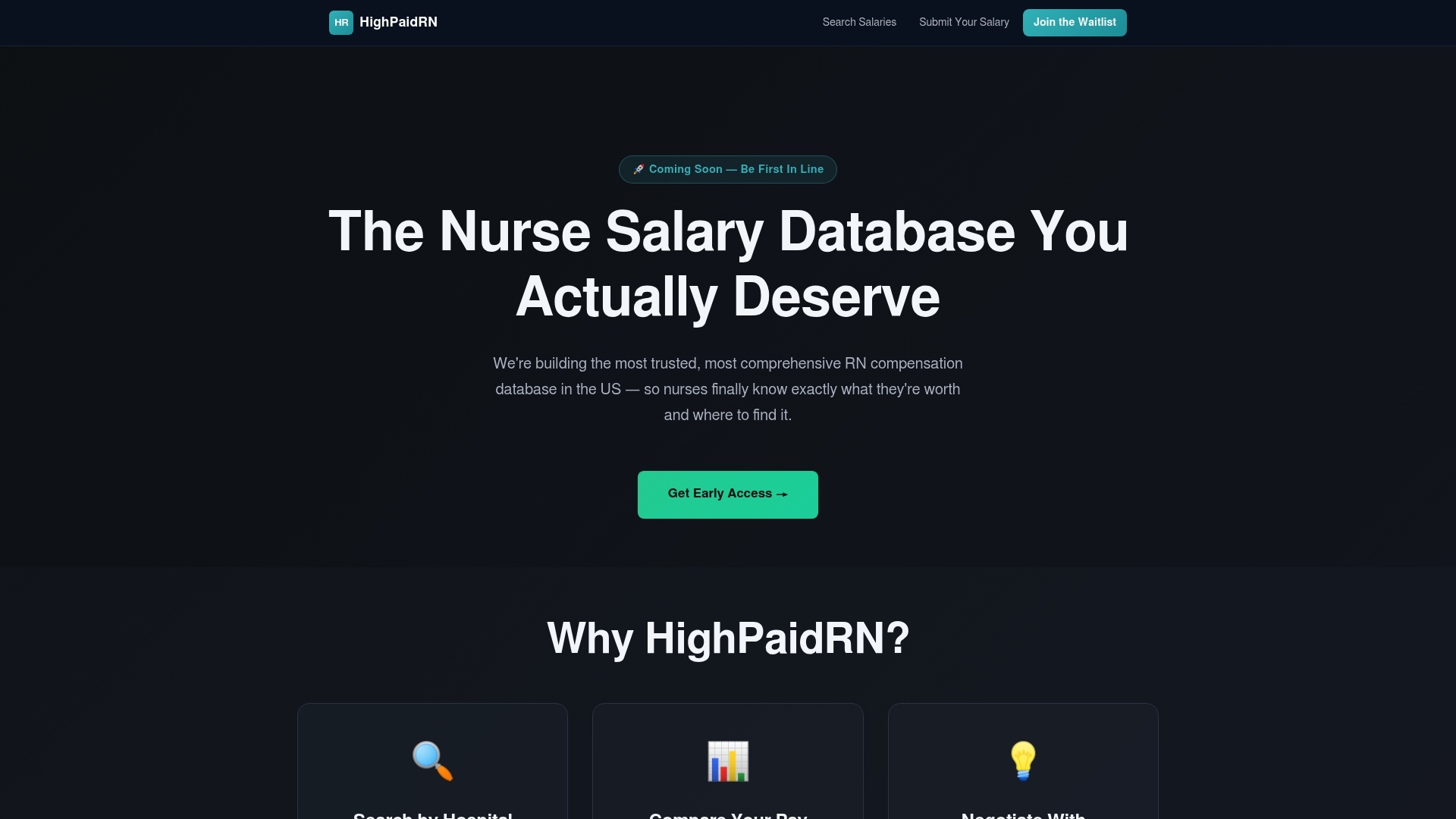
Whether you're preparing for an annual review, proposing a pilot pay-equity audit to HR, or building a unit-wide case for transparent salary bands, HighPaidRN gives you the verified numbers behind every ask. Nurses who contribute their own salary data anonymously also strengthen the database for every RN who comes after them.
Start benchmarking your nursing salary today and build your negotiation packet with real market data.
Useful sources and further reading
- National Nurses United — Organizing: How It Works: Step-by-step overview of the NLRB authorization-card and election process for nurses pursuing collective bargaining.
- BLS — Registered Nurses Occupational Outlook: Official U.S. government wage data by state and metro area; the baseline for any benchmarking exercise.
- AAMC — A Shared Commitment to Fair Pay: Governance, compensation philosophy, recurring equity studies, and funding mechanisms for academic medical centers.
- AHLA — Achieving Provider Compensation Parity: Structured roadmap for health systems to define equity, conduct reviews, and adopt equal-pay policies.
- UCSF Healthforce Center — Closing the Gender Pay Gap for Female Nurses: Covers state pay-transparency laws and the trade-offs of transparency programs, including wage compression.
- NBER Working Paper — Nurse Wages (Pablo Estrada): Empirical analysis of the nursing wage gap; finds a 4–10 percent adjusted gap with overtime as a key driver.
- NCBI Bookshelf — The Future of Nursing 2020–2030, Paying for Equity: Policy context on payment models, workforce diversity, and structural barriers to health equity.