

Institutional pay discrimination is the embedding of pay disparities into an organization's policies, procedures, or wage-setting systems rather than in any single manager's decision. The Equal Employment Opportunity Commission (EEOC) enforces federal laws including the Equal Pay Act (EPA), Title VII of the Civil Rights Act, the Age Discrimination in Employment Act (ADEA), and the Americans with Disabilities Act (ADA) that prohibit this form of compensation discrimination. The U.S. Department of Labor (DOL) also provides workers with filing rights and retaliation protections. OECD analysis shows that differences in firm-level wage-setting practices explain a large portion of overall wage inequality, which means the problem often lives in the institution, not in one bad actor.
If you suspect you are affected, start here:
- Pull your pay history and compare it to job descriptions and posted pay ranges for your role.
- Request your employer's job-evaluation criteria and compensation policy from HR in writing.
- Contact the EEOC or DOL if the evidence points to a pattern across a group, not just your own situation.
The single most important takeaway: systemic pay gaps require systemic evidence, and a single colleague comparison is rarely enough to establish an institutional problem.
Table of Contents
- What institutional pay discrimination is and how it differs from individual bias
- How institutional pay discrimination shows up in real workplaces
- U.S. laws and agencies that cover institutional pay discrimination
- How to tell whether a pay gap is institutional: what data to collect
- Step-by-step actions if you suspect institutional pay discrimination
- How employers can prevent or remediate pay discrimination
- How verified salary databases help reveal institutional pay gaps
- Key Takeaways
- Why this topic matters more than most people realize
- HighPaidRN gives nurses the market data to challenge institutional pay gaps
- Useful sources and further reading
What institutional pay discrimination is and how it differs from individual bias
Systemic pay discrimination occurs when an organization's compensation structure, policies, or procedures produce lower pay for members of a protected class as a group. The EEOC's compensation discrimination guidance makes clear that a compensation claim can be brought under Title VII, the ADEA, or the ADA even when no person outside the protected class holds an identical higher-paying job. That is the defining feature of institutional discrimination: the disparity is built into the system, not dependent on a direct comparator.

Individual discrimination, by contrast, involves a specific decision by a specific person, such as a supervisor who unilaterally pays one employee less because of their race. Institutional discrimination is harder to detect because no single act is obviously wrong. The harm accumulates across hundreds of pay decisions shaped by the same flawed policy.
Key distinctions at a glance:
- Who it affects: Institutional discrimination affects a class of employees across an entire department, facility, or firm. Individual discrimination typically affects one person or a small group tied to one decision-maker.
- How it appears: Institutional patterns show up in aggregate pay data, job-classification systems, and promotion rates. Individual acts appear in specific pay decisions, performance reviews, or verbal statements.
- Evidence needed: Institutional cases rely on statistical patterns, policy documents, and demographic data. Individual cases often turn on direct comparators and documented statements.
- Legal remedies: Both types are covered by federal law, but institutional cases are more likely to involve class or systemic claims handled by the EEOC or DOL.
Protected characteristics and governing statutes:
- Race, color, religion, sex, national origin: Title VII of the Civil Rights Act
- Sex-based pay for substantially equal work: Equal Pay Act (EPA)
- Age (40 and over): Age Discrimination in Employment Act (ADEA)
- Disability: Americans with Disabilities Act (ADA)
- Genetic information: Genetic Information Nondiscrimination Act (GINA)
Compensation under these statutes covers more than base salary. It includes bonuses, overtime, benefits, insurance, and any other payment made on behalf of an employee.
One term worth understanding precisely: the EPA's "establishment" requirement means comparisons must be made between employees at the same physical location. "Substantially equal" work does not mean identical work; it means jobs requiring equal skill, effort, and responsibility performed under similar working conditions.
How institutional pay discrimination shows up in real workplaces
The most common mechanisms are structural, not personal. They operate through the rules that govern how pay is set, how jobs are classified, and who gets access to higher-paying roles.
Systemic wage-setting mechanisms to watch for:
- Starting-pay formulas tied to prior salary. When employers anchor starting pay to a candidate's previous wages, they can perpetuate historical gaps for women and workers of color who were already underpaid.
- Job ladders that channel groups into lower-paying tracks. If a hospital consistently places nurses from certain demographic groups in lower-acuity units with lower specialty differentials, the pay gap is a product of the assignment system, not individual performance.
- Pay secrecy rules. Policies that discourage or prohibit employees from discussing wages prevent workers from detecting group-level disparities.
- Differential access to overtime and bonus-eligible roles. When scheduling practices limit certain groups' access to premium-pay shifts or bonus-eligible positions, the compensation gap widens without any single discriminatory act.
- Inconsistent application of merit or seniority systems. A merit system that rewards the same performance differently across demographic groups is a textbook example of institutional wage disparity.
EEOC guidance specifically identifies steering protected-class members into lower-paid jobs and discriminatory promotion or appraisal procedures as indirect practices that depress compensation for entire classes of employees.
Nursing-specific patterns. In healthcare, specialty pay differences by hospital type can reflect genuine skill premiums or institutional bias. A pattern where nurses of a particular demographic are consistently assigned to departments with lower shift differentials, regardless of their qualifications, is a red flag. Department-level pay variance can create pay gaps that look like occupational differences but are actually driven by assignment policies.

Academic research using linked employer-employee data confirms that both within-job gaps and between-firm segregation drive gender pay disparities in the U.S., with the within-job gap accounting for roughly half of the baseline gender pay gap in some samples.
Two illustrative scenarios:
A hospital system applies a uniform "market-rate" starting pay formula that uses zip-code-level wage data. Because those zip codes reflect historical residential segregation, nurses hired from certain areas start at lower base rates. No individual manager made a discriminatory choice, but the policy produces a racially correlated pay gap across the entire system.
An ICU nurse with five years of experience requests a transfer to a higher-paying cardiac step-down unit. HR's internal policy requires a supervisor recommendation, and supervisors in her unit have historically recommended only nurses who fit an informal profile. The policy is facially neutral, but its application consistently blocks one demographic group from accessing higher-paying roles.
U.S. laws and agencies that cover institutional pay discrimination
Four federal statutes form the core legal framework, and two agencies enforce them.
The Equal Pay Act (1963). The EPA requires equal pay for men and women performing substantially equal work in the same establishment. It is the narrowest of the four statutes: claims are limited to sex-based differentials, and the comparison must be within the same physical location. Employer defenses include bona fide seniority systems, merit systems, and incentive pay systems based on quantity or quality of production.
Title VII of the Civil Rights Act (1964). Title VII covers a broader range of protected characteristics (race, color, religion, sex, national origin) and can reach indirect practices that depress pay for protected groups. Unlike the EPA, Title VII does not require a direct comparator in the same establishment. A systemic pattern of lower pay for a protected class, produced by facially neutral policies, can support a Title VII claim.
Age Discrimination in Employment Act (1967). The ADEA prohibits compensation discrimination against workers 40 and older. It applies to employers with 20 or more employees, a higher threshold than the 15-employee minimum for Title VII and the ADA.
Americans with Disabilities Act (1990). The ADA prohibits compensation discrimination based on disability and applies to employers with 15 or more employees. Like Title VII, it can reach indirect practices that produce lower pay for workers with disabilities.
Agency roles:
- The EEOC investigates charges, issues guidance, and can litigate on behalf of affected workers. Most federal pay discrimination claims must go through the EEOC before a private lawsuit can be filed.
- The DOL enforces the EPA through its Wage and Hour Division and provides workers with information about their rights and filing options.
Filing windows. Charge-filing deadlines vary by statute and state. Under the EPA, employees generally have two years to file suit (three years for willful violations) and are not required to file an EEOC charge first. Under Title VII, ADEA, and ADA, workers in most states must file an EEOC charge within 300 days of the discriminatory act (180 days in states without a fair employment agency). Check the EEOC's charge-filing page for current deadlines specific to your state.
When to file internally vs. externally. An internal HR complaint preserves your relationship with the employer and may trigger a faster resolution. An EEOC charge is required before suing under Title VII, ADEA, or ADA, and it starts the clock on the agency's investigation. Filing both is common; they are not mutually exclusive.
This article provides general information, not legal advice. Confirm current rules with the EEOC, DOL, or a qualified employment attorney.
How to tell whether a pay gap is institutional: what data to collect
Single-colleague comparisons are weak evidence of institutional discrimination. The EEOC's compensation discrimination section and labor-economist analysis both emphasize that detecting systemic patterns requires broad, verified market data rather than one-to-one comparisons.
Evidence checklist:
- Pay history by job classification (base pay, bonuses, overtime, benefits)
- Job descriptions and posting records for your role and comparable roles
- Hiring and offer-letter records showing starting pay by demographic group
- Promotion and performance-review records across your department or facility
- Bonus and overtime distribution by job title and demographic group
- Benefit differences (health insurance tiers, retirement contributions) by employee group
- Demographic composition of each job category or pay band
Sample data table schema to compile or request:
Fill in each cell with real figures from HR records or your employer's pay-transparency disclosures. Consistent median differences across multiple job codes, combined with demographic clustering in lower-paid codes, are the clearest indicators of an institutional problem.
Statistical patterns to watch for (no formulas required):
- A gap that appears in one job title is weak evidence. The same gap appearing across five or ten job titles in the same facility is a strong signal.
- Clustering of a protected group in lower-paid job classifications, even when members of that group have equivalent qualifications, points to assignment or promotion policies rather than individual performance.
- Large pay differences between your facility and comparable facilities in the same market, not explained by specialty or location, suggest firm-level wage-setting practices are at work. OECD research confirms that between-firm differences contribute materially to overall wage inequality.
Pro Tip: When requesting pay or job-evaluation data from HR, frame it as a routine professional inquiry: "I'm reviewing my compensation relative to market benchmarks and would like to understand the job-evaluation criteria and pay range for my classification." This keeps the request factual, avoids signaling a complaint prematurely, and creates a written record of your inquiry.
For nurses, nursing compensation research tools can help you build the external market comparators you need before approaching HR or the EEOC.
Step-by-step actions if you suspect institutional pay discrimination
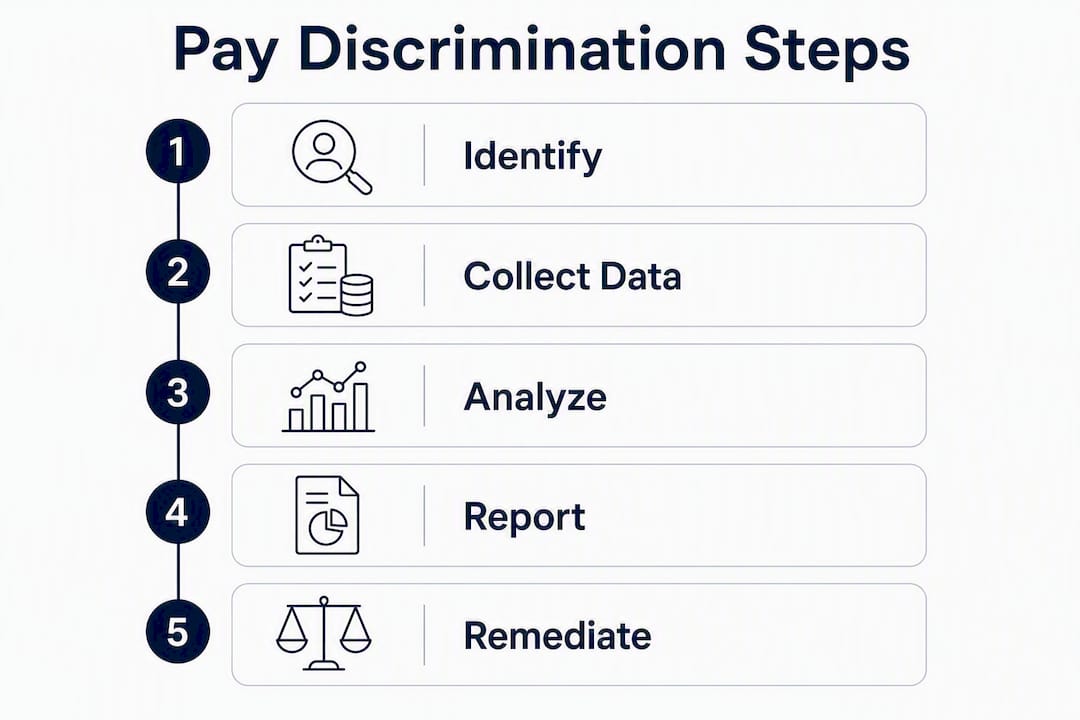
Acting methodically protects you legally and builds the strongest possible case. Here is a practical sequence.
- Document what you know now. Write down dates, amounts, job titles, and any conversations related to your pay. Include the names of colleagues whose pay you have reason to believe differs from yours, and the source of that information.
- Request your personnel file and pay records. In most states, employees have a legal right to review their personnel file. Ask HR in writing and keep a copy of the request.
- Obtain your employer's compensation policy and job-evaluation criteria. Ask HR for the written pay policy, the pay range for your job classification, and the criteria used to set pay within that range.
- Gather external market comparators. Use verified salary databases filtered by specialty, location, and employer type to establish what comparable workers earn elsewhere. Nursing salary benchmarks by career level can anchor your comparison.
- Calculate simple group-level metrics. Compare median pay for your job classification by demographic group using the data you have collected. A consistent gap across multiple job codes is more persuasive than a single data point.
- Preserve all communications. Save emails, texts, and written policies. Do not delete anything related to your pay, your performance reviews, or your requests for information.
- File an internal complaint if the evidence supports it. Submit a written complaint to HR or your employer's EEO officer. Keep a copy. Note the date and the name of the person who received it.
- Contact the EEOC or DOL. If the internal process stalls or the evidence points to a systemic pattern, file a charge with the EEOC or contact the DOL's Wage and Hour Division. The EEOC's charge-filing page walks you through the process.
- Consult an employment attorney or union representative. An attorney can assess whether your evidence meets the threshold for a formal claim and advise on overlapping statutes. If you are in a unionized workplace, your union steward can initiate a grievance and access collective bargaining protections.
When multiple laws apply. Filing under both the EPA and Title VII is common in sex-based pay cases. The EPA has a shorter filing window and does not require an EEOC charge before suit, while Title VII allows broader claims and longer remedies. An attorney can help you decide which combination fits your situation.
Timeline summary:
- EPA: file suit within 2 years (3 years for willful violations); no EEOC charge required first.
- Title VII, ADEA, ADA: file EEOC charge within 300 days (180 days in some states); right-to-sue letter required before filing in federal court.
- Always verify current deadlines directly with the EEOC or DOL, as state laws can extend or modify these windows.
How employers can prevent or remediate pay discrimination
Workers benefit from understanding what a responsible employer response looks like, because it helps you evaluate whether your employer is taking the issue seriously or managing liability.
Employer prevention checklist:
- Conduct routine pay audits disaggregated by race, sex, age, and disability status across every job classification.
- Use transparent, documented job-evaluation systems that tie pay to measurable factors (skill, effort, responsibility, working conditions) rather than subjective assessments.
- Publish pay ranges for every job classification and require that starting offers fall within the posted range.
- Standardize promotion criteria and document every promotion decision with the criteria applied.
- Adopt an explicit anti-retaliation policy covering employees who raise pay concerns or participate in investigations.
- Correct identified pay gaps with retroactive adjustments, not just prospective raises.
Pro Tip: A rigorous pay-audit report should include: the scope (which employees, which time period, which pay components), the methodology (regression or cohort analysis, control variables used), disaggregated median and mean pay by demographic group and job classification, and a corrective-action plan with timelines. An audit that produces only a summary conclusion without disaggregated data is not adequate for detecting institutional patterns.
The role of unions and collective bargaining. Economic Policy Institute analysis ties wage suppression to the erosion of worker institutions, including weaker unions and reduced enforcement. Collective bargaining agreements that set transparent pay scales, seniority rules, and grievance procedures are among the most effective structural tools for preventing institutional wage disparity. Workers in unionized settings have access to grievance arbitration, which can address systemic pay issues faster than EEOC proceedings. For nurses considering how employer-level factors affect wages, union presence is one of the most consistent predictors of pay equity.
How verified salary databases help reveal institutional pay gaps
Detecting institutional pay discrimination requires data at scale. A single colleague's salary tells you almost nothing about whether your employer's pay policies are discriminatory. What you need are aggregated, verified comparators across many workers in similar roles, filtered by specialty, location, and employer type.
What verified salary databases provide:
- Filtered median pay and pay ranges by nursing specialty, state, hospital type, and employment condition (staff, travel, per diem).
- Aggregated data that protects individual privacy while revealing firm-level and market-level patterns.
- External benchmarks that can be used to test whether an employer's explanation for a pay gap (e.g., "our market is different") holds up against real data.
- A starting point for the evidence table described in the identify-and-gather section above.
How workers and advocates can use these tools:
- Benchmark starting pay offers against verified market medians before accepting a position.
- Identify firm-level outliers: if one hospital system pays significantly below the market median for a given specialty, that gap warrants investigation.
- Prepare aggregate evidence for internal complaints or EEOC charges by showing that the employer's pay falls below verified market norms for a protected group.
- Support collective bargaining negotiations with data that reflects current market conditions rather than the employer's self-reported figures.
Privacy and data integrity. Anonymous, aggregated salary contributions protect individual nurses while enabling the kind of systemic analysis that single-person comparisons cannot support. HighPaidRN's database is built on this model: nurses contribute verified salary data anonymously, and the platform aggregates it into searchable benchmarks filtered by state, specialty, hospital type, and employment condition. That combination of granularity and privacy is what makes the data useful for identifying institutional patterns rather than just individual outliers.
Key Takeaways
Institutional pay discrimination is a structural problem requiring structural evidence: aggregate pay data, policy documents, and demographic patterns across job classifications, not just a single colleague comparison.
| Point | Details |
|---|---|
| Definition | Institutional pay discrimination is pay disparities embedded in policies or wage-setting systems, not isolated individual acts. |
| Legal tools | EPA, Title VII, ADEA, and ADA all prohibit compensation discrimination; EEOC and DOL enforce these statutes and accept charges. |
| Top red flags | Consistent group-level pay gaps across multiple job codes, demographic clustering in lower-paid classifications, and inconsistent application of merit or seniority rules. |
| Filing deadlines | EPA allows 2 years to file suit; Title VII, ADEA, and ADA require an EEOC charge within 300 days (180 in some states). Verify current deadlines with the EEOC. |
| HighPaidRN | HighPaidRN's verified salary database lets nurses benchmark pay by specialty, location, and hospital type to build the external comparators needed for institutional pay gap analysis. |
Why this topic matters more than most people realize
The conventional framing of pay discrimination focuses on the individual: one worker, one supervisor, one bad decision. That framing is not wrong, but it misses the larger problem. Most pay gaps that persist across entire professions and industries are not the product of individual malice. They are the product of policies that were designed without examining their demographic effects, or that were designed with those effects in mind and never corrected.
Nursing is a clear example. The profession is predominantly female, and the pay gaps that exist within it often track not just gender but race, specialty assignment, and employer type. A nurse who suspects she is underpaid relative to her qualifications is not imagining things. She is observing the downstream effect of wage-setting systems that have operated without adequate transparency or accountability for decades.
The practical implication is that individual negotiation, while valuable, has limits. A nurse who successfully negotiates a higher salary at one employer has not changed the policy that set her starting offer below market. Systemic problems require systemic responses: pay audits, transparent compensation frameworks, collective bargaining, and the kind of verified market data that makes it impossible for an employer to claim ignorance of what comparable workers earn.
Sharing salary data anonymously is not just a personal benefit. It builds the market transparency that makes institutional discrimination harder to sustain.
HighPaidRN gives nurses the market data to challenge institutional pay gaps
Knowing your rights under the EPA, Title VII, ADEA, and ADA is the first step. The second step is having the data to back your case. That is where most nurses get stuck: HR cites "market rates," but without verified external benchmarks, it is hard to know whether those rates reflect the actual market or the employer's preferred narrative.
HighPaidRN's salary database fills that gap. Nurses can filter verified salary data by state, specialty, hospital type, and employment condition to see exactly what comparable workers earn across the market. The data comes from anonymous contributions by nurses themselves, which means it reflects real compensation rather than self-reported employer figures. Whether you are preparing evidence for an internal complaint, benchmarking a job offer, or supporting a collective bargaining negotiation, the platform gives you the aggregate comparators that make institutional patterns visible.
Explore HighPaidRN's verified salary database and see how your compensation compares to verified market benchmarks for your specialty and location.
Useful sources and further reading
The following primary sources and research publications support the claims in this article and provide authoritative guidance for workers, advocates, and employers.
- Facts About Equal Pay and Compensation Discrimination | EEOC — Overview of federal laws prohibiting compensation discrimination, including which statutes cover which protected characteristics and what forms of pay are covered.
- Equal Pay Act (1963) | EEOC — Full text and EEOC summary of the EPA, including the "substantially equal" standard and employer defenses.
- Q&A: Compliance Manual Section on Compensation Discrimination | EEOC — Practical Q&A format explaining the standards governing compensation discrimination across all four major statutes.
- How to File a Charge of Employment Discrimination | EEOC — Step-by-step guidance on filing an EEOC charge, including deadlines and what to expect during the investigation.
- Pay Discrimination | U.S. Department of Labor — DOL overview of worker rights under the EPA and other nondiscrimination protections, including filing options and retaliation protections.
- The Role of Firms in Wage Inequality | OECD (2021) — OECD analysis showing that firm-level wage-setting practices explain a large portion of overall wage inequality and contribute to gender pay gaps.