

Why nursing salary varies by department
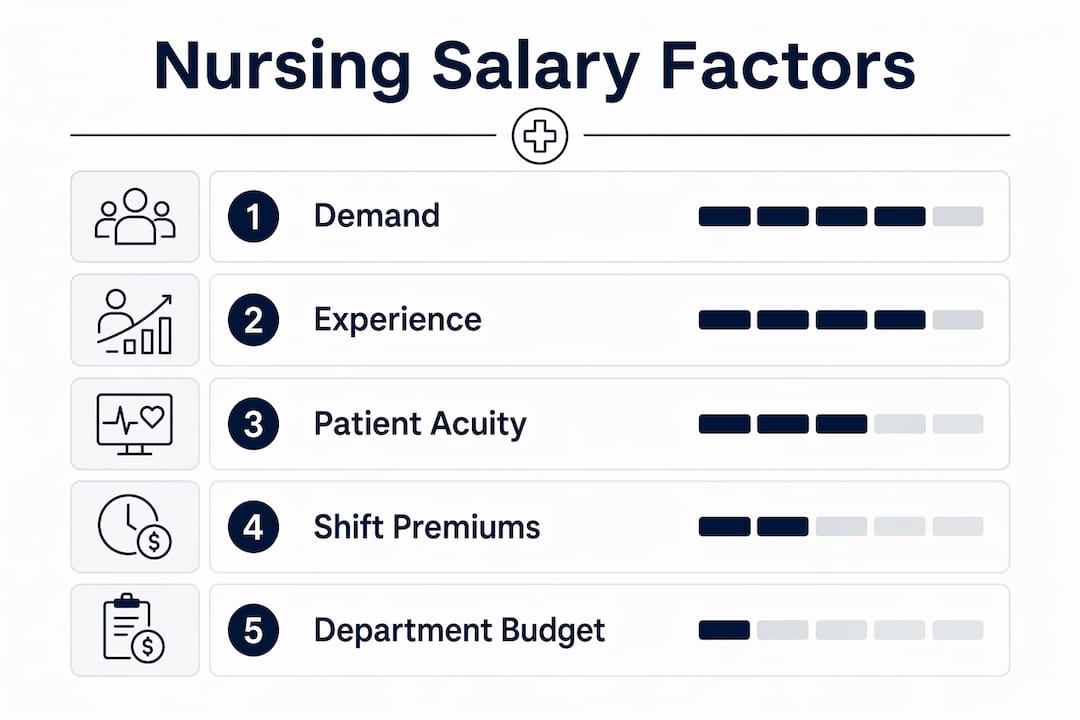
Nursing salary differences across departments come down to a handful of concrete forces: specialty demand, patient acuity, clinical complexity, and how each department is funded. A nurse in a surgical ICU and a nurse in an outpatient clinic may hold the same RN license, yet their paychecks can differ by $13,110 or more annually, based on 2024 averages for hospital surgical nurses ($94,110) versus ambulatory/clinic RNs ($81,000). That gap is not random. It reflects deliberate decisions made at the institutional, market, and policy levels.
The core reasons nursing salaries differ by department include:
- Specialty demand and nursing shortages driving premiums in critical care, psychiatric, and acute care units
- Patient acuity and clinical risk requiring higher skill thresholds in departments like the ICU, ED, and OR
- Certifications and advanced roles such as CCRN or CRNA credentials that command measurable pay increases
- Departmental budgets and funding sources that determine how much a unit can offer in base pay
- Shift differentials for nights, weekends, and holidays that inflate total compensation in high-acuity units
- Geographic location and practice setting creating wide variation even within the same specialty
- Union presence and collective bargaining protecting pay floors in some departments but not others
- Years of experience and education level adding structured increments on top of base specialty pay
Understanding these factors gives you a clear picture of where pay comes from and, more practically, where you have room to negotiate.
How much do nurses earn by specialty in 2026?
Salary differences across nursing specialties are wide enough to reshape a career decision. At the top of the pay scale, Certified Registered Nurse Anesthetists (CRNAs) earn approximately $214,000–$223,210 annually, reflecting the advanced practice scope, independent clinical judgment, and liability that come with anesthesia administration. At the other end, nurses in general medical-surgical units typically earn between $68,000 and $90,000, a range that reflects lower acuity and broader staffing availability.
Specialty certifications add a measurable premium on top of base pay, with varying increments depending on the certification and department. Broader education upgrades also contribute meaningful salary increases.
| Nursing Specialty | Typical Annual Salary Range | Notes |
|---|---|---|
| CRNA (Nurse Anesthetist) | $214,000–$223,210 | Advanced practice; highest-paid RN role |
| ICU / Critical Care RN | — | CCRN certification adds a measurable premium |
| Emergency Department RN | — | High acuity; frequent shift differentials |
| Surgical / Perioperative RN | ~$94,110 average | Hospital setting; OR complexity premium |
| Labor and Delivery RN | — | Specialty demand drives pay above med-surg |
| Psychiatric / Mental Health RN | — | Shortage-driven premiums in many markets |
| Medical-Surgical RN | $68,000–$90,000 | Baseline for most bedside RN comparisons |
| Ambulatory / Clinic RN | ~$81,000 average | Lower acuity; fewer shift differentials |
Key specialty highlights worth knowing:
- CRNAs sit at the top of the RN pay scale by a wide margin, reflecting their doctoral-level training and independent practice authority.
- ICU and ED nurses benefit from both acuity-based base pay and consistent access to night and weekend differentials.
- Surgical nurses in hospitals earn an average of about $94,110, compared to roughly $81,000 for nurses in ambulatory care settings.
- Psychiatric mental health nursing pays above the national median in many markets due to persistent staffing shortages.
- Med-surg remains the entry point for most new graduates and sets the baseline against which specialty premiums are measured.
The salary table above reflects general market ranges. Your actual pay will shift based on state, employer type, union status, and the additional factors covered below.
What factors actually drive nursing salary differences across departments?
Experience and education level
Years of experience and formal education create structured pay increments that compound over a career. A nurse with ten years in a specialty unit earns meaningfully more than a new graduate in the same department, not just because of tenure but because experienced nurses require less supervision, handle higher-acuity assignments, and often precept new staff. Education amplifies this: the $20,000–$40,000 premium tied to an MSN reflects both expanded scope and the administrative or advanced practice roles that degree unlocks.

Shift differentials, overtime, and holiday pay
Shift differentials are one of the most underestimated factors in total nursing compensation. Night shifts add 15%–25% to base pay, weekends add 10%–20%, and holiday pay can double the hourly rate. A nurse working nights and weekends in the same role as a day-shift colleague may take home 25%–40% more annually. High-acuity departments like the ICU and ED run 24/7 with full staffing needs, so their nurses access these differentials far more consistently than nurses in outpatient or clinic settings.
Patient acuity and clinical risk
Departments with higher patient acuity pay more because the clinical stakes are higher. ICU nurses manage ventilators, vasopressors, and continuous hemodynamic monitoring. OR nurses work in sterile fields with direct surgical responsibility. These environments demand specialized competency, and hospitals price that accordingly. The inverse is also true: a clinic nurse managing routine follow-up visits operates in a lower-risk environment, and base pay reflects that reduced complexity.

Departmental budgets and funding sources
Not every department has equal access to compensation dollars. Revenue-generating units like the OR, cardiac cath lab, and labor and delivery typically operate with larger budgets than cost centers such as psychiatric units or long-term care floors. When a department generates more billable procedures, it tends to retain more budget flexibility for competitive salaries and retention bonuses. This structural reality means two nurses with identical credentials can earn different base pay simply because of which unit they work in.
Union presence and collective bargaining
Union contracts set pay floors, step increases, and differential structures that protect nurses from arbitrary wage decisions. In unionized hospitals, a med-surg nurse's pay is governed by a negotiated scale that advances predictably with tenure. Non-union environments leave more room for individual negotiation but also more room for pay compression and inconsistency. The presence or absence of a union in a given department or facility is one of the clearest predictors of whether nurses in that unit earn at or above market rate.
Geographic location and practice setting
Location creates some of the widest salary gaps in nursing. The average RN salary nationally sits at $86,000, but California nurses average $133,000 while Mississippi nurses average $63,000. That $70,000 spread reflects cost of living, state-level staffing regulations, and local market competition. Government-employed nurses earn roughly 16% more than peers in comparable private-sector roles, adding another layer of setting-based variation on top of specialty and geography.
Pro Tip: When evaluating a job offer, calculate total compensation rather than base salary alone. Add shift differentials, overtime potential, and any certification pay to get an accurate comparison across departments and employers.
How do demand, job growth, and leadership roles shape nursing pay?
Nursing shortages are not uniform across specialties, and that unevenness drives some of the sharpest pay premiums in the field. Psychiatric mental health and acute care nursing face persistent staffing gaps, pushing salaries and sign-on bonuses above what the base market would otherwise support. When a hospital cannot fill a unit, it raises pay. That simple supply-and-demand dynamic explains why some departments consistently outpace others even when the clinical complexity is comparable.
Fastest-growing and highest-demand areas in nursing include:
- Psychiatric and mental health nursing, where workforce shortages have been documented for years and show no sign of closing
- Critical care and ICU nursing, driven by aging patient populations and the complexity of chronic disease management
- Perioperative and surgical nursing, where OR backlogs and procedure volume keep demand elevated
- Geriatric and long-term care nursing, reflecting demographic trends as the U.S. population ages
- Home health and community nursing, growing as care shifts away from inpatient settings
Leadership roles represent a separate pay tier entirely. A Chief Nursing Officer (CNO) often commands a salary exceeding $240,000, reflecting enterprise-level responsibilities that go well beyond clinical care. CNOs oversee multi-site operations, manage large budgets, and set staffing policy across entire health systems. Nurse managers and directors sit below that ceiling but still earn premiums tied to the number of units they supervise and the complexity of their administrative scope. For nurses considering a leadership career path, the pay jump from bedside to management is real and substantial, though it comes with a different set of demands.
The relationship between demand and pay also plays out in travel nursing. Specialties with the most acute shortages generate the highest travel contracts, sometimes paying two to three times what a staff nurse earns in the same unit. That premium is temporary and tied to the assignment, but it illustrates how market forces translate directly into compensation when institutional need is high enough.
What salary transparency means for nurses negotiating their pay
Pay transparency is reshaping how nurses understand and advocate for their compensation. No federal mandate currently exists requiring employers to post salary ranges, but many states have enacted their own laws requiring employers to disclose pay bands. The result is a patchwork system where a nurse in Colorado or California may have access to posted salary ranges while a colleague in a state without transparency laws negotiates blind.
Transparency matters because it closes the information gap that has historically allowed wage disparities to persist. When salary ranges are posted, nurses can identify whether they are being paid below the midpoint for their role, whether their department pays less than comparable units at competing hospitals, and whether their specialty commands a premium they have not yet captured. Without that data, most nurses negotiate from a position of incomplete information.
Key ways pay transparency and verified salary data support better compensation:
- Nurses can benchmark their current pay against verified market rates by specialty, setting, and state
- Posted salary ranges reduce disparities tied to negotiation confidence rather than clinical value
- Access to real compensation data helps nurses identify whether a pay gap reflects market reality or employer practice
- Transparency laws, where they exist, give nurses legal standing to request salary range information before accepting an offer
HighPaidRN's salary database addresses this gap directly. The platform aggregates anonymously submitted compensation data from RNs across specialties and states, then segments it by specialty, hospital type, and employment condition. That means you can see what ICU nurses at teaching hospitals in your state actually earn, not just a national average that smooths over the variation that matters most. For nurses who want to identify a pay gap or prepare for a salary negotiation, that level of specificity is what makes the difference between a general estimate and a defensible number.
The benefits of salary transparency extend beyond individual negotiation. When nurses collectively share compensation data, the entire profession gains a clearer picture of where pay is fair and where it falls short. HighPaidRN's model is built on exactly that principle: the more nurses contribute their data, the more accurate and useful the benchmarks become for everyone.

HighPaidRN gives you verified, specialty-specific salary data so you can negotiate from a position of knowledge. Search your specialty and state to see what nurses in your role actually earn.
Key Takeaways
Nursing salary varies by department because specialty demand, patient acuity, shift structure, departmental funding, and geographic location each apply distinct and compounding pressure on what any given unit can and will pay.
| Point | Details |
|---|---|
| Specialty and acuity drive the largest gaps | CRNAs earn $214,000–$223,210 annually; med-surg nurses typically earn $68,000–$90,000. |
| Shift differentials add 25%–40% to total pay | Night shifts add 15%–25% and weekends add 10%–20% for nurses working those hours consistently. |
| Education and certifications pay measurably | An MSN adds $20,000–$40,000; specialty certifications add $2,000–$8,000 on top of base salary. |
| Location creates a $70,000 salary spread | California RNs average $133,000; Mississippi RNs average $63,000 against a $86,000 national average. |
| Transparency tools close the negotiation gap | Verified salary data by specialty and state lets nurses benchmark pay and negotiate with real numbers. |