

Collective salary sharing empowers nurses by converting private pay data into defensible market leverage that improves negotiation outcomes and exposes pay inequities across specialties and states. Here is what the evidence shows:
- Negotiation leverage: Knowing the median RN wage of $93,600 nationally, and how far your local market deviates from it, gives you a specific, sourced number to anchor any salary conversation.
- Pay-equity pressure: Organizations that embrace transparency see a 20% reduction in pay disparities, according to Korn Ferry.
- Workplace trust: Open salary discussions reduce the secrecy that breeds suspicion and disengagement among nursing teams.
HighPaidRN is a vetted, nurse-focused platform that supports anonymous, verified salary sharing with filters by state, specialty, and hospital type.
Table of Contents
- Why collective salary sharing benefits nurses right now
- What experts and research say about salary transparency
- How collective salary sharing actually works
- What U.S. law says about discussing your salary
- How to share salary data safely and anonymously
- How to turn salary data into a negotiation win
- How to measure whether collective salary sharing is working
- How HighPaidRN supports safe, verified salary sharing
- Key Takeaways
- The case for acting on salary data, not just collecting it
- HighPaidRN gives you verified data to negotiate with confidence
- Useful sources and further reading
Why collective salary sharing benefits nurses right now
The stakes are concrete. RN wages vary by tens of thousands of dollars depending on state and specialty, meaning two nurses with identical credentials and experience can earn dramatically different amounts based purely on geography or employer type.
| Data Point | Figure | Source |
|---|---|---|
| National median RN wage | $93,600 | BLS via Empowered Nurses |
| Pay-disparity reduction with transparency | A significant reduction | Korn Ferry |
| NLRA private-sector pay-discussion protection | Since 1935 | New York Times |
Stat to know: Korn Ferry reports that organizations embracing pay transparency see a 20% reduction in pay disparities — a measurable shift, not a theoretical one.
The trust argument is equally practical. When nurses can verify that a colleague in the same unit, with the same shift differential, earns significantly more, that information moves from rumor to evidence. Salary equity for nurses depends on data, not assumptions.
Pro Tip: When reviewing aggregated salary data, always filter by state and specialty first. National medians mask regional variance that can exceed $30,000 annually, making them nearly useless for a single-employer negotiation.

What experts and research say about salary transparency
HR consultant Wendy Sellers argues that salary transparency prevents discrimination by forcing employers to justify pay differences using objective criteria. Without that pressure, subjective factors fill the gap, and those factors rarely favor nurses who do not negotiate.
Lorie A. Brown, R.N., M.N., J.D., frames the issue differently but arrives at the same conclusion: salary is a signal of how a healthcare system values nurses. When nurses share pay data, they shift power toward market-informed, professional equity rather than leaving compensation to institutional discretion.
Korn Ferry's research reinforces both positions. Their guidance recommends that organizations disclose pay ranges and compensation frameworks internally and publicly to enable accountability. When employers do not do this voluntarily, collective nurse salary data fills the gap.
| Expert / Source | Core Claim |
|---|---|
| Wendy Sellers, HR consultant | Transparency forces objective justification of pay differences |
| Lorie A. Brown, R.N., M.N., J.D. | Salary signals systemic value; shared data shifts power |
| Korn Ferry | Disclosed pay ranges reduce disparities and build trust |
How collective salary sharing actually works
Three formats dominate in practice, each with different risk profiles and data quality.
- Anonymous crowdsourced databases collect individual submissions, strip identifiers, and aggregate entries by role, state, specialty, and employer type. Platforms verify entries against pay stubs or W-2 data before including them.
- Unit-level surveys gather data within a single department or hospital, often organized by a charge nurse or union rep. Responses are pooled and reported as ranges, never individual figures.
- Shared spreadsheets with redaction work for small groups but carry higher re-identification risk. Remove name, hire date, and any combination of filters that could narrow to one person.
The data fields that matter most for negotiation are: hourly base rate, total compensation (including differentials), shift type, employer type (hospital, outpatient, agency), state, specialty, and FTE status. Each field adds a filter that makes the aggregate more comparable to your own situation.
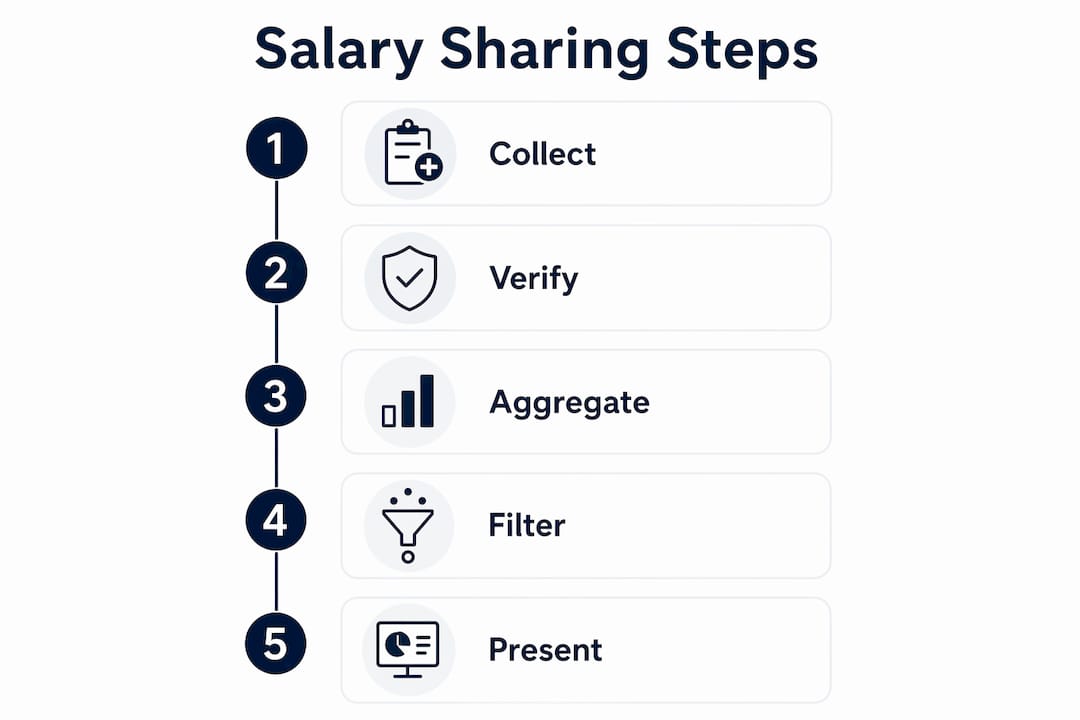
The process flow is straightforward: collect → verify → aggregate → filter → present. Verification is the step most nurses skip, and it is the one that determines whether an employer takes the data seriously.
Pro Tip: Ask any platform you use how they verify entries and how long they retain raw submissions. A platform that cannot answer both questions clearly is not one you should trust with your pay data.
What U.S. law says about discussing your salary
Federal law protects most private-sector nurses' right to discuss pay. The National Labor Relations Act, in place since 1935, covers most private-sector employees and prohibits employers from retaliating against workers who discuss wages with colleagues.
That protection has real limits. Managers and supervisors are generally excluded. Public-sector nurses operate under state law, which varies. And legal protection does not prevent informal retaliation: social pressure, exclusion from desirable assignments, or a chilly performance review.
Know the signals: If a manager asks you to stop discussing pay, that request may itself violate the NLRA. Document it in writing immediately.
Common escalation signals that mean you should consult a union rep or employment attorney before continuing:
- A written warning citing salary discussions as the cause
- Sudden schedule changes or assignment shifts following a pay conversation
- A formal HR meeting framed around "confidentiality" of compensation
- Any threat, explicit or implied, tied to your participation in a salary survey
Pro Tip: Keep all salary-related communications in writing. If a conversation happens verbally, follow up with a brief email summarizing what was said. That paper trail matters if you ever need to file a complaint.
This article provides general information, not legal advice. Confirm your specific rights with an employment attorney or your union representative.
How to share salary data safely and anonymously
Follow these steps before submitting data to any platform or group survey.
- Collect the right fields. Gather your base hourly rate, total annual compensation, shift differentials, specialty, employer type, state, and FTE percentage.
- Remove all direct identifiers. Strip your name, employee ID, hire date, and unit name from any document you share.
- Use ranges, not exact figures, in small groups. If fewer than 10 nurses are contributing, report in $5,000 bands rather than exact salaries to prevent re-identification.
- Check metadata before uploading. PDFs and photos of pay stubs can embed your name and device information. Use a metadata-removal tool or photograph only the relevant fields.
- Submit through a verified platform. Platforms with documented verification methodology and clear data-retention policies offer meaningfully stronger privacy than a shared Google Sheet.
- Confirm the minimum sample size. Aggregates based on fewer than 10 entries are statistically weak and easier to reverse-engineer. Ask the platform what their threshold is.
Pro Tip: Before contributing, read the platform's privacy policy specifically for language about data retention and third-party sharing. "We do not sell your data" and "we retain anonymized submissions indefinitely" are two very different statements.
How to turn salary data into a negotiation win
An evidence packet is the difference between a salary request and a salary argument. Build yours to include:
- Aggregate median and range for your role, state, and specialty
- Sample size and date range of the underlying data
- A one-paragraph methodology summary (how entries were collected and verified)
- Your current compensation versus the market median
For a 1:1 conversation with a manager, the framing is direct: "Based on verified, anonymized data from [X] RNs in [state] with my specialty and experience level, the market median is [figure]. My current rate is [figure]. I'd like to discuss closing that gap." Detailed negotiation scripts tailored to nursing roles can help you prepare for common pushback.
For group or team-level bargaining, present the aggregate data in a written brief to HR or nursing leadership. Attach the methodology summary. Request a formal response within 30 days.
Escalation path:
- Informed 1:1 conversation with direct manager
- Written request to HR with evidence packet attached
- Formal HR meeting with union rep present if available
- Group petition signed by multiple nurses citing the same data
- Union grievance or external complaint if retaliation occurs
How to measure whether collective salary sharing is working
Define success before you start, or you will not know when you have achieved it.
| Metric | What to Track |
|---|---|
| Sample size by filter | Number of verified entries per state/specialty/employer type |
| Median shift | Change in offer or raise amounts before and after data sharing |
| Negotiations initiated | Number of nurses who used the data in a formal salary conversation |
| Policy changes | Employer posting of pay ranges or adjustment of pay bands |
A practical pilot runs over 90 days: spend the first 30 days collecting and verifying entries, the next 30 days using the data in negotiations, and the final 30 days documenting outcomes. Follow up at the 3-month and 6-month marks to see whether offer amounts or posted ranges have shifted. Report aggregate outcomes back to contributors — how many negotiations were initiated, what the median outcome was — without identifying any individual.
How HighPaidRN supports safe, verified salary sharing
HighPaidRN is built specifically for U.S. registered nurses and addresses the privacy and verification gaps that make informal sharing risky. The platform's nurse salary transparency tools include:
- Anonymous data submission with identifier removal built into the intake process
- Filters by state, specialty, hospital type, and employment condition so your evidence packet reflects your actual market
- Verified entries checked against documented pay data before inclusion in aggregates
- Exportable evidence packets formatted for use in salary conversations with managers or HR
To build a negotiation-ready aggregate, filter by your state, specialty, and employer type, then check the sample size before drawing conclusions. If the filtered result returns fewer than 10 entries, broaden one filter (employer type, for example) and note the adjustment in your methodology summary.
Pro Tip: When you export an evidence packet from HighPaidRN, record the date, filter settings, and sample size in a separate document. Employers sometimes ask follow-up questions weeks later, and having that context on hand keeps your argument credible.
Key Takeaways
Collective salary sharing works because anonymized, verified data gives nurses a specific, defensible market figure that shifts the negotiation from a personal request to an evidence-based conversation.
| Point | Details |
|---|---|
| Legal protection is real but limited | The NLRA protects most private-sector nurses' right to discuss pay, but managers and public-sector nurses have different coverage. |
| Filters determine data quality | Always filter by state, specialty, and employer type before using aggregated data in a negotiation. |
| Evidence packets close the gap | A methodology summary, sample size, and dated aggregate turn salary data into a credible negotiation tool. |
| Measure outcomes to scale | Track median shifts, negotiations initiated, and policy changes at 3 and 6 months to know whether the effort is working. |
| HighPaidRN as your starting point | HighPaidRN offers anonymous submission, verified aggregates, and exportable evidence packets filtered for your specific role and market. |
The case for acting on salary data, not just collecting it
The most common mistake nurses make with salary data is treating it as interesting rather than useful. Collecting figures, comparing them privately, and then walking into a performance review with nothing written down is the same as not collecting them at all.
What actually shifts outcomes is the combination of verified data, a clear methodology, and a formal written request. Employers respond differently to a nurse who says "I'd like a raise" versus one who presents a dated, filtered aggregate from a documented source and asks for a specific adjustment. The second conversation is harder to dismiss and easier to escalate if the response is inadequate.
The fear of retaliation is legitimate, and anonymized platforms exist precisely to address it. But anonymity alone is not enough. The data has to be credible, the sample size has to be defensible, and the nurse using it has to be willing to follow through. Salary equity for nurses does not happen because data exists. It happens because nurses use it.
HighPaidRN gives you verified data to negotiate with confidence
Nurses who want to act on the practices described in this guide have a direct starting point. HighPaidRN is a privacy-first salary database built exclusively for U.S. registered nurses, offering verified, anonymous compensation data filtered by state, specialty, hospital type, and employment condition.
Unlike informal spreadsheets or general salary sites, HighPaidRN verifies entries before including them in aggregates, which means the figures you present to an employer can withstand scrutiny. The platform's exportable evidence packets are formatted for real negotiation conversations, not just personal reference.
- Anonymous submission with no identifiable fields retained
- Filters for state, specialty, hospital type, and FTE status
- Verified entries with documented methodology
- Evidence packets ready to present in salary meetings
Visit HighPaidRN to contribute your anonymous salary data or pull a filtered aggregate for your next negotiation. One entry from you strengthens the database for every nurse who comes after you.
Useful sources and further reading
- The Nursing Salary Divide | Empowered Nurses — BLS wage data and regional variance analysis; foundational for understanding why state and specialty filters matter.
- Pay Transparency in the Workplace | Korn Ferry — HR research on the 20% disparity reduction and recommendations for disclosing pay frameworks.
- The Benefits of Sharing Your Salary | New York Times — NLRA legal protections and the history of employer wage suppression tactics.
- Should You Discuss Your Salary at Work? | The Muse — Wendy Sellers on transparency preventing discrimination; practical workplace guidance.
- Four Benefits of Sharing the Salary | National AfterSchool Association — Organizational evidence that transparency prompts policy adjustments and improved pay practices.
- 5 Benefits of Sharing Your Salary | aSweatLife — Peer-salary knowledge as the foundation of informed self-advocacy and negotiation.
- Nursing Compensation Research Guide | HighPaidRN Blog — Verification best practices, sample-size thresholds, and documentation standards for credible aggregated data.
- Benefits of Nursing Salary Transparency | HighPaidRN Blog — Nurse-focused overview of how transparency supports pay equity and bargaining power.
- Salary Negotiation for Nurses | HighPaidRN Blog — Scripts and step-by-step negotiation planning tailored to nursing career stages.