

Yes, performance reviews affect nurse raises in the U.S., but merit ratings are rarely the only factor. Pay bands, merit pool budgets, union contracts, and market adjustments all shape how much of a raise you actually see. Understanding how performance review affects nurse raises means knowing which of those forces are in play at your facility — and how to position yourself before the conversation happens.
Nurse raises typically fall within a moderate annual range, though circumstances can push the increase higher or lower in some cases. A strong performance rating can move you toward the top of your merit band, but it cannot override a frozen budget or a step-scale ceiling. The fastest practical action you can take right now is to build a one-page "brag sheet" before your next review.
Start here:
- Pull your current salary benchmarks from HighPaidRN and note your state, specialty, and employer type.
- Write down three to five measurable wins from the past 12 months — patient satisfaction scores, error-avoidance examples, committee work, certifications earned.
- Schedule a brief pre-review conversation with your manager to align on expectations before the formal meeting.
Table of Contents
- How do employers actually connect performance reviews to pay?
- What do managers actually score on a nursing performance review?
- What raise amounts should nurses realistically expect?
- How can you improve your evaluation and pay outcome?
- What should you do when a strong review produces a small raise?
- When do reviews happen and when do raises take effect?
- How to use salary data to strengthen your pay request
- Exact phrases and questions to use in a pay or review meeting
- Key Takeaways
- What nurses often get wrong about performance reviews and pay
- HighPaidRN gives you the salary data to make your case
- Useful sources and further reading
How do employers actually connect performance reviews to pay?
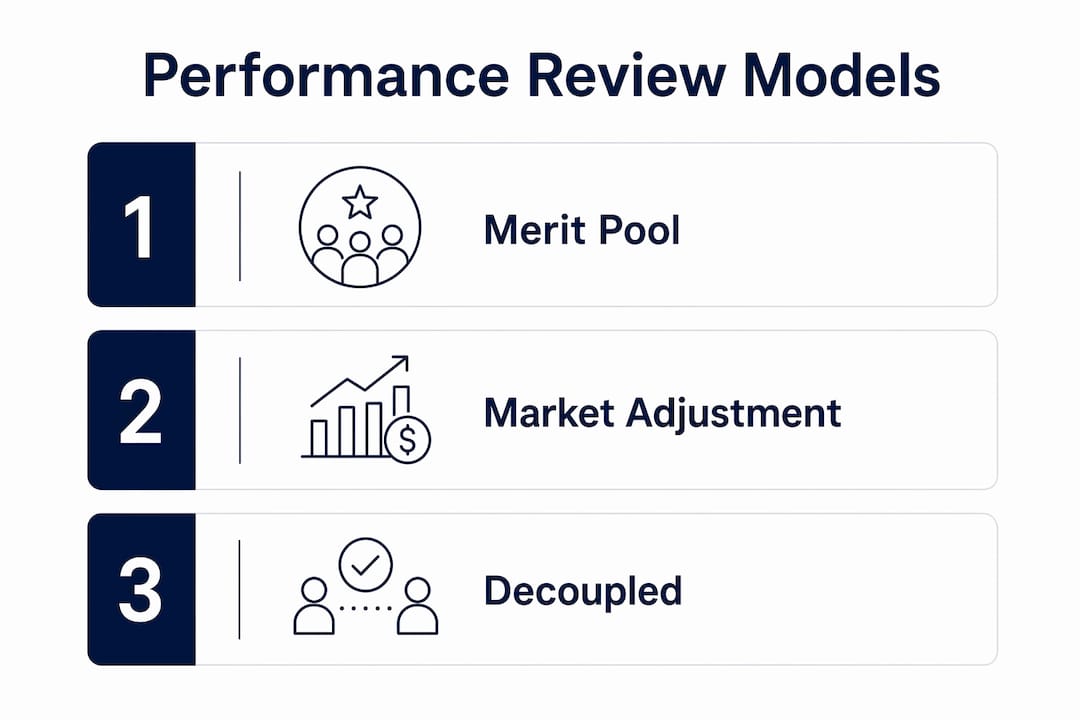
Most U.S. hospitals use one of three models to link performance ratings to compensation decisions, and knowing which one your employer uses changes your strategy entirely.

The merit pool model is the most common. HR sets a fixed budget, often expressed as a percentage of total payroll, and distributes it based on ratings. A "meets expectations" rating might earn 2%–4%, while "exceeds expectations" can reach toward the top end of that range; exact percentages vary by facility and year. The pool is finite, so every high rating competes with every other high rating across the unit.
The market-adjustment model separates merit from market positioning. Here, HR benchmarks your role against external salary data and adjusts pay to keep you within a target range, regardless of your rating. Your review still matters for promotion eligibility and bonus calculations, but your base pay adjustment is driven by where you fall in the market band.
The decoupled model stages the two conversations entirely. HR experts recommend separating pay discussions from performance reviews because combining them shifts nurses' focus away from developmental feedback and toward the dollar figure. If your facility uses this model, the review meeting is about growth, and a separate compensation conversation follows weeks later.
Pay bands and union contracts add another layer. Many hospital systems set salary ranges for each nursing role, and once you reach the top of your band, merit increases stop until a reclassification or promotion occurs. Union-negotiated step increases follow a fixed schedule and are not tied to individual ratings at all. Differences across hospital types and pay structures explain why two RNs with identical ratings can receive very different raises.
Signals that tell you which model your employer uses:
- Your offer letter or employee handbook references a "merit pool" or "compensation budget."
- HR sends a separate meeting invite for a "compensation review" after your performance meeting.
- Your union contract specifies step increases by years of service rather than rating.
- Your manager says raises are "pending HR approval" after the review.
Pro Tip: Ask your manager or HR business partner directly: "Is our merit pool a fixed percentage of payroll, and does my rating determine where I fall within that pool?" Most HR teams will answer this question plainly, and the answer tells you exactly how much leverage your rating carries.
What do managers actually score on a nursing performance review?
Performance appraisals in nursing typically evaluate seven to nine categories, but not all of them carry equal weight when merit dollars are allocated. Peer-reviewed research on nursing appraisal design recommends aligning evaluation criteria to measurable clinical outcomes and providing evaluator training to reduce bias — a standard many hospitals still fall short of.
The categories managers most commonly score:
- Clinical competence: Skill proficiency, adherence to evidence-based protocols, and safe medication administration.
- Patient-safety outcomes: Near-miss reporting, infection rates, fall prevention, and error documentation.
- Patient satisfaction: HCAHPS scores tied to your unit, direct patient feedback, and complaint resolution.
- Teamwork and communication: Handoff quality, interdisciplinary collaboration, and conflict resolution.
- Reliability and attendance: Unexcused absences, tardiness, and willingness to cover shifts.
- Policy adherence: Documentation accuracy, compliance with charting standards, and regulatory requirements.
- Certifications and continuing education: Specialty certifications (CCRN, CEN, PCCN), CE completions, and unit-based training.
- Leadership and committee work: Precepting new nurses, serving on shared governance committees, and quality improvement projects.
Of these, patient-safety outcomes, clinical competence, and patient satisfaction tend to carry the most weight in merit calculations because they connect directly to hospital reimbursement and regulatory scores. Certifications and committee work often tip a borderline rating from "meets" to "exceeds."
Measurable evidence you can collect throughout the year:
- Screenshot or print your unit's patient satisfaction reports when your name appears.
- Keep a running log of precepting hours with dates and orientee names.
- Save emails from charge nurses or physicians acknowledging your clinical decisions.
- Document every CE completion and certification renewal with dates.
Watch out for these common rating pitfalls: Unexcused absences are the single fastest way to drop a rating, even when clinical performance is strong. Persistent documentation errors — late charting, incomplete assessments — signal unreliability to managers reviewing a full year of records. A single documented teamwork incident can anchor an otherwise strong review if it was not addressed and resolved at the time.
When completing your self-evaluation, map each accomplishment directly to the rubric language your facility uses. If the rubric says "demonstrates evidence-based practice," write exactly that phrase and follow it with a specific example. Managers reviewing dozens of self-evaluations remember the ones that mirror the scoring criteria.

What raise amounts should nurses realistically expect?
Annual nurse raises commonly fall within a 2–4% range, with some hospitals offering lower or higher increases under specific circumstances. Cost-of-living adjustments, when offered, typically sit at the lower end of that range and are applied uniformly regardless of rating.
Factors that push a raise above the typical range:
- Specialty shortage: ICU, OR, and labor-and-delivery nurses in high-demand markets often receive larger merit pools or targeted retention bonuses.
- Added certifications: Earning a specialty certification mid-year can trigger a pay reclassification outside the annual merit cycle at some facilities.
- Promotion: Moving from staff RN to charge nurse or clinical nurse specialist typically produces a 5–15% base pay adjustment.
- Union-negotiated step increases: These follow a fixed schedule and can add 2–5% annually independent of merit ratings.
- Successful market-data negotiation: Presenting verified percentile data in a pay meeting has produced adjustments of several percentage points at facilities with flexible compensation policies.
The largest pay events for nurses rarely come from annual merit alone. Reclassification, lateral moves to higher-paying employers, and signing bonuses at competing facilities consistently produce larger increases than a single strong review cycle. Geographic pay variation also matters: a 3% raise in California carries a different dollar value than the same percentage in a lower-wage state, and market-adjustment thresholds differ by region.
Pro Tip: If your facility uses a merit pool, ask HR what percentage of payroll is allocated this cycle before your review. Knowing the pool size tells you whether a 4% raise is even mathematically possible for your unit.
How can you improve your evaluation and pay outcome?
The review cycle is a 12-month process, not a single meeting. Nurses who consistently earn the highest merit ratings treat documentation as an ongoing habit rather than a pre-review scramble.
Before the review
- Build a one-page brag sheet with four to six measurable outcomes: patient satisfaction data, error-avoidance examples, CE completions, committee contributions, and any leadership work.
- Pull salary benchmarks from HighPaidRN filtered by your state, specialty, and hospital type to understand where your current pay sits relative to the market.
- Review your facility's performance rubric and identify the two or three criteria where you have the strongest documented evidence.
- Schedule a 15-minute pre-review conversation with your manager to ask what they are looking for and whether there are any concerns you should address.
- Write your self-evaluation using the rubric's exact language, with a specific example for every criterion you claim to exceed.
SMART goal template for clinical goals
A SMART goal tied to a measurable metric gives your manager something concrete to reference at the next review. Example: "By [date], I will complete my CCRN certification and precept two new ICU nurses, as documented in the unit's preceptor log." Specific, measurable, achievable, relevant, and time-bound goals are far easier for a manager to score as "exceeds expectations" than vague commitments.
During the review
- Open by summarizing your top two or three accomplishments before your manager sets the tone.
- Ask clarifying questions: "How is this criterion weighted in the merit calculation?" and "What would exceeding this standard look like next year?"
- If a rating surprises you, ask for a specific example rather than accepting it silently.
- Confirm any agreements in writing by following up with a brief email summary after the meeting.
After the review
- Request a written development plan with clear milestones if one is not offered.
- Schedule quarterly check-ins to document incremental wins before the next annual cycle.
- Track every goal completion with a date stamp so the evidence is ready 12 months from now.
Pro Tip: Time your certification completions to land two to three months before your review date. Managers writing evaluations in real time are more likely to score certifications as "current and relevant" when they are fresh, and some facilities trigger an off-cycle pay review when a new specialty credential is added.
Practical guidance on salary negotiation tactics can help you translate a strong evaluation into a concrete pay request once the review is complete.
What should you do when a strong review produces a small raise?
A mismatch between a high rating and a low raise is more common than most nurses expect, and it usually has a structural explanation rather than a personal one.
Common reasons for a weak raise despite a strong review:
- The merit pool was frozen or reduced due to budget constraints.
- Your base pay is already at or near the top of your pay band.
- HR timing delayed the effective date to the next fiscal quarter.
- Your facility uses a step scale that caps annual increases regardless of rating.
- A market-adjustment review was not triggered because your pay already falls within the target range.
Immediate steps when the raise does not match the review:
- Request a dedicated pay discussion meeting, separate from the performance conversation, within two weeks of receiving your raise notice.
- Bring your benchmarking data: state, specialty, median pay, and 75th percentile from a verified source.
- Ask directly: "How is my raise calculated, and what would need to change for me to receive a larger increase?"
- Ask when the next opportunity for a pay review occurs — some facilities allow off-cycle adjustments for market equity.
Sample language for requesting a market adjustment:
"Based on verified salary data for [specialty] RNs in [state], my current base pay is below the median for my experience level and employer type. I'd like to discuss a market-adjustment review to bring my compensation in line with current benchmarks."
If HR declines, ask for the specific policy that governs market adjustments and whether a reclassification or promotion pathway is available. Document every conversation with a follow-up email.
Escalation steps: If the process seems inequitable — for example, if colleagues with lower ratings received comparable raises — you have the right to ask HR for a written explanation of how merit increases were calculated. Union members can file a grievance through their contract's dispute resolution process. When internal options are exhausted, an external market move often produces the largest pay increase available, particularly in high-demand specialties. Asking for a higher nurse salary requires a different approach when the conversation moves outside the annual merit cycle.
When do reviews happen and when do raises take effect?
Most U.S. hospitals run annual performance reviews on one of two schedules: a universal fiscal-year cycle (often October through January) or an anniversary-date cycle tied to each nurse's hire date. Knowing which your facility uses determines when you need to start preparing.
Typical timeline checkpoints:
- 90 days before review: Begin collecting measurable evidence, updating your brag sheet, and scheduling a pre-review conversation with your manager.
- 30 days before review: Submit your self-evaluation, confirm the rubric criteria, and pull current salary benchmarks.
- Review meeting: Present accomplishments, ask about weighting and calculation, and document any agreements in writing.
- 2–4 weeks post-review: HR and the compensation committee finalize merit decisions; raises are approved or held pending budget sign-off.
- 4–8 weeks post-review: Raise becomes effective, often on the first pay period of the new fiscal quarter or the nurse's anniversary date.
- Paycheck change: Confirm the effective date in writing; discrepancies between the approved raise and the paycheck amount should be reported to HR immediately.
Probationary reviews, typically at 90 days for new hires, can affect pay if the initial offer was contingent on performance. Mid-cycle evaluations at six months are less common but do occur at facilities with continuous performance management models, and they can trigger an early merit adjustment at some hospitals.
HR questions to confirm your timeline:
- "What is the effective date for merit increases approved in this review cycle?"
- "Is our facility on a fiscal-year or anniversary-date review schedule?"
- "Are mid-cycle pay adjustments available for certifications or reclassifications?"
- "When does the compensation committee meet to approve merit decisions?"
How to use salary data to strengthen your pay request
Verified salary data is the single most persuasive tool in a pay conversation. A manager or HR representative can dismiss a vague claim that you are "underpaid," but a one-page packet showing your current pay against the market median and 75th percentile for your specialty and state is much harder to set aside.
Fields to collect for your benchmarking packet:
- State and metro area
- Nursing specialty (ICU, ED, OR, med-surg, etc.)
- Years of experience
- Employer type (academic medical center, community hospital, for-profit system)
- Median hourly or annual pay
- 75th percentile pay
- Shift differentials (night, weekend)
- Source and date of the data
Sample data table format:
| State | Specialty | Median Pay | 75th Percentile | Source |
|---|---|---|---|---|
| California | ICU RN | [from HighPaidRN] | [from HighPaidRN] | HighPaidRN verified data |
| Texas | ED RN | [from HighPaidRN] | [from HighPaidRN] | HighPaidRN verified data |
| Florida | Med-Surg RN | [from HighPaidRN] | [from HighPaidRN] | HighPaidRN verified data |
When presenting this data in a meeting, cite the source explicitly: "This is from HighPaidRN's verified, anonymous salary database, filtered for my state, specialty, and hospital type." Specificity signals that you did your homework and that the numbers are not anecdotal.
HighPaidRN filters salary data by state, specialty, hospital type, and employment condition, and outputs median and percentile figures nurses can cite directly. Because the data is contributed anonymously by verified RNs, it reflects actual take-home compensation rather than posted ranges, which tend to skew lower. Nursing salary transparency research consistently shows that nurses who enter pay conversations with verified market data achieve better outcomes than those who rely on general estimates.
Keep your packet to one page. A concise, well-labeled table with your current pay, the market median, and the 75th percentile for your role is more persuasive than a lengthy report. Attach a second page only if you are requesting a reclassification and need to document the scope of your current responsibilities.
Exact phrases and questions to use in a pay or review meeting
Having the right language ready before a review or pay meeting reduces anxiety and keeps the conversation focused on facts rather than feelings.
Opening lines for a review meeting:
- "Before we go through the rubric, I'd like to share a few highlights from the past year that I think are relevant to each category."
- "I've prepared a brief summary of my measurable contributions this year. Can I walk you through it?"
Opening lines for a follow-up pay discussion:
- "I'd like to schedule a separate conversation specifically about my compensation. When would be a good time?"
- "I've done some benchmarking on current market rates for my specialty and experience level, and I'd like to share what I found."
Questions to ask your manager:
- "How is each criterion weighted in the merit calculation?"
- "What rating would I need to receive the maximum merit increase available?"
- "When is the next opportunity for a pay review outside the annual cycle?"
- "Is there a reclassification pathway for nurses who have taken on additional responsibilities?"
Objection-handling when HR says "no budget":
-
Manager: "The merit pool is very limited this year." Nurse: "I understand. Can you tell me when the next budget cycle opens and what I would need to document between now and then to be positioned for a larger increase?"
-
Manager: "Your pay is within the band for your role." Nurse: "I appreciate that. My benchmarking shows my pay is below the median for my specialty and state. Is there a market-equity review process I can request?"
-
Manager: "We can't make exceptions to the pay scale." Nurse: "I'm not asking for an exception — I'm asking whether a reclassification or title change might better reflect the scope of work I'm currently doing."
These responses keep the conversation professional and forward-looking. They also create a paper trail: follow every meeting with a brief email summarizing what was discussed and what the next step is.
Key Takeaways
Performance reviews matter for nurse raises, but pay bands, merit pool budgets, and union contracts usually set the ceiling — your rating determines where you land within that ceiling, not whether the ceiling moves.
| Point | Details |
|---|---|
| Reviews set your position in the merit band | A strong rating earns the top of the available merit range, typically a 2–4% annual increase. |
| Budget constraints cap the raise size | Frozen pools, pay bands, and step scales often limit increases regardless of rating. |
| Brag sheet plus market data is the strongest move | Combining documented wins with verified salary benchmarks gives you concrete leverage. |
| Separate the pay conversation from the review | Request a dedicated compensation meeting to keep the focus on market data and career trajectory. |
| HighPaidRN provides verified benchmarking data | Filter by state, specialty, and hospital type to build a one-page packet you can cite in any pay meeting. |
What nurses often get wrong about performance reviews and pay
The conventional wisdom says "get a great review, get a great raise." That framing sets nurses up for frustration. A strong review is necessary but rarely sufficient. The real leverage points are structural: knowing your pay band ceiling, understanding whether your facility uses a merit pool or a market-adjustment model, and timing your certifications and conversations to the compensation calendar.
What most articles on this topic underemphasize is the value of the pre-review conversation. Waiting until the formal meeting to learn how your manager is scoring you is the equivalent of studying after the exam. A 15-minute check-in two months before your review, where you ask directly what "exceeds expectations" looks like in each category, gives you time to collect the right evidence and address any concerns before they become a rating.
The other underrated move is requesting a separate pay meeting rather than expecting the raise discussion to happen organically at the end of a performance review. Research on performance management supports this: when pay and performance are discussed simultaneously, both conversations suffer. Nurses who treat the review as a growth conversation and schedule a dedicated compensation meeting with market data in hand consistently report better outcomes.
Salary data changes this dynamic entirely. Walking into a pay meeting with a one-page packet showing your current pay against the verified median and 75th percentile for your specialty and state transforms the conversation from a request into a business case. Managers and HR representatives respond differently to data than to assertions.
HighPaidRN gives you the salary data to make your case
Knowing your market value is the foundation of every successful pay conversation. HighPaidRN's verified salary database lets you filter by state, specialty, hospital type, and employment condition to see exactly where your current pay stands relative to the median and 75th percentile for nurses in your role.
The data is contributed anonymously by verified RNs, which means it reflects actual compensation rather than posted ranges. You can pull a benchmarking snapshot in minutes and build the one-page packet described in this article. Every figure is filterable, percentile-ranked, and citable in a manager or HR meeting.
Search your specialty and state on HighPaidRN to see your current market position and build your negotiation packet today.
Useful sources and further reading
These sources support the claims in this article and can help you build a credible one-page benchmarking packet for your next pay conversation.
-
Designing the optimal annual performance review for nurses — Peer-reviewed guidance on structuring nursing appraisals to reduce bias and support development; useful for understanding what well-designed evaluations look like and how to align your self-evaluation to them.
-
The impact of performance assessments in enhancing employee productivity: A qualitative synthesis — A synthesis of 48 sources (2010–2024) finding that developmental, transparent appraisal systems increase motivation while punitive systems reduce engagement; supports the argument for requesting constructive, criteria-based feedback.
-
What works and doesn't in performance management (McKinsey) — Analysis of performance-management best practices emphasizing conversation quality over rating format; relevant when preparing for a pre-review discussion with your manager.
-
Separating pay increases from performance reviews (Tandem HR) — HR practitioner guidance on why staging pay and performance conversations produces better outcomes for both parties; use this to justify requesting a dedicated compensation meeting.
-
Impact of annual appraisal processes on nurses' job performance and satisfaction (Iranian Journal of Health Sciences) — Systematic review of 11 cross-sectional studies finding that structured appraisal processes with clear expectations and constructive feedback improve both performance and job satisfaction.
-
Nurses' views and attitudes of the performance appraisal process (PMC) — Peer-reviewed study on how nurses perceive appraisal systems; useful context for understanding the gap between how evaluations are designed and how they are experienced.
-
Nurse salary increases: current trends in hospitals — Practitioner-level overview of raise frequency and typical percentage ranges; use to set realistic expectations before your review.
-
HighPaidRN nursing compensation research guide — Methodology and best practices for compiling compensation research; a practical companion to the benchmarking packet guidance in this article.