

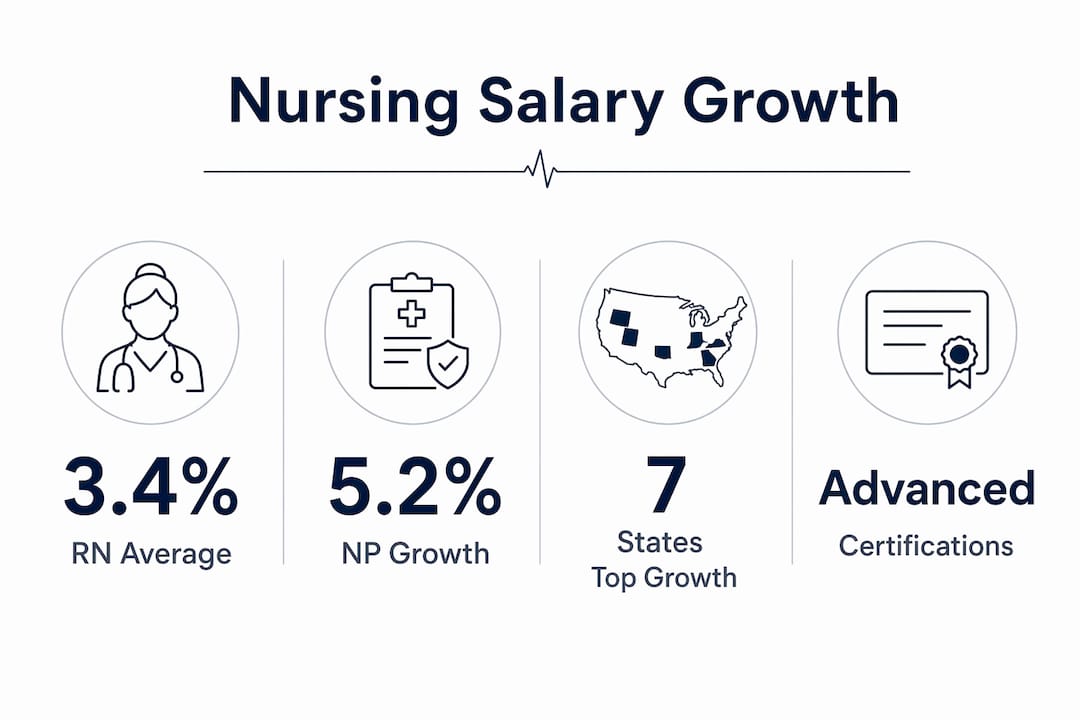
Nursing salary growth in the U.S. runs at roughly 3.4% annually for registered nurses, while nurse practitioners in high-demand states are seeing wage increases of up to 12.3% year over year. Those two numbers tell very different stories about where the profession is heading. The BLS reports a 2024 median RN wage of $93,600 per year, or $45.00 per hour, with the top 10% earning above $135,320. Understanding what drives the gap between average and top earners is exactly what separates nurses who negotiate confidently from those who accept whatever is offered.
Key figures at a glance:
- RN employment growth (2024–2034): 5% projected, faster than the average for all occupations
- Nurse Practitioner employment growth (2024–2034): 40% projected
- Median RN annual wage growth: approximately 3.4%
- NP wage growth ceiling: up to 12.3% in some states
- Median salaries by credential: LPNs/LVNs at $58,232, RNs at $85,000, APRNs at $130,000 per the 2026 Nurse Salary and Work-Life Report
Inflation has complicated the picture. When general price levels rise faster than wages, real purchasing power can stagnate even as nominal pay climbs. That dynamic makes tracking the nursing salary growth rate more than an academic exercise. It directly affects whether your paycheck actually goes further this year than it did last year.
Stat to know: The BLS projects 166,100 new RN jobs between 2024 and 2034, a pace that outstrips the 3% average growth rate across all U.S. occupations.
How have nursing salary growth rates trended historically and where are they headed?
Nursing wages have grown steadily over the past decade, but the pace has not been uniform. Periods of acute staffing shortages, most notably during and after the COVID-19 pandemic, pushed wages up sharply as hospitals competed for available nurses. That surge has moderated, but it reset baseline expectations across the profession.
| Metric | Historical Trend | Projected (2024–2034) |
|---|---|---|
| RN median annual wage | Gradual increase, accelerated recently | ~3.4% annual growth |
| NP median annual wage | Consistent above-average growth | Up to 12.3% in high-demand states |
| RN employment | Steady expansion | +5% (166,100 new jobs) |
| NP employment | Rapid expansion | +40% |
| LPN/LVN median salary | Slower growth than RN/NP | $58,232 median (2026 report) |
| APRN median salary | Strong growth tied to scope expansion | $130,000 median (2026 report) |
The BLS projects RN employment to grow 5% from 2024 to 2034, which is faster than the 3% average across all occupations. Advanced practice roles tell an even more compelling story: NP employment is on track to expand 40% over the same period, driven by primary care shortages and expanded prescriptive authority in most states.
Key figure: The BLS median RN salary of $93,600 in 2024 sits noticeably above the $85,000 median reported by broader nursing surveys. That gap reflects methodology differences, not a data error. BLS focuses on a narrower occupational definition, which tends to pull the median higher.
Inflation has been a persistent headwind. When consumer prices rise faster than nominal wages, real wage growth turns negative even when the dollar figure on a paycheck increases. Nurses who received a 3% raise in a year when inflation ran at 4% effectively took a pay cut in purchasing power terms. Tracking real wage growth, not just nominal increases, gives a more accurate picture of whether nursing compensation is actually keeping pace.
How does nursing salary growth vary by state and specialty?
State-level variation in nursing wage growth is wide enough to make geography one of the most consequential career decisions a nurse can make. West Virginia posted a 7.8% year-over-year RN wage increase in 2025, South Dakota recorded 6.8%, and Nebraska came in at 6.6%. All three exceed the national median of 3.4% by a meaningful margin, and none of them are states typically associated with the highest absolute nursing salaries.

That distinction matters: high growth rate and high absolute wage are not the same thing. A state with a lower baseline salary can still offer faster wage acceleration, which compounds favorably over a career. Cost of living also shapes the real value of those wages. A 7.8% raise in West Virginia carries different purchasing power than the same percentage increase in California or New York.
States and specialties with notable wage growth:
- West Virginia: 7.8% RN wage growth YoY, driven by rural healthcare demand
- South Dakota: 6.8% growth, reflecting persistent staffing shortages in the region
- Nebraska: 6.6% growth, tied to expanding health system infrastructure
- Nurse Practitioners (nationwide): up to 12.3% wage growth in high-demand states
- Home health and community care RNs: growth generally trails hospital-based peers
- ICU and critical care specialists: above-average wage growth due to acuity and skill requirements
- Certified Registered Nurse Anesthetists (CRNAs): among the highest absolute wages in nursing, with strong growth tied to surgical volume
Specialty choice shapes the trajectory of nursing income growth as much as geography does. Advanced practice roles, particularly NPs and CRNAs, consistently outpace staff RN wage growth because demand for their services is expanding faster than the supply of qualified practitioners. For nurses weighing a specialty transition, the wage growth differential between a staff RN role and an NP position can reach tens of thousands of dollars annually within a few years of completing additional training.
Regional economic conditions add another layer. States with strong union presence, active collective bargaining agreements, and nurse-to-patient ratio legislation tend to produce more consistent wage floors, which limits downside risk even if they sometimes cap upside growth. States without those structures can see sharper swings in both directions.
What factors drive nursing salary growth and wage trends?
Nursing salary growth does not happen in a vacuum. Several distinct forces push wages up or hold them flat, and understanding which ones apply to your situation gives you real leverage in a negotiation.
Primary factors affecting nursing wage growth:
- Specialty and acuity: Higher-acuity roles like ICU, NICU, and OR command premium pay and faster growth
- Geographic location: State labor markets, cost of living, and regional demand all shape local wage trajectories
- Employer type: Magnet-designated hospitals, large health systems, and government employers often pay differently than community hospitals or long-term care facilities
- Advanced degrees and certifications: BSN-to-MSN transitions, NP licensure, and specialty certifications like CCRN or CEN consistently produce measurable pay increases
- Supply and demand balance: Local nursing shortages accelerate wage growth; oversupply slows it
- Inflation: Nominal wage increases that trail inflation represent real pay cuts
- Collective bargaining: Union contracts and state-level bargaining agreements set wage floors and scheduled increases
Advanced certifications and NP roles tend to produce the largest single-step wage jumps. Advanced practice nurses see higher salary growth than staff RNs because their scope of practice is broader and the demand for their services is growing faster than training pipelines can supply. A nurse who moves from a staff RN position into a Family Nurse Practitioner role does not just earn more. The annual growth rate on that higher base also compounds more quickly.
Employer bargaining power shapes outcomes in ways that salary surveys rarely capture. A nurse working at a hospital with a strong union contract may receive automatic step increases tied to tenure, regardless of market conditions. A nurse at a non-union facility in the same city may need to negotiate every raise individually, which means the outcome depends heavily on preparation and market knowledge. Understanding supply and demand dynamics in your specific market is one of the most practical things you can do before entering any compensation conversation.

Pro Tip: Before your next review, research the wage growth rate in your state and specialty, not just the national average. If your state posted 6%+ growth last year and your raise was 2%, you have a data-backed case for a larger increase.
How HighPaidRN helps you act on nursing salary growth data
Knowing the national nursing salary growth rate is useful context. Knowing the growth rate for your specific specialty, in your state, at your type of employer, is what actually moves the needle in a negotiation. That level of segmentation is exactly what HighPaidRN provides through its verified salary database.
The platform lets nurses filter salary data by state, specialty, hospital type, and employment condition, so the benchmark you bring to a conversation reflects your actual market rather than a national average that may not apply to your situation. The BLS reports a median RN salary of $93,600 for 2024, while broader surveys report medians closer to $85,000. That $8,600 gap comes from methodology differences, and without understanding which figure applies to your role and region, you risk anchoring a negotiation on the wrong number.
Interpreting salary data accurately requires knowing where it comes from. BLS figures use a narrower occupational definition and tend to run higher. Broader nursing surveys capture a wider range of roles and settings, which pulls the median down. Neither is wrong. They measure slightly different things, and a nurse who understands that distinction can use both sources strategically.
Best practices for using salary growth data in real decisions:
- Filter by your specific state and specialty before drawing any conclusions from national figures
- Compare BLS data against survey-based sources to understand the range, not just a single number
- Track year-over-year changes in your specialty's median wage, not just the current snapshot
- Use employer-type filters to see whether hospital systems, government employers, or outpatient settings pay differently in your market
- Identify which specialties in your state are posting the fastest wage growth, then evaluate whether a transition makes sense for your career goals
- Bring printed or exported salary benchmarks to performance reviews as supporting evidence
Salary reports also vary because they capture different points in time and use different survey populations. A report published in early 2026 may reflect wages collected in mid-2025, while BLS data published the same year reflects may 2024 figures. Knowing the reference period of any data source prevents you from treating stale figures as current market rates.
Pro Tip: Use HighPaidRN's filters to pull salary data for your exact specialty and state before any negotiation or job change. Comparing that figure against the BLS median for the same role gives you a defensible range, not just a single number to argue from.
Nurses who are considering a move into higher-growth specialties can use career-level salary benchmarks to model what a transition would mean for their earnings trajectory over five or ten years. The difference between a staff RN salary growing at 3.4% annually and an NP salary growing at 10%+ compounds into a very large gap over a career. Running those numbers before committing to additional training is exactly the kind of decision that salary transparency tools make possible.
Key Takeaways
Nursing salary growth rates vary sharply by specialty and state, with RNs averaging 3.4% annually while nurse practitioners in high-demand markets see growth exceeding 12%.
| Point | Details |
|---|---|
| RN median wage growth | BLS data shows approximately 3.4% annual growth, with a 2024 median of $93,600. |
| NP wage growth potential | Nurse practitioners see up to 12.3% annual wage growth in some states, far outpacing staff RN rates. |
| Employment outlook | RN jobs are projected to grow 5% from 2024 to 2034; NP roles are projected to grow 40%. |
| State variation matters | West Virginia (7.8%), South Dakota (6.8%), and Nebraska (6.6%) all exceeded the national RN median growth rate in 2025. |
| Data source differences | BLS reports a $93,600 RN median; broader surveys report around $85,000, reflecting methodology differences nurses should understand before negotiating. |