

What is nursing residency pay, and what can you expect to earn?
Nursing residency pay is the salary and benefits a newly graduated nurse receives while completing a structured residency program, typically lasting about a year. Residency salaries vary widely but generally range from moderate to competitive amounts depending on the program and location.
That figure represents the midpoint of a fairly wide range. Here is what the pay distribution looks like qualitatively: lower earners receive amounts slightly below average, median earners are near typical salary values, higher earners make notably more, and the highest earners reach near the top end of the scale.
Salary callout: Nursing residency wages span more than $24,000 from the 25th to the 90th percentile, meaning location, hospital type, and program structure have a real impact on your starting paycheck.
Pay variability is driven by geography, hospital size, and program type. A federally funded VA residency in Miami pays differently than a private health system in California, and those differences compound quickly over a 12-month program.
Table of Contents
- How nursing residency salaries break down across percentiles
- Which U.S. states and cities pay nurse residents the most?
- How does nursing residency pay compare to related roles?
- Where does nursing residency salary data come from?
- What total compensation looks like beyond your base hourly rate
- Key Takeaways
How nursing residency salaries break down across percentiles
Understanding where you fall on the pay scale helps you negotiate with confidence. The table below presents nurse resident salary benchmarks across multiple time periods and percentiles.

| Percentile | Annual Salary | Monthly Pay | Weekly Pay | Hourly Rate |
|---|---|---|---|---|
| 10th | Below typical lower range | Below typical lower monthly | Below typical lower weekly | Below typical lower hourly |
| 25th | Near lower quartile range | Near lower quartile monthly | Near lower quartile weekly | Near lower quartile hourly |
| Median | Near median salary range | Near median monthly | Near median weekly | Near median hourly |
| 75th | Near upper quartile range | Near upper quartile monthly | Near upper quartile weekly | Near upper quartile hourly |
| 90th+ | Among highest salaries | Among highest monthly | Among highest weekly | Among highest hourly |
A few factors push nurses toward the higher end of this range. Education level matters: nurses with a BSN often start above the median, while those with an ADN may land closer to the 25th percentile. Hospital size plays a role too, with large academic medical centers typically offering more competitive base pay than community hospitals. Location is the single biggest lever, which the next section covers in detail.
Data note: Salary.com data for June 2026 reports that the national average annual salary for nurse residency roles is $73,041, with a typical range spanning from $64,734 to $81,220, and top earners reaching up to $88,660. Median figures may differ slightly by program and job title, but this average reflects the most comprehensive recent data.
Which U.S. states and cities pay nurse residents the most?
Geography shapes nursing residency compensation more than almost any other single variable. High cost-of-living states tend to offer the highest base rates, but regional demand and union presence also push wages up.
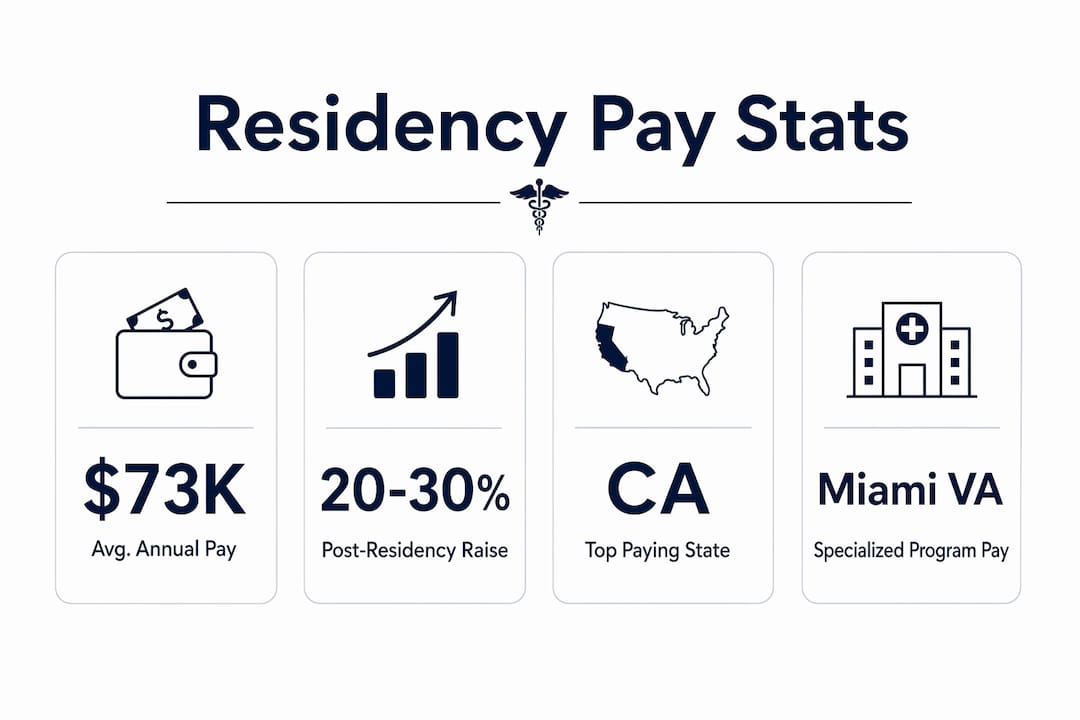
- California: Hourly rates reach up to $75.52 per hour, roughly 60% above the national average. Cost of living is high, but the gross pay advantage is substantial.
- Colorado: Average hourly pay around $48, with maximums near $52, driven by strong hospital system demand in the Denver metro area.
- Florida: Average hourly rates around $40, with top rates reaching $47. The Miami VA Healthcare System offers federally funded residency stipends around $63,010 annually, which sits below the state's private-sector ceiling but includes federal benefits.
- New York: Urban health systems in New York City consistently pay above national medians, with United Health Services in Johnson City offering $40.70 per hour base pay plus shift differentials.
- Virginia: UVA Health's new graduate RN program starts at $36–$39.50 per hour depending on specialty, competitive for the Southeast region.
States with strong union presence and high nurse-to-patient ratio regulations, particularly California, consistently produce the highest residency wages. Rural states and those without staffing mandates tend to cluster near or below the national median.
How does nursing residency pay compare to related roles?
Nursing residency pay is intentionally structured below the full registered nurse rate, reflecting the supervised, training-intensive nature of residency programs.
Related roles and how they compare:
- Staff RN (post-residency): Typically $47–$55 per hour nationally, a meaningful jump once residency is complete.
- ICU/critical care nurse resident: Often earns at the higher end of the residency pay scale due to specialty complexity, with some programs paying $38–$42 per hour.
- Pediatric or med-surg nurse resident: Generally tracks near the median, $33–$36 per hour, with less specialty premium.
- Senior residency or clinical advancement roles: Specialty certifications and clinical mentorship access can accelerate movement into higher pay tiers post-residency.
The residency period is a defined investment. Most nurses see a 20–30% pay increase when they transition to a full staff RN role, particularly in high-demand specialties.
Where does nursing residency salary data come from?
The figures in this article draw from multiple sources, each with a different methodology. Salary.com aggregates compensation data from employer-submitted surveys, HR systems, and job postings, updating figures continuously. Their nurse residency and nurse resident datasets reflect distinct job title classifications, which is why the two medians differ slightly.
Vivian.com pulls from actual job postings and self-reported pay data from nurses who have held these roles, giving a real-time market view. Government sources like the VA publish fixed stipend amounts tied to federal pay schedules, which are transparent and verifiable. HighPaidRN's own nursing compensation research methodology layers specialty and location filters onto verified self-reported data, offering nurses a more granular comparison than national averages alone can provide.
No single source captures every program. Cross-referencing two or three data points before evaluating an offer gives you a clearer picture than relying on any one figure.
What total compensation looks like beyond your base hourly rate
Base pay is only part of what nursing residency compensation delivers. Hospitals structure their offers to include several components that materially affect your net income.
- Shift differentials: Night, weekend, and holiday shifts typically add $3–$8 per hour on top of base pay. UHS, for example, builds shift differential into a total package that reaches approximately $84,656 annually from a $40.70 base.
- Sign-on and incentive bonuses: UVA Health offers a $10,000 incentive bonus paid in installments during residency. Sign-on bonuses at other systems range widely.
- Tuition reimbursement and loan repayment: Many hospitals offer tuition reimbursement or loan repayment assistance to help offset nursing school debt, though residency programs do not typically pay tuition directly.
- Tuition forgiveness and relocation assistance: Some programs tie these benefits to tenure requirements post-residency, meaning you must stay a set period after completing the program to receive the full benefit.
- Health, dental, vision, and life insurance: Standard across most hospital systems; the VA Miami program includes all four.
- Retirement contributions: UHS includes 403(b) employer matching. PTO accrual also begins during residency at most institutions.
- Certification reimbursements and clinical advancement incentives: These "hidden" payouts can add thousands of dollars annually and are worth asking about directly during the offer stage.
Pro Tip: When comparing two residency offers, calculate the total first-year value: base pay plus shift differential earnings, sign-on bonus, and the dollar value of benefits like loan repayment. A $3/hour lower base rate can easily be offset by a $10,000 sign-on bonus and stronger loan forgiveness terms.
Healthcare institutions actively monitor market conditions to adjust residency pay, so the RN total compensation picture at any given hospital can shift year to year. Always ask for a written breakdown of every component before signing.
Key Takeaways
Nursing residency pay averages $73,041 per year nationally, but total compensation including shift differentials, bonuses, and benefits can push first-year earnings significantly higher depending on location and program.
| Point | Details |
|---|---|
| National average pay | Nurse residency salaries average $73,041 per year nationally, with typical ranges from $64,734 to $81,220 and top earners up to $88,660 according to June 2026 Salary.com data. |
| Wide salary range | Pay spans more than $24,000 from the 25th to the 90th percentile. |
| Geography drives the gap | California hourly rates reach $75.52, roughly 60% above the national average. |
| Total comp matters most | Shift differentials, sign-on bonuses, and loan repayment can add thousands beyond base pay. |
| Post-residency jump | Full staff RN roles typically pay $47–$55/hour, a clear step up from residency rates. |