

Merit-based pay for registered nurses means employer-run raises, bonuses, or pay differentials tied to measurable performance, skills, or documented duties — not seniority alone, and not federal physician programs like MIPS. If your hospital offers a clinical ladder, a performance bonus, or a certification differential, that is merit-based pay. The single most useful thing you can do right now: start a running log of every certification, precepted shift, charge assignment, and quality contribution you complete, then pull your market median from HighPaidRN before your next annual review.
- Who it affects most: Nurse leaders and managers, where a significant minority of organizations use short-term annual incentive plans (AIPs). Bedside RNs more commonly access merit pay through clinical ladders and differentials.
- What AORN recommends: Start conversations about success criteria early in the year, document exemplars by clinical-ladder category, and ask for a specific compensation outcome during your review.
- Your market anchor: HighPaidRN's salary database, segmented by state, specialty, and hospital type, gives you the external comparator that turns your internal achievements into a defensible dollar ask.
Table of Contents
- What forms does merit-based pay take for RNs?
- How hospitals actually build and administer merit-pay programs
- How to build a documented case for a merit-pay increase
- Exactly when and how to ask for a merit-pay increase
- Red flags and pitfalls to watch for in merit-pay policies
- How to use market salary data to strengthen your request
- Key Takeaways
- The case for treating merit pay as a year-round project
- HighPaidRN gives you the market data your negotiation needs
- Useful sources and further reading
What forms does merit-based pay take for RNs?
Performance-based pay nursing programs come in several distinct structures. Knowing which ones your employer uses tells you exactly what to document and target.
- Clinical advancement programs (clinical ladders): Documented activities — national certifications, precepting new hires, teaching, or community volunteer work — earn percentage-based base-pay increases. A nurse moving from Ladder II to Ladder III might see a modest base increase tied to a portfolio submission.
- Annual incentive plans (AIPs) and performance bonuses: Typically reserved for charge nurses, managers, and directors, these tie a lump-sum or percentage payout to unit or system outcomes. Bedside staff occasionally qualify, but it is less common.
- One-time bonuses: Sign-on, retention, and performance bonuses are lump sums, not recurring pay changes. Sign-on bonuses may be paid over several months, and performance bonuses are usually tied to quality metrics.
- Skill and certification differentials: A CCRN or CEN credential can add a small hourly differential to your base rate as a standing supplement, separate from ladder advancement.
- Shift, acuity, and spot bonuses: Evening, night, and weekend differentials reward specific assignments. Spot bonuses reward immediate high-impact contributions — covering a short-staffed unit during a crisis, for example.
Each type affects your pay differently. Ladder advances move your base permanently; bonuses and differentials can disappear if you change units or roles.
How hospitals actually build and administer merit-pay programs
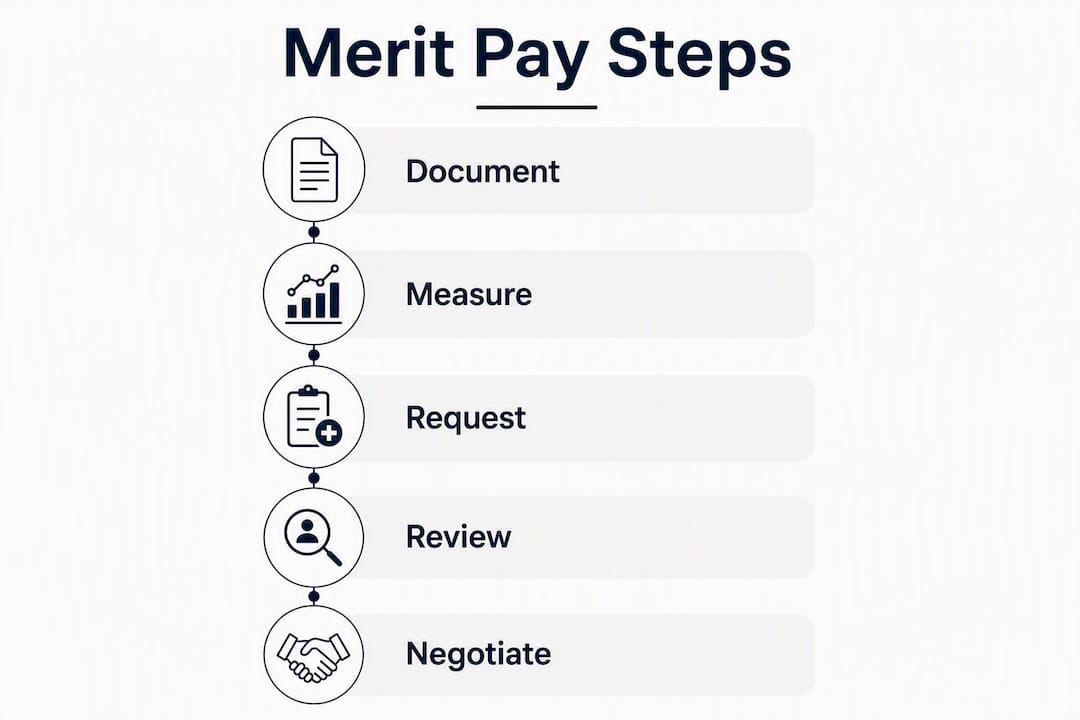
Most health systems design merit pay around a mix of objective and subjective criteria. On the objective side: certifications held, precepting hours logged, quality metrics (HCAHPS scores, fall rates, infection rates), and productivity proxies like patient volume. On the subjective side: manager ratings, peer feedback, and leadership presence.

According to AONL, a significant minority of organizations use AIPs for nurse leaders, while bedside staff more commonly encounter pay bands and clinical ladders. The SullivanCotter 2025 survey found larger median base-pay growth for RN leaders and managers compared with staff RNs, with regional variation in median hourly rates.
Timing matters. Most programs run on an annual review cycle aligned with the fiscal year, with a formal calibration committee reviewing manager ratings before payouts are finalized. Midyear check-ins exist at some organizations but rarely trigger pay changes on their own.
- Pay-band constraints: Even a top rating may yield only a small increase if you are near the top of your pay band.
- Calibration: Managers often cannot award top ratings to more than a set percentage of their team, regardless of actual performance.
- Payout schedules: Base-pay increases typically take effect at the start of the next pay period after the review; bonuses may be paid quarterly or annually.
When pay bands are rigid, employers often use retention bonuses and shift differentials as short-term tools to address pay gaps without permanently moving base pay.
How to build a documented case for a merit-pay increase
An evidence-informed case is the most reliable path to a raise. AORN recommends starting early-year conversations about success criteria and keeping detailed, exemplar-based documentation organized by clinical-ladder category.
Track these metrics all year:
- Certifications held and renewal dates
- Precepting shifts (dates, hours, names of orientees if permitted)
- Education or teaching activities (in-services, student supervision)
- Charge shifts (dates and unit census)
- Quality or outcome contributions (committee work, protocol improvements)
- Special projects or leadership responsibilities
Sample documentation table:
| Metric | Evidence needed | How it ties to compensation |
|---|---|---|
| Precepted 3 new hires | Onboarding report or manager email | Clinical ladder step increase |
| CCRN certification renewed | Certificate copy, CEU log | Certification differential ($1–$3/hr) |
| Led multiple charge shifts | Charge schedule or supervisor confirmation | Leadership criteria for ladder or AIP |
| Contributed to fall-prevention protocol | Meeting minutes, project summary | Quality metric for performance bonus |
Archive everything: unit dashboards, emails from managers, competency logs, and committee minutes. A short dated entry once a week takes five minutes and builds a complete pay-case packet by review time.
Pro Tip: Measure your BATNA (best alternative to a negotiated agreement) before the review. Pull your market median from HighPaidRN filtered by your state, specialty, and hospital type. If your current pay sits below the market median for your role, that gap is part of your case.
Exactly when and how to ask for a merit-pay increase
Timing and specificity are the two variables most nurses underestimate. AORN's guidance is clear: start the conversation early in the year, not the week before your review.
Negotiation steps:
- Schedule a planning meeting in January or February. Ask your manager: "What criteria will matter most for compensation decisions this year?" This frames your documentation from day one.
- Request a mid-year check-in. A brief 15-minute conversation in June lets you confirm you are on track and surface any gaps before the formal review.
- Prepare a one-page evidence summary before your annual review: market median from HighPaidRN, your current pay, documented contributions, and a specific dollar ask.
- State a precise number. Career-coach guidance recommends a specific dollar figure over a vague percentage. "$3,750 annually" lands more concretely than "about 5%."
- Follow up in writing if your manager gives a noncommittal answer. Email: "Thank you for our conversation on [date]. Could you confirm the timeline for a decision and any additional steps I should complete?"
Email template to open the conversation:
If denied, ask for three things: a written development plan with specific criteria for reconsideration, a timeline for the next review opportunity, and whether non-salary compensation (tuition reimbursement, retirement matching, additional PTO) is available. These benefits carry real dollar value and are often negotiable even when base pay is not.
Red flags and pitfalls to watch for in merit-pay policies
Not every merit-pay program delivers what it promises. Knowing the warning signs protects your pay and your career mobility.
- Opaque criteria: If your employer cannot give you a written list of what earns a top rating, the system is subjective by design.
- Pay-band caps: A "merit" increase of 1% when you are at the top of your band is functionally cosmetic. Ask HR where you sit in your band before the review.
- Inconsistent application: If colleagues with similar credentials and duties receive different outcomes, ask HR for anonymized payout ranges or calibration notes.
- Bonus repayment clauses: Sign-on and retention bonuses often require repayment of the gross amount if you leave before a set period — meaning you may owe more than you received after taxes.
Pro Tip: Before signing any bonus agreement, ask HR two questions: "Is repayment calculated on gross or net pay?" and "What percentage of eligible staff received the top payout tier last year?" Both answers tell you whether the program is real or largely theoretical.
How to use market salary data to strengthen your request
Market data converts your internal achievements into an externally validated ask. The process is straightforward.
Step 1: Pull your market median from HighPaidRN, filtering by your state, specialty, and hospital type. For a strong ask, note the 75th percentile as well.
Step 2: Build a simple comparator table for your manager:
| Data point | Value |
|---|---|
| Market median (your state/specialty/hospital type) | [from HighPaidRN] |
| Your current base pay | [your figure] |
| Gap to market median | [calculated difference] |
| Requested increase | [specific dollar amount] |
| Justification | CCRN renewal + 3 preceptees + several charge shifts |
Step 3: Present this as a one-page appendix, not a verbal estimate. A written table signals preparation and makes the conversation easier for your manager to escalate to their own leadership.
SullivanCotter's 2025 data shows targeted base-pay increases for leaders and hard-to-fill specialties, with regional variation. If you are in a high-demand specialty or an underserved region, that market context belongs in your case. HighPaidRN's filters for hospital type and state-level pay variance let you build a comparator set that matches your actual situation, not a national average that may not reflect your market.
Key Takeaways
Merit-based pay for RNs works best when you document contributions year-round, anchor your ask to verified market data, and request a specific dollar figure during a planned conversation.
| Point | Details |
|---|---|
| Start documentation early | Track certifications, precepting, charge shifts, and quality contributions from January onward. |
| Know your program type | Bedside RNs typically access merit pay through clinical ladders and differentials rather than annual incentive plans. |
| Use a specific dollar ask | A precise figure ("$3,750 annually") is more persuasive than a vague percentage request. |
| Watch bonus fine print | Repayment clauses on sign-on bonuses are often calculated on gross pay, not take-home pay. |
| Anchor to market data | Use HighPaidRN's state/specialty/hospital filters to pull a verified median before your review. |
The case for treating merit pay as a year-round project
Most nurses approach their annual review as a single event. The nurses who consistently earn merit increases treat it as a year-round project. The difference is not talent or tenure — it is documentation and timing.
The conventional advice is to "know your worth." That is incomplete. Knowing your worth means nothing without the evidence to back it up in the specific language your employer's program uses. A clinical ladder does not reward general excellence; it rewards documented certifications, logged precepting hours, and verified charge shifts. The same principle applies to any performance-based pay system: the criteria are written down somewhere, and your job is to match your evidence to those criteria before the conversation starts.
One more thing worth saying plainly: asking for merit pay is not entitlement. It is alignment. When you present documented contributions alongside market data, you are showing your employer that your pay reflects both your value to the unit and the competitive market for your skills. That framing tends to land better than any salary negotiation script.
HighPaidRN gives you the market data your negotiation needs
Knowing you are underpaid and being able to prove it are two different things. HighPaidRN closes that gap with a nurse salary database built specifically for RNs, segmented by state, specialty, hospital type, and employment condition. You can pull a verified market median for your exact role, see the 75th percentile for a strong ask, and contribute your own anonymous salary data to keep the database current for every nurse who comes after you.
Use HighPaidRN to build the comparator table in Section 7, anchor your dollar ask in Section 5, and check whether your current pay sits below the market median before your next review. The nursing compensation research guide on the HighPaidRN blog walks through the full research process if you want a deeper look at how to interpret the data. When you are ready to act, visit highpaidrn.com to access the database and start building your case.
Useful sources and further reading
These are the primary sources behind the guidance in this article. Each covers a distinct part of the merit-pay picture.
- AORN: How to Advocate for Yourself — Tips for Negotiating a Salary Increase — Covers documentation strategy, exemplar-based preparation, and timing for annual review conversations.
- AONL Compendium 2.0: Redefining Total Rewards for Nurse Leaders — The primary source for AIP prevalence data (40%–45% for leaders) and retention bonus context.
- NurseJournal: 7 Different Types of Nursing Bonuses Explained — Detailed breakdown of bonus types, eligibility, and repayment clause risks.
- SullivanCotter 2025 Nursing Compensation Report — National benchmarks for RN base-pay growth by role and region.
- ASRN: How to Negotiate Your Best Nursing Compensation Package — Practical guidance on total-compensation negotiation, including non-salary benefits.
- Clinical Advancement Programs and Retention — Research on how clinical ladders link documented activities to base-pay increases and improve retention.
- HighPaidRN Salary Negotiation Guide — Practical scripts and tactics for nurses preparing to ask for a raise.