

A compact (multistate) license does not automatically raise your base hourly rate, but it produces real, measurable increases in take-home earnings by cutting recurring licensing costs and eliminating the contract gaps that quietly drain annual income. The governing bodies behind this system are the Nurse Licensure Compact Commission and the National Council of State Boards of Nursing (NCSBN); the tool nurses use to quantify the financial upside is HighPaidRN's verified salary database.
The compact's pay impact works through four channels:
- Licensing cost savings: Per-state fees of $100–$200 disappear for every compact state you work in.
- Reduced contract gaps: No waiting on new state approvals means fewer unpaid days between assignments.
- Access to higher-paying markets: A single license opens 41 member states, including high-wage markets you could not pursue cost-effectively before.
- Discipline risk: A licensing action can suspend compact privileges immediately, cutting off travel and PRN income overnight.
Table of Contents
- What is the Nurse Licensure Compact and how does the home state rule work?
- How the compact changes where and how you can get paid
- Direct vs. indirect pay effects: what the NLC actually changes
- How disciplinary action can immediately cut your earning capacity
- How to use verified salary data to negotiate as a compact nurse
- Steps to protect and maximize your pay as a compact nurse
- Key Takeaways
- Why verified pay data changes the compact conversation
- HighPaidRN gives you the salary evidence compact nurses need
- Useful sources and references
What is the Nurse Licensure Compact and how does the home state rule work?
The NLC is an interstate agreement that allows eligible RNs and LPN/LVNs to practice across member states without obtaining additional licenses. NCSBN administers the compact's uniform licensure requirements (ULR), and the Nurse Licensure Compact Commission oversees governance and interstate communication.
Your multistate license is issued by your Primary State of Residence (PSOR), which is the state where you hold a driver's license, are registered to vote, and file your federal taxes. Property ownership does not determine PSOR. When you accept an assignment in another compact state, your single license is recognized there automatically — no separate application, no additional fee.
As of 2026, 41 states and territories participate in the NLC, covering the vast majority of the continental U.S. You can verify current membership on the NCSBN website, which maintains the official state list. In-person practice in compact states is covered automatically. Telehealth is a gray area: some employers require credentialing in the patient's physical state regardless of compact membership, so confirm the policy with each employer before starting.
How the compact changes where and how you can get paid
The most direct earning benefit is geographic reach. A travel nurse finishing a 13-week contract in Texas can accept an assignment in Colorado, Arizona, or Georgia without restarting the licensing clock. A PRN nurse near a state border can pick up shifts across that line the same week. These are not hypothetical scenarios; they are the everyday operational reality for nurses in compact states.
Concrete earning opportunities the compact opens up:
- Back-to-back travel contracts across compact states without reapplication delays or fees.
- PRN shifts in neighboring states, adding income without a second license.
- Access to high-demand markets where short-staffing drives up contract rates.
- Telehealth roles (subject to employer credentialing policies — always verify).
The elimination of licensing bottlenecks that previously forced gaps between assignments is one of the compact's most underappreciated financial benefits. California license processing, for example, can take 10–12 weeks. A compact nurse bypasses that wait entirely for the 41 member states.
Pro Tip: Keep physical copies of your PSOR documentation — driver's license, voter registration, and most recent federal tax filing — in a dedicated folder. Travel agencies and credentialing departments will ask for these, and having them ready prevents delays that cost you contract start dates.
Direct vs. indirect pay effects: what the NLC actually changes
Understanding this distinction is what separates nurses who negotiate well from those who leave money on the table.

| Impact Type | What the NLC Changes | What It Does NOT Change |
|---|---|---|
| Direct | Removes per-state licensing fees ($100–$200 each) | Base hourly rate set by employer |
| Direct | Eliminates waiting periods for compact-state assignments | Collective bargaining terms or union scales |
| Indirect | Widens geographic market access, increasing competition for your labor | State-imposed minimum pay standards |
| Indirect | Reduces administrative overhead for agencies and hospitals | Specialty premiums (set by market demand) |
| Indirect | Enables faster pivots to higher-demand, higher-paying markets | Hospital budget caps |
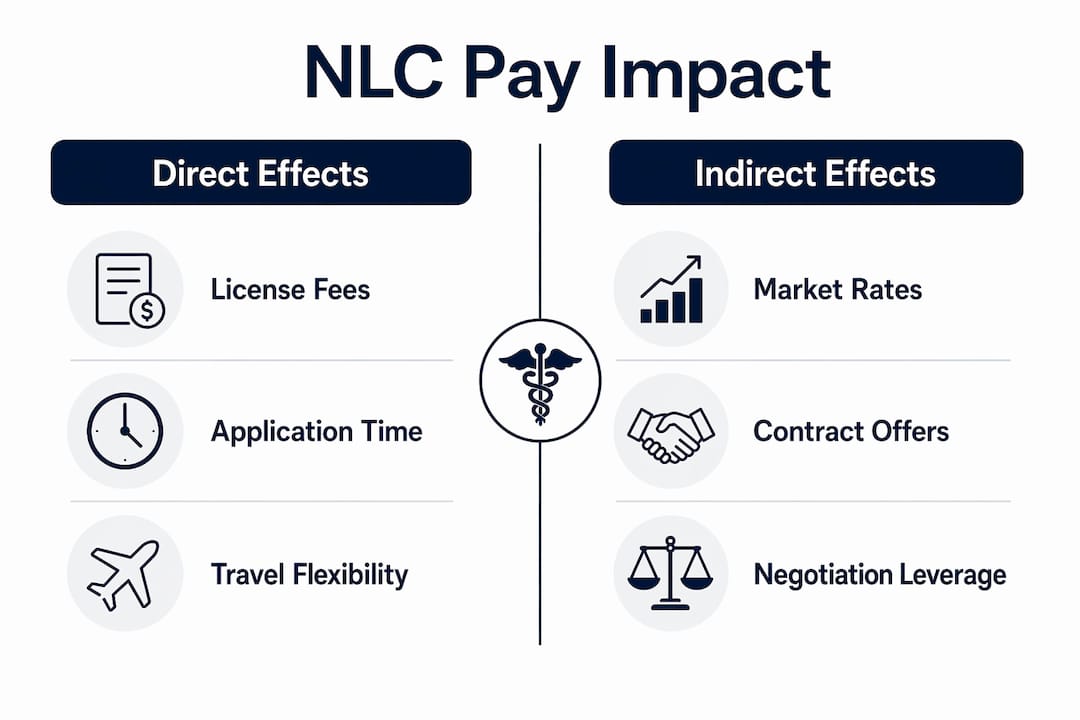
The NLC does not instruct any employer to pay you more. What it does is remove the friction that previously made high-paying markets inaccessible or too expensive to pursue. A nurse working three non-compact states per year could spend $300–$600 or more in fees alone, before accounting for the processing time that delays contract starts. The compact eliminates that recurring cost.
State-level supply and demand still drives the actual rate differential between markets. A compact license gives you access to those differentials; it does not create them. The practical implication for negotiations: frame compact access as a factor that reduces your cost of doing business and increases your availability, not as a credential that commands a premium on its own.
How disciplinary action can immediately cut your earning capacity
This is the risk most nurses underestimate until it happens.
A single licensing action in your home state can strip compact privileges across all 41 member states simultaneously. For a travel nurse whose income depends on cross-state contracts, that is an immediate earnings crisis, not a future concern.
Steps to protect your compact status and earning capacity:
- Monitor your license status monthly on your state board's public lookup tool.
- Report any complaint or investigation to your agency immediately. Agencies find out anyway; early disclosure preserves the relationship.
- Maintain documentation of your PSOR at all times. A gap in residency documentation can complicate your compact standing.
- Understand the 60-day rule. When you permanently change your PSOR to a new compact state, you must apply for a multistate license in that state within 60 days. Missing this window creates a licensure lapse that affects your eligibility for assignments.
- Consult a nursing attorney before responding to any board complaint. The stakes are your multistate privileges and your income.
If your compact privileges are suspended, your single-state license in your home state typically remains valid. That preserves your ability to work locally while the matter is resolved, but it ends travel and PRN income across state lines.
How to use verified salary data to negotiate as a compact nurse
The compact's value in a negotiation is concrete, not abstract. Here is how to build the argument.
The salary metrics that matter most are state median by specialty, facility-type premiums, and travel contract total earnings versus base hourly pay. A compact nurse can present data from multiple markets simultaneously, which is a negotiating position a single-state nurse cannot replicate.
A short, evidence-based negotiation script:
"Based on verified market data for ICU nurses in this state, the median rate is [X]. I also have access to comparable rates in [compact state Y], where current contracts are running [Z]. Given my compact license and immediate availability, I'm requesting [target rate]."
The licensing-cost angle strengthens the case further. If you are negotiating with a travel agency, note that your compact license eliminates their cost of sponsoring additional state applications, which can run $100–$200 per state plus administrative time.
Pro Tip: Convert licensing savings into a dollar figure before your negotiation. If a non-compact nurse would need two additional state licenses at $150 each, that is $300 in direct savings to the agency. Present it as a line item, not a vague benefit.
HighPaidRN's salary database is built for exactly this kind of preparation. Filters by state, specialty, hospital type, and employment condition let you pull the specific market medians your negotiation needs. The data is contributed anonymously by nurses, which means it reflects real offers, not posted ranges. Use the nursing compensation research guide to structure your data pull before any salary conversation.
Steps to protect and maximize your pay as a compact nurse
Before you start any assignment:
- Confirm your PSOR is current and matches your driver's license, voter registration, and tax filing.
- Verify the assignment state is an active NLC member on the NCSBN website.
- Update your employer's credentialing file with your multistate license number and expiration date.
- Log your license renewal date in a calendar with a 90-day advance reminder.
Ongoing steps for travel nurses:
- Keep a backup single-state license application ready for high-priority non-compact states (California is the most common).
- Track application timelines for non-compact states you plan to work in; some take months.
- Maintain a folder with copies of any complaint records, board correspondence, and resolution documentation.
- Run a HighPaidRN salary search before each contract renewal to confirm your rate is current with the market.
Key Takeaways
A compact (multistate) license does not raise base pay directly, but it removes licensing costs and contract gaps that meaningfully increase annual earnings for travel and PRN nurses.
| Point | Details |
|---|---|
| No automatic base-rate increase | Employers set rates based on market, specialty, and budget — not license type. |
| Real indirect earnings gains | Eliminating $100–$200 per-state fees and contract gaps adds up across multiple assignments per year. |
| 41 states covered | NLC membership gives access to most of the continental U.S. with a single license. |
| Discipline is the biggest risk | A licensing action can suspend compact privileges across all member states immediately, ending travel income. |
| HighPaidRN for negotiation | Use HighPaidRN's state- and specialty-filtered salary data to build a verified, market-backed pay request. |
Why verified pay data changes the compact conversation
The compact's financial value is easy to understate because most of it is indirect. Nurses who walk into a negotiation citing "flexibility" get a different response than nurses who cite a specific market median, a dollar figure for licensing savings, and a documented gap in their current rate versus the regional benchmark. That shift from abstract to concrete is what verified, segmented salary data actually does.
There is also a collective dimension worth acknowledging. When nurses anonymously contribute their salary data to platforms like HighPaidRN, they reduce the information asymmetry that has historically kept nursing wages lower than market conditions would otherwise support. A compact nurse who uses that data well is not just negotiating for herself; she is contributing to a more transparent market for every nurse who comes after her. The compact opens doors. Verified data is what you use once you are through them.
HighPaidRN gives you the salary evidence compact nurses need
Knowing your compact license removes barriers is one thing. Knowing exactly what the market pays in the states you can now access is what turns that knowledge into a higher offer.
HighPaidRN's verified salary database lets you filter by state, specialty, hospital type, and employment condition to pull the exact market medians your negotiation needs. The data comes from nurses who have contributed their real compensation figures anonymously, so you are working with actual offers, not estimated ranges. Pull a specialty-by-state report, add your licensing-cost savings as a line item, and present a written request backed by numbers your employer cannot dismiss.
Visit HighPaidRN to run your salary search and build your negotiation case today.
Useful sources and references
| Source | What it covers | Why it matters |
|---|---|---|
| NCSBN — Licensure Compacts | Official NLC governance, uniform licensure requirements, and APRN compact | Primary authority on compact rules and state membership |
| NURSECOMPACT — How it Works | PSOR rules, multistate license mechanics, and discipline risk | Authoritative operational guide including legal insight on compact privileges |
| Wanderly — Compact Nursing License Guide | Per-state fee ranges, processing times, and travel nurse scenarios | Practical cost and timeline data for travel nurses |
| AMN Healthcare — Rise of Compact Licenses | Contract gap elimination and start-date advantages | Industry perspective on operational benefits |
| HighPaidRN Salary Database | Verified, state- and specialty-segmented nurse salary data | Primary negotiation tool recommended in this article |
| HighPaidRN — Travel Nurse Total Earnings | Real earnings examples for travel nurses by market | Grounds negotiation scripts in realistic figures |
This article is general information for educational purposes. Confirm current NLC membership, licensing requirements, and any legal or disciplinary matters with your state board of nursing or a qualified nursing attorney.