

Peer salary comparison, also called compensation benchmarking, is the process of measuring your pay against a clearly scoped group of nurses in the same specialty, location, hospital type, and employment condition to determine whether your compensation is below, at, or above market. The result is concrete: you walk into your next negotiation with a documented salary band built on real market data, not a gut feeling.
Three sources anchor a credible comparison for U.S. registered nurses:
- Bureau of Labor Statistics (BLS): national and state-level occupational wage data, best for directional context
- HighPaidRN: nurse-specific, filterable database segmented by specialty, state, hospital type, and employment condition
- General salary sites (Glassdoor, Payscale, Monster): useful for quick checks, limited on specialty granularity
Table of Contents
- Why does peer salary comparison matter for registered nurses?
- How do you define a valid peer group as a nurse?
- How to run a peer salary comparison step by step
- Where can you find credible nurse salary data?
- Why a nurse-focused database gives you negotiation-grade data
- What mistakes should you avoid in a peer salary comparison?
- Key Takeaways
- The part most nurses skip that changes everything
- HighPaidRN gives you the granularity free tools cannot match
- Useful sources for nurse salary data
Why does peer salary comparison matter for registered nurses?
A well-scoped peer comparison changes the dynamic of a salary conversation. Instead of asking for more money, you are presenting evidence that your current pay sits below the market midpoint for your role. That shift, from request to evidence, is what moves offers.
Salary benchmarking uses market data filtered by role, level, and location to build a reference point for compensation decisions. For nurses, that reference point exposes pay gaps that would otherwise stay invisible, especially across hospital types and specialties where pay can vary by tens of thousands of dollars annually.
Concrete benefits of running a peer salary analysis:
- Negotiate a specific band, not a vague "more money" ask, which managers can act on
- Detect internal equity gaps if colleagues in the same unit with similar experience earn more
- Prioritize job searches by identifying which hospital types or metros pay at the 75th percentile for your specialty
- Gauge retention risk by seeing how far your current pay sits from what competing employers offer
Time and cost are reasonable. A usable comparison takes roughly two to four hours using free public sources; paid or nurse-specific databases cut that to under an hour and add specialty-level granularity that free tools often lack.
How do you define a valid peer group as a nurse?
Accuracy depends entirely on matching the right variables. A comparison that mixes ICU nurses with med-surg nurses, or teaching hospital pay with community hospital pay, produces a number that looks precise but means nothing in a real negotiation.
The five dimensions that must align in your peer group:
- Specialty: ICU, OR, med-surg, ED, NICU, oncology, and so on. Never blend specialties.
- Geographic location: state-level data is a starting point; metro-level data is more useful for local negotiations.
- Hospital type: Magnet-designated, Level I teaching, community, private system, or independent. Pay differences across these categories can be significant.
- Employment condition: staff RN, travel/agency, per diem. Travel and per diem rates are not comparable to staff base pay.
- Experience and certification: years of practice and specialty certifications (CCRN, CEN, CNOR) both affect where you land in a pay distribution.
Two example peer groups that work:
- ICU RN, Level I teaching hospital, Boston metro, staff position, 5 years experience, CCRN certified
- OR RN, suburban community system, Dallas metro, staff position, 3 years experience, CNOR in progress
Pro Tip: Focus your peer group on the organizations your unit actually recruits from or loses staff to. Those are your true talent competitors, and their pay rates are the ones your manager is already watching. Hospital type pay differences can run $10,000 or more annually for the same specialty.

How to run a peer salary comparison step by step
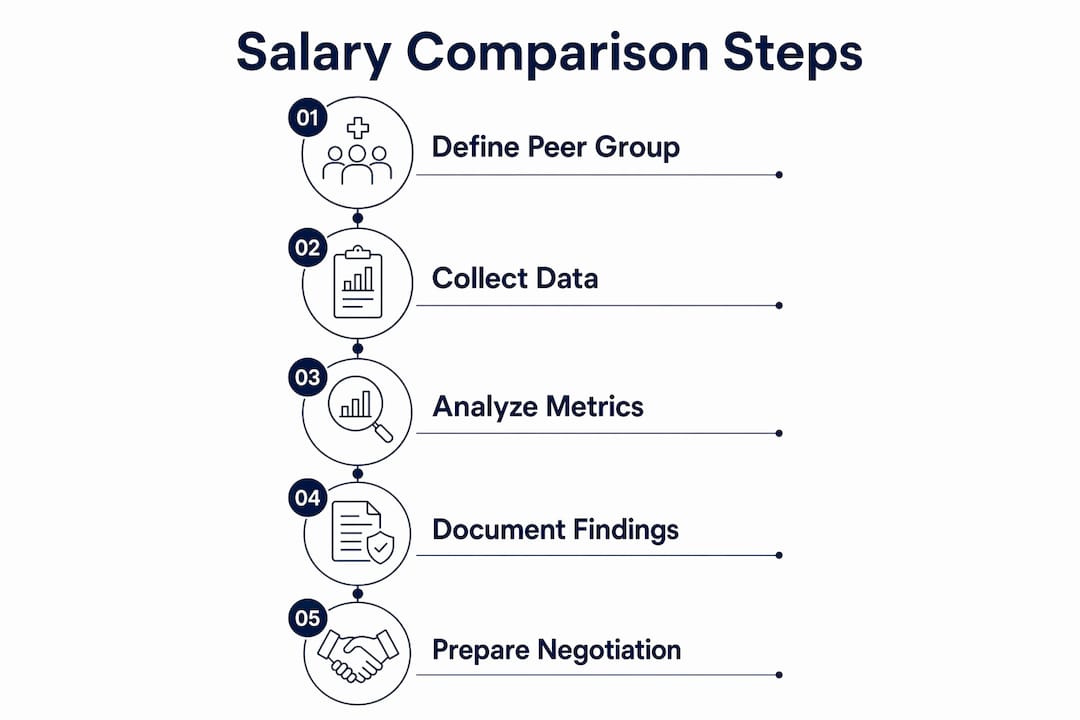
A usable comparison follows five steps: scope peers, list data sources, pull figures, record percentiles, then calculate your band.
Step-by-step workflow
- Scope your peer group using the five dimensions above. Write them down before you pull any data.
- List three or more data sources. Use at least one public source (BLS or CareerOneStop), one state nursing association survey if available, and one nurse-specific database.
- Pull state + specialty + hospital-type figures from each source. Record median, 25th percentile, and 75th percentile where available.
- Normalize to annual salary. Convert hourly rates: multiply hourly pay by 2,080 (40 hours × 52 weeks) for a standard staff comparison. Add shift differentials and bonuses to get total compensation.
- Compute your position and target band. If your annualized pay falls below the median across your sources, your floor ask is the median. Your target is the 75th percentile if your experience and certifications support it.
Data collection template
| Source | Locale | Specialty | Hospital type | Sample size | 25th pct | Median | 75th pct | Notes |
|---|---|---|---|---|---|---|---|---|
| BLS | State | RN (general) | All | Large | — | — | — | Directional only |
| State assoc. survey | Metro | ICU RN | Teaching | Note if listed | — | — | — | Check date |
| HighPaidRN | Metro | ICU RN | Teaching | Listed in tool | — | — | — | Filter by staff |
| Glassdoor | Metro | ICU RN | Mixed | Unlisted | — | — | — | Self-reported |
Quick calculation example
An ICU RN earning $42/hour ($87,360 annualized) pulls three sources showing a median of $95,000 and a 75th percentile of $108,000 for her specialty, metro, and hospital type. Her documented band for negotiation: $95,000 (floor) to $108,000 (target). She presents the band, not a single number, which gives the manager room to move without feeling cornered.
Negotiation prep checklist:
- Print or save each source with its URL, date, and sample size
- Write two to three impact statements (patient outcomes, charge experience, certifications earned)
- Time the ask: annual reviews and offer letters are the highest-leverage moments
- Present the band as market data, not a personal demand: "Based on current market data for ICU RNs at teaching hospitals in this metro, the range is $95,000 to $108,000."
For more on phrasing and timing, the salary negotiation guide for nurses covers specific language that works in real conversations.
Where can you find credible nurse salary data?
Use a mix of public, institutional, and nurse-focused sources. Each serves a different purpose.
| Source type | Examples | Granularity | Cost | Best for |
|---|---|---|---|---|
| Federal occupational data | BLS, CareerOneStop | State, broad occupational | Free | Trend context, national floor |
| State nursing association surveys | California Board of Registered Nursing and similar | State + some specialty | Free to members | Local specialty context |
| Specialty association surveys | AACN, AORN | Specialty + national | Free to members | Specialty-specific benchmarks |
| General salary sites | Glassdoor, Payscale, Monster | Metro, broad role | Free | Quick directional checks |
| Nurse-specific databases | HighPaidRN | State + specialty + hospital type + employment condition | Subscription | Negotiation-grade granularity |
BLS data is authoritative for occupational totals and trend context but often lacks the state-plus-specialty granularity needed for specialty-level negotiations. General salary sites fill gaps quickly but rely on self-reported data with unlisted sample sizes. State nursing association surveys, where current, offer the most locally relevant specialty data at no cost to members. A nurse-specific database like HighPaidRN adds the hospital-type and employment-condition filters that make a comparison defensible in a real negotiation.
Why a nurse-focused database gives you negotiation-grade data
General salary sites were not built for nursing specialties. They aggregate across roles, hospital types, and employment conditions in ways that blur the distinctions that actually matter to an ICU RN negotiating at a Magnet hospital.
A nurse-specific database provides the filters that make a comparison credible:
- State and metro-level filtering
- Specialty selection (ICU, OR, NICU, ED, med-surg, oncology, and more)
- Hospital type (teaching, community, Magnet, private system)
- Employment condition (staff, travel, per diem)
- Shift pattern (nights, days, rotating)
- Percentile reporting (25th, median, 75th) with sample size displayed
HighPaidRN is built specifically for this workflow. An ICU RN can filter to her exact specialty, state, and hospital type and see where her pay lands in the distribution. A travel RN can check premium rates by state before accepting an assignment. The data comes from anonymized, nurse-contributed submissions, which means the sample reflects actual nursing compensation rather than HR-estimated ranges.
Transparency and methodology matter. When evaluating any salary database, check for three things: the sample size behind each data point, the date the data was collected, and whether contributions are verified and anonymized. A source that cannot answer those three questions should not anchor your negotiation.
For a broader look at how specialty salary expectations vary across nursing roles, that context helps you set realistic targets before you filter.
What mistakes should you avoid in a peer salary comparison?
Common mistakes produce misleading conclusions. The most frequent: using national averages for a local negotiation, mixing specialties, or relying on a single source with an unlisted sample size.
Red flags to watch for:
- Wrong specialty match: comparing ICU pay to general RN averages understates your market rate
- Mismatched hospital type: community hospital rates used to negotiate at a Level I teaching hospital skew low
- Small or unlisted sample size: fewer than 10 responses for your specific filter combination is not a reliable benchmark
- Outdated data: salary data older than 18 months may not reflect current local labor market conditions
- National averages for local negotiations: local supply and demand drive pay differences that national figures mask entirely
Peer-group quality determines the quality of your insight. As compensation research consistently shows, a poorly scoped peer set produces unreliable advice. The fix is straightforward: narrow your filters until the comparison reflects the organizations you actually compete with for jobs.
Validation checklist before you use any data point in a negotiation:
- Sample size is listed and at least 10 for your specific filter combination
- Data is dated within the last 18 months
- Geographic filter matches your metro or state, not national
- Percentiles (not just an average) are provided
- Total compensation components are specified (base, shift differential, bonuses)
Pro Tip: When sample sizes are small across individual sources, combine multiple credible sources and document the combined sample size and collection date. Presenting a manager with three sources that agree is more persuasive than one source with a large sample.
A complete comparison typically costs nothing beyond time if you use BLS and state association data. Nurse-specific databases with full filtering run on a subscription model and can reduce research time significantly while adding the granularity free sources lack.
Key Takeaways
Peer salary comparison works when you match specialty, location, hospital type, and employment condition, then use percentiles from three or more sources to build a documented band for negotiation.
| Point | Details |
|---|---|
| Match all five peer dimensions | Specialty, metro, hospital type, employment condition, and experience must all align for a valid comparison. |
| Use percentiles, not averages | The 25th, median, and 75th percentile show where you stand; present a band, not a single number, in negotiation. |
| Validate every data point | Check sample size, data date (within 18 months), and geographic granularity before using any figure. |
| Combine at least three sources | BLS, a state nursing association survey, and a nurse-specific database together produce a defensible range. |
| HighPaidRN adds specialty-level filters | Filter by state, specialty, hospital type, and employment condition to get negotiation-grade data in one place. |
The part most nurses skip that changes everything
The conventional advice is to "do your research before negotiating." That framing undersells what peer salary comparison actually does. It does not just give you a number. It gives you a structure that shifts the entire conversation.
Most nurses who feel underpaid already know it. What they lack is the documented, source-cited evidence that makes a manager take the conversation seriously. A single national average from a general salary site does not do that. A three-source comparison, filtered to specialty and hospital type, with percentiles and sample sizes documented, does.
The other piece most guides miss: total compensation, not base pay, is what you are actually comparing. Shift differentials, charge pay, certification bonuses, and retirement contributions can add $8,000 to $20,000 annually to a staff RN's package. A peer comparison that ignores those components can make a competitive offer look low or a low offer look competitive. Always normalize to total compensation before drawing any conclusion.
The nurses who get the best outcomes from benchmarking are not the ones with the most data. They are the ones who scoped their peer group correctly, documented their sources, and presented a band with confidence. The data is the foundation. How you use it in the room is what closes the gap.
HighPaidRN gives you the granularity free tools cannot match
Free salary tools are a starting point, not a finish line. When you need to filter by specialty, hospital type, and employment condition in the same query, and see the percentile distribution behind the result, a general salary site falls short. That is the gap HighPaidRN was built to close.
HighPaidRN is a nurse-focused salary database that lets you filter by state, specialty, hospital type, and employment condition to see exactly where your pay lands in the market distribution. Data comes from anonymized, nurse-contributed submissions, so the figures reflect what nurses in your role are actually earning, not HR estimates. Every result displays the sample size and data recency so you can assess confidence before you use a figure in a negotiation.
Whether you are an ICU RN preparing for an annual review or a travel nurse evaluating a new assignment, start your salary comparison on HighPaidRN and build your negotiation band with data that matches your actual peer group.
This article is general information, not professional compensation or legal advice. Verify current figures with primary sources or a qualified compensation professional for your specific situation.
Useful sources for nurse salary data
A short annotated list of where to pull raw data, and what each source is best for:
- Bureau of Labor Statistics (BLS): National and state occupational wage data. Best for trend context and a national floor. Filter by SOC code 29-1141 (Registered Nurses). Note the survey year before citing.
- CareerOneStop: Powered by BLS data with a comparison interface. Useful for side-by-side state or occupation comparisons. Free.
- State nursing association surveys: California Board of Registered Nursing and equivalent bodies in other states publish periodic salary surveys by specialty. Free to members; check the publication date carefully.
- Specialty association surveys: AACN (critical care), AORN (perioperative), and similar organizations publish annual compensation reports filtered by specialty. Free or low cost to members.
- HighPaidRN: Nurse-specific database with filters for state, specialty, hospital type, and employment condition. Displays percentiles and sample size. Best source for negotiation-grade granularity.
- General salary sites (Glassdoor, Payscale, Monster): Useful for directional checks and quick metro-level context. Self-reported data; sample sizes often unlisted. Do not use as your primary negotiation source.
When documenting any source, record: the URL, the date you accessed it, the filters you applied, the sample size if listed, and the percentiles returned. A manager who asks "where did you get that number?" should get a complete, dated answer.