

After you receive a formal offer, run this six-step sequence before you sign: research ICU-specific benchmarks, document your credentials, request a live conversation, present a data-backed ask, trade for non-salary items if needed, and confirm every agreement in writing. ICU nurses carry real leverage right now. Short-staffing in critical care units and the premium that certifications like CCRN command mean most employers have room to move, even when they say otherwise.
Your 24–48 hour action checklist:
- Pull ICU salary data filtered by your metro area, hospital type, and specialty (start with HighPaidRN, then cross-check with BLS registered nurse data)
- List your credentials, certifications, and any charge or preceptor experience with estimated dollar value
- Set three numbers: your opening ask, your realistic target, and your walk-away
- Draft a short email to request a compensation conversation (template in Step 2 below)
- Identify your top three non-salary priorities in case base pay is fixed
- Review your offer letter for vague language before the call
Table of Contents
- What are the ICU nurse offer negotiation steps you need to prepare?
- When should you ask, and how do you start the conversation?
- How do you run the negotiation conversation with confidence?
- What can you negotiate when base pay is fixed?
- How do you handle pushback without losing your leverage?
- What do you need to get in writing before you start?
- How do you use salary data to build a credible benchmark?
- Key Takeaways
- HighPaidRN gives you the ICU-specific data your negotiation needs
What are the ICU nurse offer negotiation steps you need to prepare?
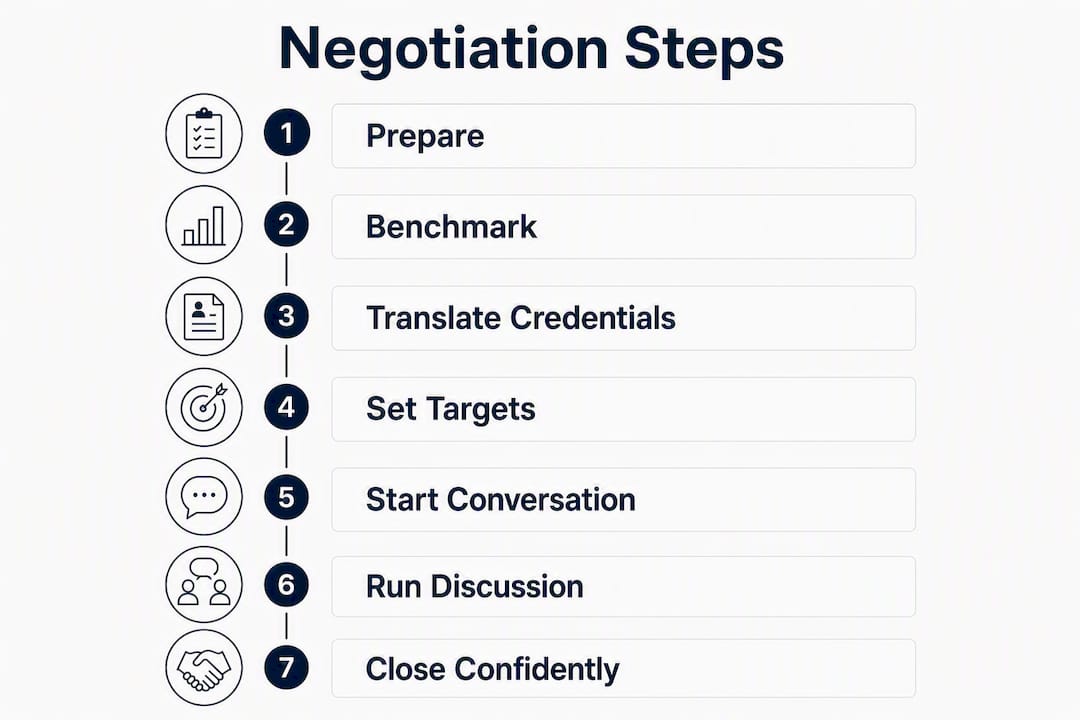
Preparation is where most nurses either win or lose the negotiation before the conversation even starts. The goal here is to build a case that feels factual and specific, not emotional or arbitrary.
Pulling ICU-specific salary benchmarks
Generic RN salary data will not serve you well in a negotiation. You need comparators that match your specialty, your city, and your hospital type. HighPaidRN lets you filter by ICU specialty, metro area, hospital type, and employment condition, pulling from a verified database of nurse-submitted salaries. That level of granularity is what turns a vague "I think I deserve more" into "the local 65th percentile for CCRN-certified ICU RNs at academic medical centers in this metro is $X per hour."
Pair that with the BLS occupational wage data for a broader regional anchor, and use Glassdoor or PayScale for additional crowd-sourced context. Public sources provide useful regional and occupation-level data, but their specialty and hospital-type granularity is limited. Use them as a sanity check, not your primary citation. ICU and ER specialties consistently command higher pay than med-surg, and certifications like CCRN plus experience in high-acuity settings increase your market worth measurably.
Translating credentials into dollar value
Before the call, write down every credential that differentiates you: CCRN certification, years in a Level 1 trauma or cardiac ICU, preceptor or charge nurse duties, ECMO experience, or any specialty training. These are not just resume items. They are negotiating assets with real market value. Employers pay more for nurses who reduce orientation time, cover charge shifts, or bring specialized skills that are hard to recruit for.
Your negotiation worksheet
Fill this out before any conversation:
| Item | Your Number |
|---|---|
| Opening ask (hourly or annual) | $___ |
| Realistic target | $___ |
| Walk-away number | $___ |
| Top non-salary priority #1 | e.g., sign-on bonus |
| Top non-salary priority #2 | e.g., extra PTO week |
| Top non-salary priority #3 | e.g., certification reimbursement |
Keep this in front of you during the call. It prevents you from agreeing to something in the moment that you will regret later.
Pro Tip: Aim for an opening ask at the 60th–75th percentile for your comparator group, not the 90th. A number grounded in a real percentile sounds credible; a number that feels aspirational without data behind it gives the recruiter an easy reason to dismiss it.
When should you ask, and how do you start the conversation?
Timing matters as much as preparation. The right window is after a formal offer has been extended but before you accept. Negotiating earlier, before an offer exists, signals desperation. Negotiating after you sign removes all your leverage.
Live conversations — phone or video — are the preferred format. Tone, pacing, and real-time responsiveness all work in your favor in a way that email cannot replicate. An email is appropriate for one purpose: scheduling the call.
Email template to request a compensation discussion
Subject: Compensation Discussion — [Your Name]
Hi [Recruiter/Hiring Manager Name],
Thank you so much for the offer — I'm genuinely excited about the opportunity to join the team. Before I finalize my decision, I'd love to schedule a brief call to discuss the compensation package. Would [Day/Time] or [Day/Time] work for you?
Looking forward to connecting.
[Your Name]
Keep it short. No numbers in the email. The goal is to get on a call, not to negotiate in writing.
Call opener
Once you're on the phone, open with warmth before you get to business:
"Thanks again for the offer — I'm really interested in this role and the unit. I've done some research on local market rates for ICU nurses with my background, and I'd love to talk through the compensation. Is now still a good time?"
Pro Tip: When you receive the offer, ask for 24–48 hours to review it before responding. This is standard, professional, and gives you time to prepare without appearing rushed or unprepared. Most recruiters expect it.
How do you run the negotiation conversation with confidence?
The structure of the conversation matters. Nurses who combine appreciation, data, and a specific request consistently get better outcomes than those who lead with need or frustration. Here is the framework that works.

The core script for experienced ICU RNs
That's it. State the appreciation, name the data source, tie it to your specific credentials, and make a clear ask. Then stop talking.
Variant for new grads or travelers
New graduates are typically offered the bottom of a hospital's pay range, and there is usually room to move within published pay bands or to request a higher starting step. A shorter version works well:
"I understand new grad offers often start at the lower end of the range. Based on my ICU clinical hours and my NCLEX score, I'd like to ask about starting at Step 2 rather than Step 1, or about a modest sign-on to offset my relocation costs."
Practical tactics that hold up in real conversations
Anchor with a specific number. Ranges invite employers to pick the lower end. State a specific figure: "$48.50 per hour" rather than "somewhere in the $46–$50 range."
Use calibrated questions. When a recruiter says the offer is firm, respond with: "What would it take for someone with my background to reach that number?" This keeps the conversation open without confrontation.
Mirror recruiter language. If the recruiter says "we have some flexibility on the sign-on," repeat the last few words back: "Some flexibility on the sign-on?" It prompts them to keep talking and often surfaces more room than they initially offered.
Let silence work. After you make your ask, stop. The pause feels uncomfortable, but filling it with qualifications weakens your position. The recruiter will respond.
Pro Tip: Keep your tone collaborative throughout. You are not adversaries. Frame every ask as working together to find a package that works for both sides. Apologetic language ("I'm sorry to ask, but...") signals that you don't believe your own case. Drop it.
What can you negotiate when base pay is fixed?
Pay bands, union contracts, and government-funded facilities sometimes make base pay genuinely immovable. That does not mean the conversation is over. Non-salary items can add thousands of dollars in real annual value, and they are often easier for employers to approve because they don't affect the permanent salary structure.
Sign-on and retention bonuses can sometimes be substantial depending on the facility and market. Shift differentials often add meaningful hourly amounts on top of base pay. Tuition reimbursement programs may offer considerable annual support. These are not small numbers.
High-value non-salary items to request:
- Sign-on or retention bonus: Often the most flexible item; ask for the amount and the payment schedule (lump sum vs. installments)
- Extra PTO: One additional week of paid time off is worth roughly one week of your gross pay annually
- Shift differentials: Night, weekend, and holiday differentials can add $4,000–$8,000 per year depending on your schedule
- Certification pay: Many hospitals offer $1–$3 per hour for active CCRN or other specialty certifications
- Tuition reimbursement: Especially valuable if you're pursuing a BSN-to-MSN or CRNA pathway
- Relocation assistance: If you're moving, ask for a specific dollar amount or a reimbursement structure
- Accelerated step placement: Starting at Step 3 instead of Step 1 can be worth $2–$4 per hour permanently
- Schedule guarantees: Specific unit placement, shift preference, or no-float clauses protect your work-life balance and have real financial value
Pro Tip: Prioritize non-salary asks by two factors: immediacy of value (sign-on cash now vs. tuition reimbursement later) and ease of approval for the employer (a one-time bonus is easier to approve than a permanent pay increase). Lead with the item that gives you the most value and costs the employer the least.
How do you handle pushback without losing your leverage?
Pushback is normal. A recruiter saying "that's above our range" or "we can't go higher" is not a final answer. It is the beginning of a structured response on your part.
Common pushbacks and how to respond
-
"We have set pay bands." "I understand completely. Given my CCRN certification and [X] years in high-acuity care, could we discuss a sign-on bonus or an accelerated step placement to bridge the gap?"
-
"That's above what we're offering other candidates." "I appreciate you sharing that. My ask is based on local market data for ICU nurses with this specialty background, not a comparison to other candidates. Can we look at the total package?"
-
"We don't have flexibility right now." "I hear you. Would it be possible to build in a 90-day salary review with a specific target, or a written commitment to revisit step placement at my first evaluation?"
-
"This is our best offer." "I really appreciate that. Could I have 24 hours to review the full package before I give you my final answer?"
What to do when you get a counteroffer
- Thank the recruiter and ask for the revised offer in writing before responding
- Compare the full package against your worksheet: base pay, shift differentials, sign-on, PTO, and benefits
The rescind question
Many nurses avoid negotiating because they fear the offer will be pulled. Recruiters consistently report that rescinds are rare when nurses negotiate professionally and with data. A thankful, collaborative, evidence-backed conversation builds credibility. The behaviors that actually risk a rescind are ultimatums, aggressive demands, and negotiating after you have already accepted. Stay professional, stay specific, and you are almost certainly safe.
What do you need to get in writing before you start?
Verbal agreements in healthcare hiring disappear. A recruiter who promises a sign-on bonus or a specific unit placement may not be the person who processes your paperwork on day one. Get everything documented before your start date.
Checklist of items to confirm in writing:
- Base hourly rate or annual salary
- Sign-on bonus amount, payment schedule, and any repayment clause (e.g., if you leave within 12 months)
- Guaranteed PTO days or accrual rate
- Shift or unit placement commitment
- Accelerated step placement (specific step number)
- Certification pay rate and eligibility criteria
- Tuition reimbursement cap and qualifying programs
- Relocation assistance amount and reimbursement process
Confirmation email template
Hi [Name],
Thank you for our conversation today. I'm excited to move forward. To make sure we're aligned, I'd like to confirm the following terms we discussed: [base rate of $X/hr], [sign-on bonus of $X paid at 30 days], [starting at Step 3], and [one additional week of PTO]. Could you send a written offer letter or addendum reflecting these terms before I sign?
Thank you again — I'm looking forward to joining the team.
[Your Name]
Red flags to watch for
Watch for phrases like "we'll take care of that once you start" or "HR will sort it out after your first week." These are not commitments. If an employer resists putting negotiated terms in writing, that resistance is itself important information. Any negotiated item should be written into the offer letter or a signed addendum before your start date. A verbal promise is not enforceable.
How do you use salary data to build a credible benchmark?
The difference between a nurse who gets a 5% increase and one who gets 12% often comes down to how specifically they cite their data. Vague references to "market rates" are easy to dismiss. A precise, sourced comparator is much harder to argue with.
Building your one-line market claim
The goal is to produce a single sentence you can say on the call: "Local market data for CCRN-certified ICU RNs at academic medical centers in [City] shows a 65th-percentile hourly rate of approximately $X." To get there, follow these steps:
- Select your comparators: Same metro area, same hospital type (academic vs. community vs. trauma center), same specialty (MICU, CVICU, SICU), and full-time equivalence.
- Choose the right percentile: The 60th–75th percentile is a defensible ask for experienced nurses. The 50th is a floor, not a target. The 90th requires exceptional credentials to justify.
- Convert if needed: If the data shows hourly rates and you want an annual figure, multiply by 2,080 hours (standard full-time). A $48/hr rate equals approximately $99,840 annually before differentials.
- Cite your source: Naming HighPaidRN or the BLS by name in the conversation adds credibility. "Based on HighPaidRN's verified ICU salary data for this metro" lands differently than "I looked it up online."
Sample benchmark data table
| Source | Comparator | Percentile | Approximate Hourly | Annual Equivalent |
|---|---|---|---|---|
| HighPaidRN | CCRN ICU RN, academic, your metro | 65th | Pull from platform | Hourly × 2,080 |
| BLS | RN, all specialties, your state | 50th | Pull from BLS table | Hourly × 2,080 |
| Glassdoor | ICU RN, your city | 50th–60th | Pull from site | Hourly × 2,080 |
| PayScale | ICU RN, your city | 50th–60th | Pull from site | Hourly × 2,080 |
Fill in the actual figures before your call. The table is your prep sheet, not something you read aloud. Use the numbers to construct your one-line claim, then deliver it naturally.
HighPaidRN's specialty salary filters let you isolate ICU-specific data by state and hospital type, which is exactly the level of granularity that makes a benchmark credible in a negotiation. Public sources like BLS and Glassdoor are useful for broader context, but they don't distinguish between a MICU nurse at a Level 1 trauma center and a general med-surg RN. That distinction is where your leverage lives.
Presenting data without sounding transactional
Lead with gratitude, then introduce the data as context rather than a demand. "I've done some research to make sure I'm being reasonable here, and based on HighPaidRN's verified data for ICU nurses in this area, I wanted to share what I found." That framing positions you as informed and collaborative, not combative.
Key Takeaways
Nurses who prepare a data-backed case, request a live conversation, and confirm every negotiated item in writing consistently achieve better outcomes than those who accept the first offer.
| Point | Details |
|---|---|
| Prepare before you respond | Set your ask, target, and walk-away number using ICU-specific benchmarks before any conversation. |
| Negotiate after the offer | The right window is after a formal offer and before acceptance; never negotiate after signing. |
| Use named data sources | Citing HighPaidRN or BLS by name in the conversation adds credibility to your ask. |
| Non-salary items have real value | Sign-on bonuses, shift differentials, and accelerated step placement can add thousands annually. |
| Get everything in writing | Any negotiated term not in the offer letter or a signed addendum before your start date is not guaranteed. |
| HighPaidRN for benchmarking | Use HighPaidRN's ICU specialty filters and metro-level percentiles to build your one-line market claim. |
What nurses often get wrong about negotiating offers
Most nurses approach a salary conversation as if they are asking for a favor. They apologize before making their ask, accept the first counteroffer out of relief, and skip the written confirmation because they don't want to seem difficult. All three of those habits cost real money.
The data is clear: nurses who negotiate with preparation and data typically see meaningful salary increases, especially in high-demand ICU specialties. Such improvements can compound significantly over a career compared to accepting initial offers.
The other thing nurses underestimate is the value of non-salary items. A sign-on bonus of $10,000, an extra week of PTO, and certification pay of $2/hr can easily represent $15,000–$20,000 in first-year value. That is often more accessible than a base pay increase, especially in union or band-constrained settings. Knowing which items to ask for, and in what order, is just as important as knowing your target salary.
Negotiating professionally in healthcare does not damage relationships. Recruiters and hiring managers expect it. What they remember is whether you were prepared, specific, and collaborative. A nurse who walks in with verified market data and a clear, reasonable ask earns respect. That is the version of this conversation worth preparing for.
HighPaidRN gives you the ICU-specific data your negotiation needs
Most salary databases lump all RNs together. HighPaidRN is built differently: you can filter by ICU specialty, metro area, hospital type, and employment condition to pull the exact comparator your negotiation requires. The database is built from verified, anonymous nurse submissions, which means the figures reflect what ICU nurses are actually earning, not broad occupational averages.
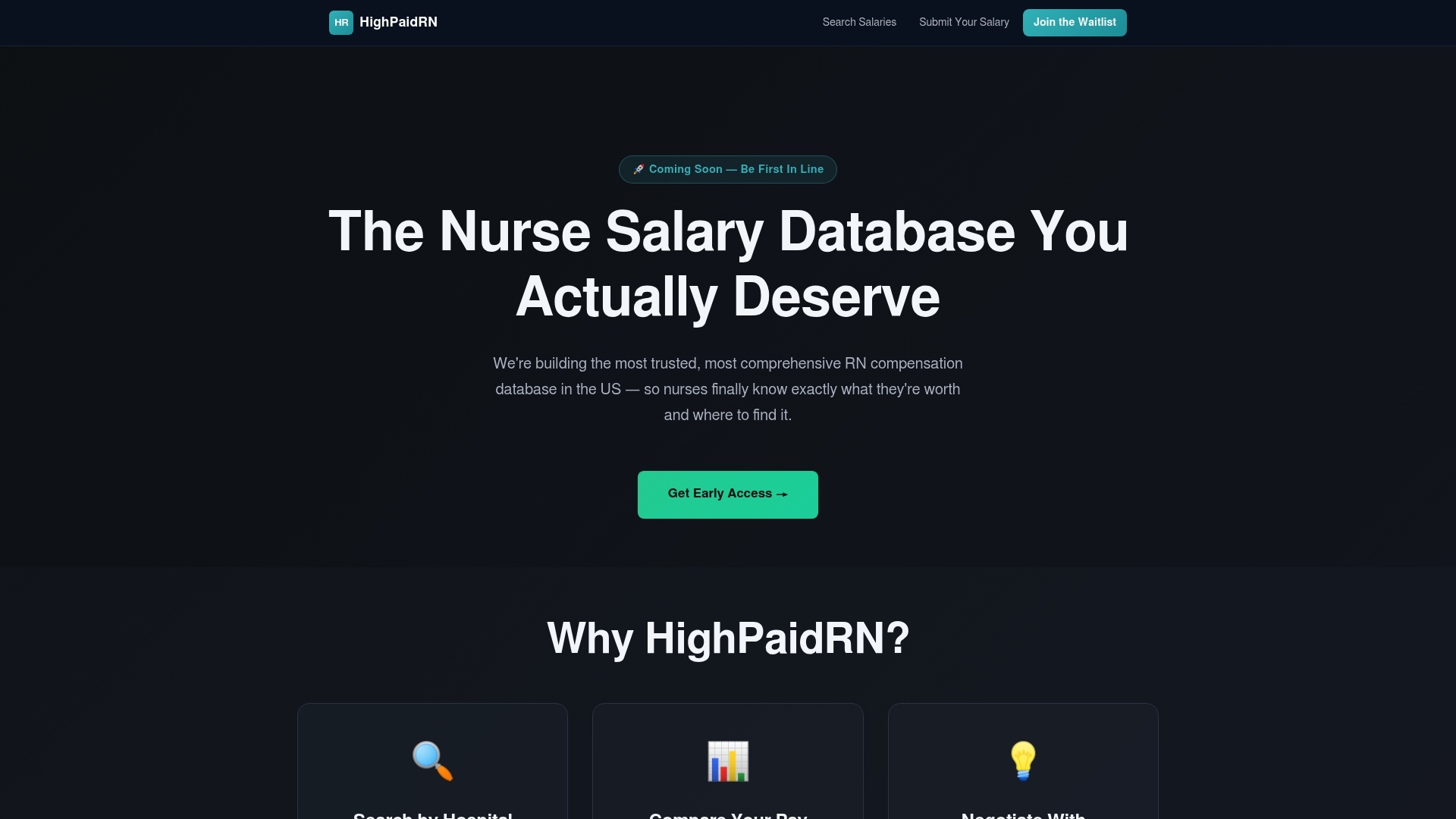
For an ICU nurse preparing to negotiate, that specificity is the difference between a vague market reference and a credible, sourced claim you can state with confidence on a call. The platform shows you percentile breakdowns so you can position your ask at the 65th or 75th percentile with a real number behind it. Certification tags and hospital-type filters mean your comparator actually matches your background.
Check your ICU salary benchmarks on HighPaidRN before your next negotiation call and walk in with data that is hard to dismiss.
Sources and further reading
-
HighPaidRN — Nurse Salary Transparency Platform: The primary tool for pulling ICU-specific, metro-level salary percentiles filtered by specialty and hospital type. Use this to build your one-line market claim before any negotiation call. Also see the HighPaidRN blog for deeper guides on salary negotiation for nurses and total compensation examples.
-
Bureau of Labor Statistics — Registered Nurses: Official occupational wage data by state and metro area. Use for a broad regional anchor and to cross-check your specialty data against the general RN market.
-
Glassdoor: Crowd-sourced salary reports useful for city-level context. Less granular than specialty-filtered platforms but helpful for confirming your benchmark is in the right range.
-
PayScale: Another crowd-sourced tool for city-level RN pay data. Best used alongside HighPaidRN and BLS rather than as a standalone source.
-
Regis College — Essential Tactics for Nursing Contract Negotiation: A solid overview of contract terms, benefits negotiation, and how to prepare for the salary conversation, particularly useful for NPs and experienced nurses.
-
Indeed — Nurse Negotiation Guide: Practical timing and scripting guidance, including the case for live conversations over email negotiation.