

Why pediatric nursing pays differently than other specialties
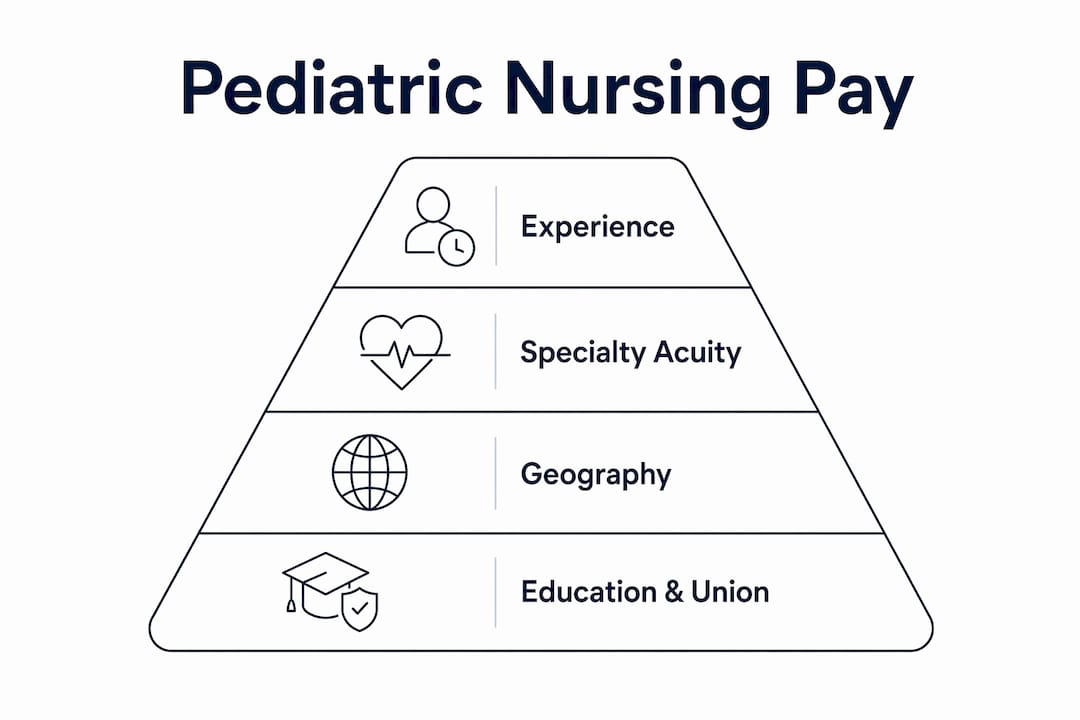
Pediatric nursing salaries differ from other nursing specialties because of a specific combination of acuity level, geographic market, years of experience, workplace setting, and certification status. These factors don't operate independently. They stack, and the gap between a new grad pediatric nurse in rural Alabama and a certified PICU nurse in San Francisco can be dramatic.
According to the BLS, pediatric nurses typically earn a range of annual salaries that vary by experience level and specialization. The BLS also reports the average nurse salary as $93,600 per year, which places pediatric nursing roughly in line with the broader RN average, though specialty and setting push individual salaries well above or below that midpoint.
Here's what drives the variation:
- Experience level: Entry-level pediatric nurses earn in the $58,000–$68,000 range; senior specialists can reach $110,000 or more
- Specialty acuity: PICU and NICU nurses command higher pay than general pediatric floor nurses due to skill complexity
- Geographic location: High-cost states like California and Massachusetts pay 40–60% more than rural southern states
- Workplace setting: Private specialty hospitals pay up to 25% more than educational or nonprofit institutions
- Education and certification: A BSN earns more than an ADN; a Certified Pediatric Nurse (CPN) credential adds $2,000–$5,000 annually
- Union status: Unionized nurses earn roughly 19% more than non-union peers
Table of Contents
- How pediatric nurse roles and responsibilities affect pay
- How does pediatric nurse pay change with experience?
- Which states pay pediatric nurses the most?
- Top pediatric nursing specialties ranked by earning potential
- How education and certification raise pediatric nurse salaries
- Unionization, workplace type, and shift differentials
- Key Takeaways
How pediatric nurse roles and responsibilities affect pay
Pediatric nursing covers a wide range of clinical environments, and the complexity of the role directly shapes compensation. A nurse managing post-op recovery for a 4-year-old after cardiac surgery operates in a fundamentally different clinical environment than one conducting well-child visits in an outpatient clinic.
General pediatric nursing duties include:
- Monitoring vital signs and developmental milestones in pediatric patients
- Administering medications with weight-based dosing calculations
- Educating families on care plans, discharge instructions, and chronic disease management
- Coordinating with pediatric physicians, therapists, and social workers
- Responding to rapid deterioration in patients who cannot always verbalize symptoms
High-acuity units like the Pediatric Intensive Care Unit (PICU) or Neonatal Intensive Care Unit (NICU) require additional competencies: ventilator management, hemodynamic monitoring, and the ability to interpret complex lab values in patients with limited physiologic reserve. These skills take years to develop and carry real clinical risk, which is why PICU nurses earn at the higher end of the pediatric nursing pay scale. Outpatient and school-based pediatric nurses, by contrast, work in lower-acuity settings with more predictable schedules, and their compensation reflects that difference.
How does pediatric nurse pay change with experience?

Experience is one of the most consistent drivers of salary growth in pediatric nursing. Pay increases are steepest in the first decade, then tend to level off or even dip slightly for nurses with 20 or more years on the job, possibly reflecting a shift toward lower-acuity or part-time roles later in careers.
| Career Stage | Experience Level | Average Hourly Rate | Estimated Annual Salary |
|---|---|---|---|
| Entry-level | Less than 1 year | — | $58,000–$68,000 range |
| Early career | 1–4 years | — | ~$66,000 |
| Mid-career | 5 years | — | — |
| Senior | 10–19 years | — | — |
| Late career | 20+ years | — | — |
Hourly figures sourced from ZipRecruiter pediatric nurse salary data.
The drop at 20-plus years is worth noting. It doesn't mean experienced nurses earn less over time universally. It often reflects a career pivot toward school nursing, case management, or per-diem work, all of which tend to pay lower hourly rates than acute care. For nurses who stay in hospital settings and pursue career-level salary benchmarks, the trajectory stays upward.
Pro Tip: If you're in your first five years of pediatric nursing, prioritizing acute care experience now builds the clinical credibility that justifies higher pay later, whether you stay bedside or move into advanced practice.
Which states pay pediatric nurses the most?
Geographic location creates some of the largest salary differences in nursing. The BLS confirms that California, Massachusetts, and Hawaii pay 40–60% above national averages for nurses, while rural southern states typically fall 15–25% below. California stands out: the BLS reports California RN pay at $66.20 per hour ($137,690 annually), with San Francisco reaching $83.83 per hour ($174,370 per year).
| State/Region | Pay Relative to National Average | Notes |
|---|---|---|
| California | 40–60% above | Highest RN pay in the U.S.; San Francisco tops at $174,370/yr |
| Massachusetts | 40–60% above | High cost of living; strong union presence |
| Hawaii | 40–60% above | Remote market; high demand, high cost |
| Washington | Above average | ZipRecruiter cites $124,010/yr for pediatric nurses |
| Rural South | 15–25% below | Lower cost of living; lower hospital budgets |
Cost of living matters here, but it doesn't fully close the gap. A pediatric nurse in San Francisco earning $174,000 still has substantially more purchasing power than the same nurse earning $65,000 in rural Mississippi, even after adjusting for housing costs. For a detailed breakdown of nursing wages by state, the regional differences go deeper than just coastal versus inland.
Urban settings consistently outpay rural ones within the same state. Cities carry higher patient volumes, more complex case mixes, and greater competition for qualified nurses, all of which push wages up.
Top pediatric nursing specialties ranked by earning potential
Not all pediatric nursing roles pay the same, even within the same hospital. Specialty complexity, certification requirements, and patient acuity create a clear pay hierarchy.
-
Pediatric Intensive Care Unit (PICU) nurse. PICU nurses manage the most critically ill pediatric patients, often requiring ventilator management, vasoactive drips, and rapid response skills. The acuity level places PICU salaries at the top of the pediatric nursing range. Nurses in this specialty often hold the CCRN (Pediatric) credential through the American Association of Critical-Care Nurses.
-
Neonatal Intensive Care Unit (NICU) nurse. NICU nurses care for premature and critically ill newborns, a population with extremely narrow physiologic margins. The specialized knowledge required, including thermoregulation, feeding tube management, and neonatal pharmacology, commands premium pay comparable to PICU.
-
Pediatric oncology nurse. Working with children undergoing chemotherapy, radiation, or bone marrow transplants demands both clinical precision and emotional resilience. Pediatric oncology nurses often work in specialty cancer centers that pay above general hospital rates.
-
Pediatric nurse practitioner (PNP). Advanced practice moves compensation into a different tier entirely. PNPs hold a master's or doctoral degree and function with significant clinical autonomy, which translates to salaries well above staff RN levels.
-
Pediatric cardiac nurse. Caring for children with congenital heart defects or post-cardiac surgery requires specialized training in hemodynamic monitoring and cardiac pharmacology. These nurses typically work in children's hospitals or large academic medical centers with higher pay scales.
-
Pediatric emergency nurse. Fast-paced, high-volume, and unpredictable, pediatric emergency nursing requires broad clinical skills and rapid decision-making. Emergency department shift differentials for nights and weekends add meaningfully to base pay.
-
Pediatric surgical nurse. Perioperative care for pediatric patients involves pre-op preparation, intraoperative assistance, and post-anesthesia recovery. Surgical settings in specialty children's hospitals tend to pay above community hospital rates.
For a broader look at specialty salary expectations across nursing, the pattern holds: higher acuity and narrower skill sets consistently command higher pay.
How education and certification raise pediatric nurse salaries
Degree level shapes both starting pay and long-term earning potential in pediatric nursing. An Associate Degree in Nursing (ADN) gets you licensed as an RN after roughly two years of school, but BSN nurses earn more and have broader advancement opportunities. Many hospital systems, particularly large academic medical centers and children's hospitals, now require or strongly prefer BSN-prepared nurses for hire.
- ADN: Qualifies for RN licensure after passing the NCLEX; lower starting pay; some employers limit advancement without a BSN
- BSN: Four-year degree; higher base pay; required by many specialty hospitals and Magnet-designated facilities
- MSN: Opens the door to advanced practice roles, clinical nurse specialist positions, and education roles with substantially higher salaries
- DNP: Doctoral-level preparation for nurse practitioners and clinical leaders; highest earning tier in nursing
Specialty certification adds another layer. The Pediatric Nursing Certification Board offers the Certified Pediatric Nurse (CPN) credential, which typically adds $2,000–$5,000 to annual pay. The American Association of Critical-Care Nurses offers the CCRN (Pediatric) for PICU nurses. The American Nurses Credentialing Center offers the Pediatric Nursing Certification (PED-BC). Each of these credentials signals clinical expertise to employers and often triggers a formal pay adjustment.
Certification also accelerates career advancement. Certified nurses tend to be prioritized for charge nurse roles, preceptor positions, and specialty unit transfers, all of which carry higher pay. The financial return on a certification exam fee is typically recovered within the first year of the pay increase.
Unionization, workplace type, and shift differentials
Beyond base pay, three structural factors shape total pediatric nurse compensation in ways that don't always show up in salary surveys: union membership, facility type, and shift differential pay.
Union membership
Unionized pediatric nurses earn roughly 19% more than non-union peers. The gap isn't just in base pay. Night shift differentials average $6.40 per hour for union nurses versus $2.85 per hour for non-union nurses. Union contracts also typically include stronger overtime protections, mandatory rest periods, and defined nurse-to-patient ratios that reduce burnout and unplanned turnover.
Workplace setting
Facility type creates consistent pay differences across the profession.
| Workplace Setting | Pay Level | Notes |
|---|---|---|
| Private specialty hospital | 10–25% above average | Highest pay; often children's hospitals or surgical centers |
| Large academic medical center | Above average | Strong benefits; union presence common |
| Community hospital | Near average | Variable by region and union status |
| Outpatient care center | Above average | BLS reports average of $102,640/yr for this setting |
| Educational/government institution | Below average | More predictable hours; lower base pay |
| School nursing | Lowest | Predictable schedule; significantly lower hourly rate |
Private specialty hospitals pay up to 25% more than educational or nonprofit settings. Outpatient care centers are a notable exception to the "hospital pays more" assumption: the BLS reports an average of $102,640 per year for pediatric nurses in that setting, above the overall average. For a detailed comparison of hospital types and nurse pay, the differences between facility categories are more pronounced than most nurses expect.
Shift differentials and overtime
Shift differential pay for nights, weekends, and holidays adds real dollars to annual income without requiring a promotion or a new credential. Overtime wages in most facilities run one and a half to three times the normal hourly rate. A pediatric nurse working four 12-hour shifts instead of three in a given week generates eight overtime hours, and those hours compound quickly over a year.
Sign-on bonuses are another factor, particularly in high-demand markets. These range from a few hundred dollars to several thousand, though they typically come with a commitment period of two to five years. Leaving before that window closes usually requires repaying a prorated portion of the bonus.
Pro Tip: Before accepting a sign-on bonus, calculate the total value of the commitment period against the opportunity cost of staying. A $10,000 bonus tied to a three-year contract may cost you more in foregone salary growth than it pays.
Key Takeaways
Pediatric nursing salaries vary widely because experience, specialty acuity, geographic location, education level, and union status each pull compensation in different directions, often simultaneously.
| Point | Details |
|---|---|
| Salary range is wide | Pediatric nurses earn $58,000–$110,000 annually, with specialists reaching higher based on acuity and setting. |
| Location creates the largest single gap | California and Massachusetts pay 40–60% above national averages; rural southern states pay 15–25% below. |
| Certification pays off quickly | A CPN credential adds $2,000–$5,000 per year, typically recovering the exam cost within the first year. |
| Union membership raises total compensation | Unionized nurses earn roughly 19% more, with night shift differentials more than double non-union rates. |
| Workplace type matters as much as specialty | Private specialty hospitals pay up to 25% more than educational or nonprofit settings for the same role. |
Knowing where you stand relative to verified market data is the first step toward negotiating pay you've actually earned. HighPaidRN gives you a salary database filtered by specialty, state, hospital type, and employment condition, so you can walk into any salary conversation with real numbers behind you.

Compare your pediatric nursing salary against verified market data on HighPaidRN and see exactly where you rank in your state and specialty.