

A 13-week travel nursing contract pays you a taxable hourly base rate plus non-taxable stipends for housing and meals. Your real take-home over those 13 weeks is a combination of taxable wages and tax-free allowances, not a single hourly figure. Understanding that split, along with guaranteed hours, overtime rules, and your tax-home status, is what separates a good offer from one that looks better on paper than it pays in practice.
Before you sign anything, check these five elements in every offer:
- Taxable hourly base rate (typically varies depending on specialty and location)
- Housing stipend (weekly, non-taxable if you maintain a permanent tax home)
- Meals and incidentals (M&IE) stipend (weekly, same tax-home condition applies)
- Guaranteed hours clause (protects your income during low-census cancellations)
- Overtime calculation method (usually time-and-a-half of the taxable base rate, not a blended rate)
Pro Tip: Before you sign, ask the agency for a written breakdown showing taxable base wages versus each stipend line item, plus a sample paystub. If they can't produce one, that's a red flag worth taking seriously.
Table of Contents
- Why 13 weeks became the standard travel nursing contract length
- How pay is structured on a 13-week contract: components and a worked sample
- How hours and overtime work on a 13-week contract
- Taxes and the tax home concept: which pay is taxable and why it matters
- How to calculate your expected take-home pay for a 13-week contract
- Common mistakes nurses make when evaluating 13-week pay packages
- Extensions, benefits, and career considerations tied to 13-week contracts
- Key Takeaways
- Why running the numbers before you sign actually changes what you accept
- HighPaidRN gives you the market data to negotiate with confidence
- Sources and further reading
Why 13 weeks became the standard travel nursing contract length
Thirteen weeks is the recognized U.S. benchmark for travel nursing assignments, though contracts can run anywhere from 8 to 26 weeks depending on facility need. The 13-week window works for both sides: it's long enough for a nurse to complete credentialing and orientation and make a meaningful contribution to the unit, yet short enough that the hospital retains staffing flexibility if census shifts or a permanent hire fills the role.
From a pay-security standpoint, the contract length matters less than the specific clauses inside it. Before you accept, verify:
- Pay frequency — (weekly is most common in travel nursing; confirm biweekly or monthly if the contract states otherwise)
Extensions are common when the nurse-facility fit is strong. Industry data describes 13 weeks as intentionally long enough for meaningful contribution but short enough to avoid long-term lock-in, which is exactly why facilities use it as a default and why extensions follow naturally when both parties want to continue.
How pay is structured on a 13-week contract: components and a worked sample

Travel nurse pay is a composite package. Typical weekly gross earnings range from $1,700 to $3,200. What matters is how that total splits between taxable and non-taxable components.
The pay components
- Travel reimbursements: — Reimbursed travel costs (mileage, airfare) are typically non-taxable when documented and within IRS limits.
Component breakdown at a glance
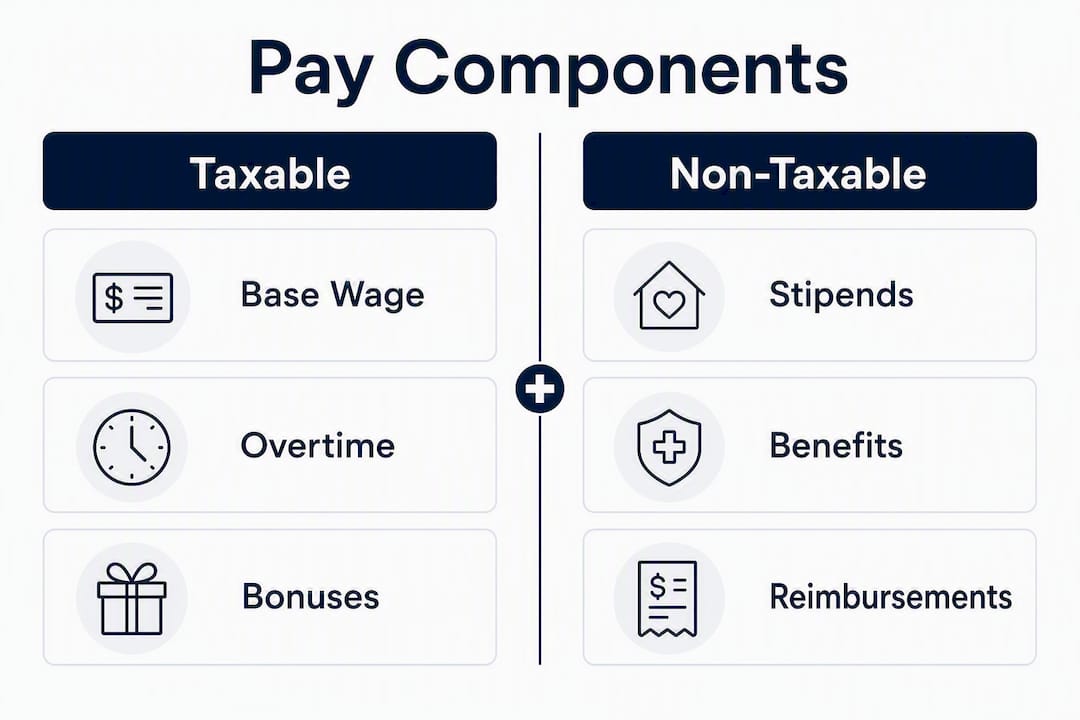
| Component | Taxable? | Typical payment method | Where to confirm |
|---|---|---|---|
| Hourly base rate | Yes | Hourly wage on each paycheck | Contract rate sheet |
| Housing stipend | No (if tax home maintained) | Weekly lump sum | Contract stipend schedule |
| M&IE stipend | No (if tax home maintained) | Weekly lump sum | Contract stipend schedule |
| Shift differential | Yes | Added to hourly wage | Contract or facility policy |
| Overtime | Yes | Time-and-a-half of base rate | Contract overtime clause |
| Sign-on/completion bonus | Yes | Lump sum (per contract terms) | Bonus addendum |
| Travel reimbursement | No (if documented) | Lump sum or mileage rate | Reimbursement policy |
| License reimbursement | No (if business expense) | Direct payment or reimbursement | Agency policy |
Worked sample: one week and 13-week total
Using a realistic mid-range contract for an ICU nurse in a mid-cost city:
-
Taxable base rate example: $28/hour × 36 hours = taxable wages
-
Housing stipend example: a weekly non-taxable amount
-
Meals and incidentals (M&IE) stipend example: a weekly non-taxable amount
-
Weekly gross package example: sum of taxable wages and stipends
-
Tax-free portion example: a significant part of the weekly package
Over 13 weeks (no overtime): $2,254 × 13 = $29,302 total gross package, of which $13,104 is taxable wages and $16,198 is tax-free stipends.
Pro Tip: Ask the agency to show you the overtime calculation method in writing. Some agencies calculate overtime on a blended rate that includes stipends, which can actually reduce your overtime premium. The correct and most common method is time-and-a-half of the taxable base rate only.
How hours and overtime work on a 13-week contract
Most 13-week contracts schedule nurses for 36–48 hours per week, with 36 hours (three 12-hour shifts) being the most common structure. The exact schedule depends on the facility, the unit, and the contract terms you negotiate.
A guaranteed-hours clause protects your income when patient census drops. Without that language, a hospital can send you home early or cancel a shift with no pay obligation. Always confirm:
- How many hours per week are guaranteed in writing
- Whether canceled shifts count toward your guaranteed total
- How float assignments to other units are handled and paid
- Whether mandatory overtime is required and how it is compensated
Overtime calculation: the math that matters
Overtime is typically calculated on the taxable base rate, not on a blended figure that folds in stipends. Using the sample contract above:
- Taxable base rate: $28/hour
- Overtime rate is generally time-and-a-half the taxable base rate
- One overtime shift example: 4 hours paid at overtime rate, adding to taxable pay
If an agency advertises a "blended rate" of $45/hour and calculates overtime on that figure instead, the math looks more favorable but may not reflect how your actual paycheck is calculated. The standard under the Fair Labor Standards Act is overtime after 40 hours in a workweek, though some states (California, for example) apply daily overtime rules. Check the law for your assignment state before you accept.
Key callout: Confirm in writing how canceled shifts, float requirements, and mandatory overtime are paid. A contract that looks strong on paper can fall short if low-census cancellations are frequent and your guaranteed-hours clause has gaps.
Taxes and the tax home concept: which pay is taxable and why it matters
The tax-home concept is the foundation of travel nurse pay. Get it right and a large portion of your package is tax-free. Get it wrong and the IRS can reclassify your stipends as ordinary income on audit.
Taxable vs. non-taxable: the core split
- Taxable: Hourly base wages, overtime pay, shift differentials, sign-on and completion bonuses
- Non-taxable (conditional): Housing stipend and M&IE stipend, but only when you maintain a bona fide permanent tax home AND the stipend amounts do not exceed GSA per-diem rates for the assignment city
The IRS defines your tax home as your principal place of business or employment, not necessarily where you sleep. For travel nurses, this typically means the area where you live permanently and pay ongoing expenses (rent, mortgage, utilities) even while on assignment. The IRS Publication 463 covers the rules in detail.
What can go wrong
Stipends that exceed GSA per-diem limits for the assignment location, or a nurse who cannot demonstrate a genuine permanent tax home, risk having those stipends reclassified as taxable wages on audit. That reclassification can create a significant unexpected tax bill.
What to do before each assignment
- Look up the GSA per-diem rate for the assignment city and confirm your stipends do not exceed those limits
- Document your permanent tax home: keep receipts, a lease or mortgage statement, and utility bills showing ongoing expenses at your home address
- Ask the agency to justify any stipend amounts that seem unusually high relative to the assignment city's GSA rate
- Consult a tax professional who works with travel healthcare workers, especially if this is your first assignment
A high stipend-to-base ratio can increase your net pay, but it also draws IRS attention. Agencies that load the package heavily toward stipends and keep the taxable base very low are a known audit trigger.
How to calculate your expected take-home pay for a 13-week contract
Running this math before you sign takes about 20 minutes and can save you from a contract that pays less than it appears. Here is a repeatable six-step process.
Step-by-step checklist
- Get the written breakdown. Request taxable base rate, each stipend amount, any bonuses, and the overtime calculation method in writing from the agency.
- Confirm guaranteed hours and overtime rules. Verify the guaranteed weekly hours and the overtime threshold (usually 40 hours, but check your assignment state).
- Look up GSA per-diem for the assignment city. Confirm your housing and M&IE stipends fall within those limits.
- Estimate federal and state tax withholding. Apply your effective federal tax rate to the taxable portion only. Add Social Security (6.2%) and Medicare (1.45%). Factor in state income tax for the assignment state — rates vary widely, and some states have no income tax.
- Add known deductions. Include health insurance premiums (if you opt into agency coverage), any agency fees disclosed in the contract, and retirement contributions if applicable.
- Calculate net weekly and 13-week totals. Add your after-tax wages to your tax-free stipends, then subtract deductions.
Worked numeric example
Using the same sample contract (ICU nurse, $28/hour base, 36 hours/week, $770 housing + $476 M&IE):
- Example gross taxable wages per week: base rate multiplied by hours worked
- Estimated tax withholding applies to taxable wages based on your tax rates
- Net taxable wages calculated after federal and state withholding
- Total tax-free stipends equal housing and M&IE amounts combined
- Estimated weekly take-home includes net taxable wages plus tax-free stipends
- After deducting health insurance premiums and other deductions, net pay is calculated
- Estimated take-home pay calculated over the full assignment length
For real 2026 paycheck examples across different specialties and locations, HighPaidRN's blog breaks down actual contract math so you can see how these numbers shift by market.
Pro Tip: Run this calculation for every offer you receive, not just the one you're leaning toward. A contract with a lower advertised weekly gross can produce higher take-home pay if the taxable base is structured correctly and stipends are within GSA limits.
Common mistakes nurses make when evaluating 13-week pay packages
Most evaluation errors come down to comparing the wrong numbers. Here are the ones that cost nurses the most.
Focusing on the blended hourly rate. Agencies often advertise a single "all-in" hourly figure that averages taxable wages and tax-free stipends. That number is a marketing figure. It inflates perceived earnings because it bundles tax-free money with taxable wages as though they're equivalent. Always ask for the split.
Ignoring the guaranteed-hours clause. A contract that pays $2,400/week on paper pays considerably less if low-census cancellations drop your hours from 36 to 24 two weeks out of thirteen. Without guaranteed-hours language, that reduction is legal and immediate.
Assuming overtime is calculated on the blended rate. Overtime is almost always calculated on the taxable base rate, not the blended figure. An agency that calculates overtime on a blended rate that includes stipends may actually be paying you less per overtime hour than the law requires. Confirm the method in the contract before you sign.
Not requesting a sample paystub. Travel healthcare contract guides consistently advise requesting a sample paystub before signing. It shows you exactly how the agency formats taxable wages, stipends, deductions, and overtime on an actual check, not just in a summary sheet.
Comparing gross weekly figures across agencies without normalizing. Two agencies offering "$2,200/week" may have completely different taxable-to-stipend splits, different guaranteed-hours terms, and different benefit deductions. The only valid comparison is estimated net take-home after taxes and deductions, using the same hours assumption for both.
Extensions, benefits, and career considerations tied to 13-week contracts
A 13-week assignment is long enough to evaluate whether a unit, specialty, or city fits your career goals. That's one of its underappreciated advantages.

How extensions work
Extensions are common when the nurse-facility relationship is strong. Most agencies will approach you about an extension two to four weeks before your end date. Key questions to ask:
- Will the pay rate change at extension, or stay the same?
- Are stipend amounts renegotiated, or locked to the original contract?
- Is the extension a new contract (with a new guaranteed-hours clause) or an addendum to the existing one?
Benefits: what may or may not be included
Benefits in 13-week contracts vary significantly by agency. Before you accept, verify:
- Health insurance: Some agencies offer coverage starting day one; others have a waiting period or require you to opt in. Compare the premium cost against marketplace alternatives.
- Retirement contributions: 401(k) options exist at some agencies but are not universal. Contribution matching, if offered, is worth factoring into total compensation.
- Continuing education and certifications: Some agencies cover CEU costs; many do not. Confirm in writing.
- License reimbursement: Many agencies advance or reimburse state licensure fees, but the method (direct payment vs. reimbursement after completion) affects your cash flow. Check whether a repayment clause applies if you leave early.
Career considerations
The 13-week model gives you something a permanent position rarely does: a structured, low-risk way to evaluate specialty and unit fit before committing. Each completed assignment adds a credentialed, verifiable line to your resume. Nurses who complete multiple assignments in high-demand specialties often find their negotiating position strengthens with each contract.
When deciding whether to extend or move on, weigh the pay rate against the market rate for that specialty and location, the quality of the unit environment, and your personal goals. An extension at a below-market rate in a unit you enjoy may still be worth it. An extension at a below-market rate in a difficult environment rarely is.
Key Takeaways
A 13-week travel nursing contract pays a taxable hourly base rate plus conditional tax-free stipends, and your real take-home depends on guaranteed hours, overtime calculation method, and whether your stipends comply with IRS tax-home and GSA per-diem rules.
| Point | Details |
|---|---|
| Pay is a composite package | Every offer combines taxable wages and non-taxable stipends; compare net take-home, not gross weekly figures. |
| Tax-free stipends are conditional | Housing and M&IE stipends are only non-taxable if you maintain a bona fide permanent tax home and stay within GSA per-diem limits. |
| Guaranteed hours protect your income | Without a guaranteed-hours clause, facilities can legally reduce your scheduled hours during low census with no pay obligation. |
| Overtime runs on the taxable base | Time-and-a-half applies to your taxable hourly base rate, not a blended rate; confirm the method in writing before signing. |
| HighPaidRN benchmarks your offer | Use HighPaidRN's salary database to compare your contract's taxable base and total package against verified market data by specialty and state. |
Why running the numbers before you sign actually changes what you accept
Most nurses who have worked a few travel contracts will tell you the same thing: the offer that looked best on the agency summary sheet was not always the one that paid best. The gap between advertised weekly gross and actual take-home is real, and it's wide enough to matter across 13 weeks.
The conventional advice is to "compare total compensation." That's correct but incomplete. What actually changes decisions is doing the specific math: separating taxable wages from stipends, applying your real tax rate to the taxable portion, checking GSA per-diem for the assignment city, and confirming the guaranteed-hours clause is specific enough to protect you. Nurses who skip that process often discover the discrepancy on their first paystub rather than before they signed.
The other thing worth saying plainly: agencies are not adversaries, but they are businesses. A package structured with a very low taxable base and very high stipends may maximize your short-term net pay, but it also creates audit exposure and reduces your Social Security earnings record over time. That tradeoff is worth understanding before you optimize for it.
Use sample paystubs, benchmark against verified market data, and document your permanent tax home for every assignment. Those three habits protect your income and your tax position simultaneously.
HighPaidRN gives you the market data to negotiate with confidence
Knowing the math is one thing. Knowing whether your offer is competitive for your specialty and location is another. HighPaidRN is a salary transparency platform built specifically for registered nurses, with a searchable database of verified compensation data segmented by state, specialty, hospital type, and employment condition.

For travel nurses evaluating a 13-week offer, that means you can look up what ICU nurses, ER nurses, or OR nurses are earning in the assignment city, see how your taxable base rate compares to the market, and walk into a negotiation with real numbers rather than guesswork. The platform's advanced filters let you isolate travel contracts specifically, so you're comparing like-for-like rather than averaging staff and travel pay together.
Nurses also contribute anonymously to the database, which means the data reflects current market conditions rather than outdated surveys. Start benchmarking your next 13-week offer on HighPaidRN and see exactly where your package stands before you sign.
Sources and further reading
These are the primary and authoritative sources to consult when verifying tax-home rules, per-diem limits, overtime law, and pay benchmarks for travel nursing assignments in the United States.
- IRS Publication 463 — Travel, Gift, and Car Expenses: The IRS's own guidance on tax-home rules, deductible travel expenses, and per-diem substantiation. Required reading before your first assignment.
- GSA Per Diem Rates: Look up the current federal per-diem rate for any U.S. city to confirm your housing and M&IE stipends are within non-taxable limits.
- IRS.gov — Tax Topics for Workers: Broader IRS guidance on withholding, W-2 reporting, and self-employment tax considerations for contract workers.
- Bureau of Labor Statistics — Registered Nurses: National wage data for RNs, including median pay and employment outlook, useful for benchmarking permanent versus travel compensation.
- TravelNursing.org — How Does Travel Nursing Work?: Practical FAQ on assignment structure, pay, and agency relationships for nurses new to travel contracts.
- HighPaidRN — Nurse Salary Transparency Platform: Verified salary data by state, specialty, and hospital type; use it to benchmark any 13-week offer against current market rates.
- HighPaidRN Blog — RN Total Compensation Examples: Worked examples of taxable versus non-taxable pay components across nursing specialties.