

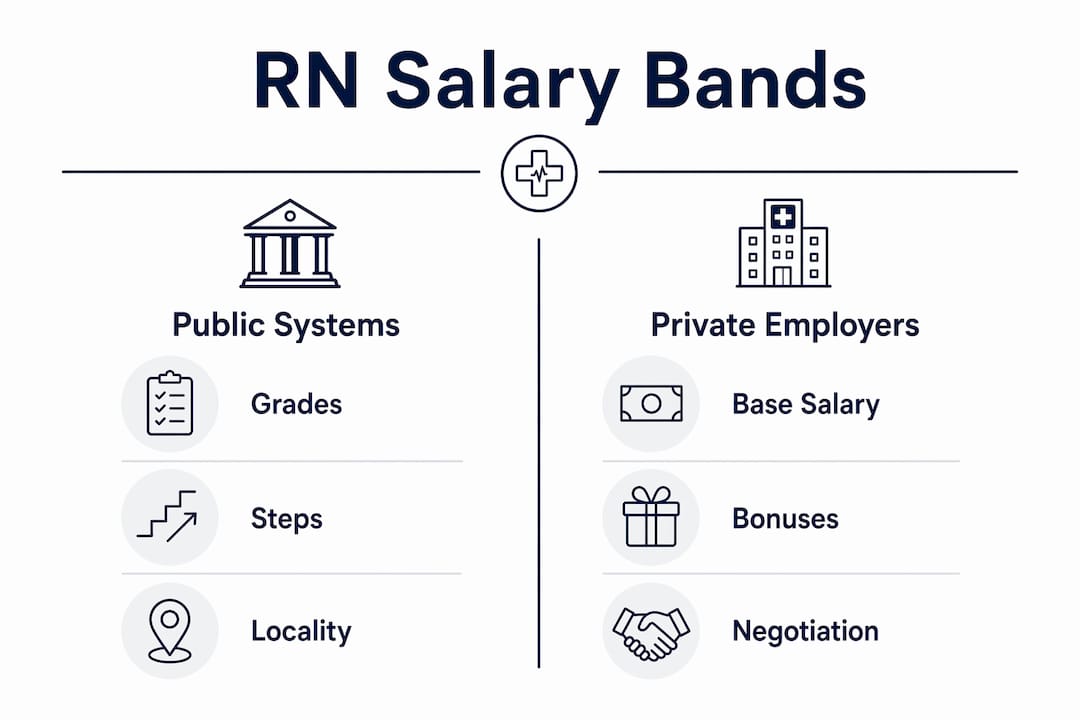
Most U.S. registered nurses do not work under a single national salary band. The two clear exceptions are the U.S. Department of Veterans Affairs (VA) under Title 38 authority and state civil service systems, where publicly available grade/step tables govern pay. If you work for a private hospital or health system, your employer almost certainly uses an internal, market-based scale that is not published anywhere you can easily look it up.
Here is what you need to know at a glance:
- Where formal bands exist: VA (Title 38 grade/step system with locality pay) and state civil service systems (Washington, California, and others publish classification salary ranges on their Office of Financial Management or HR websites).
- National benchmark: The BLS median annual wage for registered nurses was $93,600 in May 2024, with the lowest 10% earning less than $66,030 and the highest 10% earning more than $135,320. That spread tells you how much geography, specialty, and employer type can move the number.
- Your immediate next step: If you work for the VA, pull the current Title 38 pay table for your facility's locality. If you work in state civil service, search "[Your State] OFM RN salary range" to find your classification. If you work in private healthcare, request your employer's pay range in writing and benchmark it against BLS state data.
Table of Contents
- How RN salary bands and pay scales actually work
- How VA nurse pay works under Title 38
- How state civil service RN pay tables work, and how to find yours
- How private hospitals and travel nursing differ from banded public systems
- How to read your pay table and calculate total compensation
- How nurses typically increase pay: promotions, certifications, and negotiation
- Key Takeaways
- Why pay transparency matters more than most nurses realize
- HighPaidRN gives you verified salary data to back every negotiation
- Primary sources to verify your RN pay data
How RN salary bands and pay scales actually work
The term "salary band" gets used loosely, so it helps to pin down what each piece of the pay structure means before you try to read a table.
Band or grade refers to a defined pay tier, usually tied to role level, education, or scope of practice. In the VA system these are called grades; in the UK's NHS they are called bands (Band 5, Band 6, and so on). The two systems are structurally similar but entirely separate. If you have seen references to "Band 5" nursing pay, that is the NHS Agenda for Change system in the United Kingdom, not a U.S. designation.

Step is the position within a grade. Most federal and state systems assign steps numbered 1 through 10 or 1 through 15. Each step represents a fixed dollar increment above the previous one. You move through steps either automatically after a set period (time-in-grade) or through a merit-based review, depending on the employer's rules.
Base pay is the raw salary before any adjustments. Locality adjustment is a geographic supplement applied on top of base pay to account for cost-of-living differences between markets. In the VA system, locality is the single biggest variable between two nurses at the same grade and step in different cities. Shift differential is an additional hourly premium for evening, night, or weekend shifts. Clinical ladder is a private-sector equivalent of a grade system, where hospitals assign nurses to levels (typically Nurse I through Nurse IV or similar) and attach pay ranges to each level.
Pro Tip: Before you compare two offers, ask each employer for the full step schedule and the overtime calculation method. A higher base at Step 1 can be worth less over three years than a lower base with faster step progression.
Where to find official rules: collective bargaining agreements (your union rep or the state labor relations board), your state's HR or OFM website, and the VA's Title 38 pay guidance.
How VA nurse pay works under Title 38
The VA operates under Title 38 of the U.S. Code, which gives it separate pay authority from the General Schedule used for most federal civilian employees. That authority lets the VA set nurse-specific grades and steps rather than forcing RNs into the GS framework.
The grade and step structure
VA nurses are assigned a grade (typically Nurse I through Nurse IV, with Nurse I covering entry-level staff RNs and Nurse IV covering advanced practice and leadership roles) and a step within that grade. Grade assignment depends on education, licensure, and scope of practice. Step assignment reflects experience and time-in-grade. The combination of grade and step produces a base pay figure from the published pay table.
How locality pay changes the final number
Locality adjustments are applied as a percentage supplement to base pay, and they vary by the VA facility's geographic area. Two nurses at Grade II, Step 5 can have meaningfully different gross pay depending on whether they work in a high-cost metro area or a rural facility. The VA pay and locality guidance publishes locality maps and the corresponding percentages, which you can use to preview an offer before you accept it.

A sample pay-table structure (illustrative)
| Grade | Step | Base Pay (illustrative) | Locality % | Gross Pay |
|---|---|---|---|---|
| Nurse II | Step 3 | — | 28.9% | — |
| Nurse II | Step 5 | $78,000 | 28.9% | $100,542 |
| Nurse III | Step 2 | $88,000 | 28.9% | — |
| Nurse III | Step 5 | — | 28.9% | — |
These figures are illustrative only. Always verify against the current official VA pay table for your specific facility and locality.
Step-by-step: calculating your VA offer
- Locate the current VA Title 38 pay table (search "VA Title 38 nurse pay table" on va.gov or usajobs.gov).
- Identify your assigned grade and step from your offer letter.
- Find the base pay figure at that grade/step intersection.
- Look up the locality percentage for your facility's geographic area on the VA locality pay page.
- Multiply base pay by (1 + locality percentage) to get your adjusted gross pay.
- Add any applicable shift differentials (typically 10% for evenings, 15–25% for nights) to your hourly equivalent.
- Factor in the federal benefits package: health insurance, FEHB contributions, TSP retirement match, and leave accrual.
Pro Tip: Use the VA locality lookup before your interview, not after. Knowing the locality percentage for the specific facility lets you calculate the exact gross pay and compare it to private offers on equal footing.
How state civil service RN pay tables work, and how to find yours
Many states publish their RN classification salary ranges on a public-facing HR or Office of Financial Management (OFM) website. Washington State is one of the clearest examples: the Washington OFM salary range page lists the classification code, job title, and the salary steps or min/mid/max range for each nursing classification.
A typical state salary range row looks like this: a classification code, a job title such as "Registered Nurse 2," and a series of salary steps ranging from a minimum (entry into the classification) to a maximum (top of the range). Some states publish a simple three-column min/mid/max table; others publish every step individually.
How to find your state's pay table
Step 1: Identify the agency. Most states house pay schedules under the Department of Human Resources, the Office of Financial Management, or the State Personnel Board. Search "[Your State] state employee pay schedule" or "[Your State] OFM salary range."
Step 2: Find the RN classification. State civil service systems classify nurses under titles like "Registered Nurse," "Public Health Nurse," or "Correctional Nurse." Each classification has a code. Search the classification listing for "nurse" to find the relevant codes.
Step 3: Pull the salary range PDF. Most states publish annual or biennial pay schedules as downloadable PDFs. Download the current version and locate your classification code.
Step 4: Check for union or collective bargaining overrides. This is where many nurses get tripped up. A published state pay table shows the base range, but if your position is covered by a collective bargaining agreement, the union contract may set higher minimums, faster step progression, or additional differentials. Always cross-check the pay table against the current CBA for your bargaining unit.
Geography also matters at the state level. Some states apply geographic differentials for high-cost regions, similar to the VA's locality system. California's state civil service system, for example, applies geographic pay differentials in the San Francisco Bay Area. The BLS state-level wage data can help you calibrate whether a state offer is competitive for your region.
How private hospitals and travel nursing differ from banded public systems
Understanding where you sit in the pay landscape means knowing which system governs your pay. The differences between public banded systems and private employer models are substantial.
Public banded systems (VA and state civil service):
- Governing authority: federal (VA/Title 38) or state HR/OFM
- Scale type: grade/step with published ranges
- Pay calculation: base pay + locality adjustment + shift differential
- Progression: automatic steps tied to time-in-grade or merit review
- Transparency: pay tables are publicly available before you apply
Private hospital and health system pay:
- Governing authority: individual employer, often informed by market surveys (Mercer, Hay Group, or similar)
- Scale type: internal market-based scale or clinical ladder (Nurse I–IV)
- Pay calculation: base hourly rate + shift differential + annual merit increase (if budget allows)
- Progression: promotion, lateral moves, or employer budget cycles; automatic step increases are rare
- Transparency: ranges are typically internal; you often have to ask HR directly
Travel nursing contracts:
- Governing authority: staffing agency contract (8–13 week assignments)
- Scale type: contract-based; no grade/step structure
- Pay calculation: high base hourly rate + tax-free housing stipend + per-diem allowance
- Progression: renegotiated at each contract renewal
- Transparency: varies by agency; travel nurse total earnings can look very different from staff RN pay when stipends are included
The practical tradeoff is predictability versus ceiling. A VA or state civil service RN knows exactly what their pay will be in three years based on the published step schedule. A travel RN can earn significantly more in the short term through stipends and contract bonuses, but without the same retirement contributions, health benefit stability, or automatic progression. Private staff RN roles sit in the middle: more ceiling than civil service, less predictability than either. Understanding why nurse wages differ by employer helps you weigh those tradeoffs before you sign.
How to read your pay table and calculate total compensation
A pay table tells you base pay. Total compensation is the number that actually matters for comparing offers. Here is how to build the full picture.
Total compensation components
| Component | Example Value | How to Calculate |
|---|---|---|
| Base pay (annual) | $78,000 | From grade/step table or offer letter |
| Locality adjustment | +28.9% | Base × locality % (VA) or geographic diff (state) |
| Shift differential | +$3.50/hr | Hourly rate × diff % × hours worked per shift type |
| Overtime | time-and-a-half hourly | (Annual base ÷ 2,080) × 1.5 × OT hours |
| Employer health premium | ~$8,400/yr | Employer share of monthly premium × 12 |
| Retirement match | ~$3,120/yr | Base × match % (e.g., 4% match on $78,000) |
| Paid time off value | several thousand dollars per year | (Annual base ÷ 2,080) × PTO hours accrued |
All figures are illustrative. Verify each component against your offer letter, benefits summary, and pay table.
Worked example
Take a hypothetical VA Nurse II, Step 5 with a base pay of $78,000 and a locality adjustment of 28.9% (a mid-range metro area). Adjusted gross pay comes to $100,542. Add night shift differentials for three 12-hour night shifts per week: at roughly $3.50/hr extra, that adds approximately $5,460 annually. Employer health premium contribution of $8,400 and a TSP retirement match of $3,120 bring the total compensation package to approximately $117,522 before overtime.
That same nurse at a private hospital with a base of $88,000, no locality adjustment, a smaller health premium contribution, and no automatic step increases might show a higher headline salary but lower total compensation once benefits are factored in. Always run the full calculation, not just the base comparison.
Quick verification tip: Check your pay stub's payroll codes against your offer letter. Differentials should appear as separate line items. If a differential you were promised is missing, flag it with payroll immediately rather than waiting for year-end.
How nurses typically increase pay: promotions, certifications, and negotiation
Pay increases inside most nursing roles come from a predictable set of levers. Knowing which ones apply to your employer type saves time and focuses your effort.
-
Time-in-grade step increases (VA and state civil service). These are automatic in most public systems. Know your step schedule and track your anniversary date. If a step increase does not appear on your paycheck, follow up with HR in writing.
-
Clinical ladder advancement (private hospitals). Most hospital systems with clinical ladders require a formal application, a portfolio of practice evidence, and a peer review. Advancing from Nurse II to Nurse III typically comes with a defined pay increase. Ask your manager for the ladder criteria and timeline before you start the process.
-
Specialty certification differentials. Many employers pay a flat annual bonus or hourly premium for certifications like CCRN, CEN, or CNOR. The nursing specialty salary expectations guide breaks down which certifications carry the most pay weight by specialty. Document your certification and submit it to HR with a written request for the differential.
-
Shift selection. Night and weekend differentials can add thousands of dollars annually to your base. If you are early in your career and the step schedule is slow, selecting a night shift position is one of the fastest ways to increase take-home pay without changing employers.
-
Charge and lead roles. Charge nurse premiums are common in both public and private systems. Even a modest charge differential of $1–2/hr adds up across a full-time schedule.
-
Employer switching. In private systems where automatic step increases are rare, lateral moves to a new employer at a higher starting rate are often the most effective pay lever available. Many nurses find that switching employers every two to three years produces larger increases than staying in the same system and waiting for merit reviews.
-
Negotiation with documented market data. This is where preparation separates nurses who get the ask from those who do not.
Negotiation checklist
Bring these to any salary conversation with HR or a hiring manager:
- The official pay table for your grade/step (VA or state) or the published salary range if your employer has disclosed it
- BLS median RN wage for your state and employment setting
- Local market comparables filtered by specialty and hospital type
- Your certification list and any documented clinical ladder level
- A specific number, not a range; asking for a range signals flexibility downward
Sample phrasing: "Based on the current [VA/state] pay table for this grade and the BLS median for [state], my ask is $[X]. I am happy to walk through the data I used."
Pro Tip: Use HighPaidRN to pull verified, specialty-filtered salary reports for your metro area before any negotiation. Bringing a printed comparable from a named database carries more weight with HR than a general statement about market rates. Cross-check those figures against BLS state data and your official pay table to build a three-source case.
Key Takeaways
Formal RN salary bands exist primarily in the VA (Title 38) and state civil service systems; most private employers use internal market-based scales that require direct inquiry to access.
| Point | Details |
|---|---|
| Where bands exist | VA (Title 38 grade/step) and state civil service systems publish pay tables publicly. |
| National benchmark | BLS May 2024 median RN wage is $93,600; lowest 10% earn less than $66,030 and highest 10% earn more than $135,320. |
| Locality is the hidden variable | Two VA nurses at the same grade/step can earn different gross pay based on facility location. |
| Private systems require direct inquiry | Clinical ladders and market-based scales are internal; always ask HR for the written pay range. |
| HighPaidRN for market comparables | Use HighPaidRN to filter verified RN salary data by state, specialty, and employer type before negotiating. |
Why pay transparency matters more than most nurses realize
The gap between nurses who negotiate confidently and those who accept the first number offered almost always comes down to information. Public pay tables, whether from the VA or a state OFM page, give you a factual anchor that is hard for an employer to argue against. When you can point to a published grade/step row and say "this is what the table shows," the conversation shifts from opinion to arithmetic.
What most guides understate is how much the structure of a pay system shapes long-term earnings, not just the starting number. A VA nurse at Nurse II, Step 1 who advances through the step schedule over five years will see predictable, compounding increases. A private-sector nurse who accepts a higher starting base but works in a system with no automatic steps may find that their pay has barely moved three years later, while their VA counterpart has closed the gap. The step schedule is the asset, not the headline rate.
The other thing worth saying plainly: salary databases like HighPaidRN do not replace official pay tables. They complement them. A database tells you what nurses in comparable roles at comparable facilities are actually earning, which is often different from what the official range says. Using both together gives you the strongest possible position in any pay conversation. Pull your official table, pull your local market data, and walk in with both.
HighPaidRN gives you verified salary data to back every negotiation

Knowing the official pay table is step one. Knowing what nurses at comparable hospitals in your metro area are actually earning is step two. HighPaidRN is built for exactly that second step: a salary database where RNs report verified compensation data filtered by state, specialty, hospital type, and employment condition.
Before your next contract renewal or job offer, use HighPaidRN to pull a filtered comparable report for your specialty and location. You can see reported ranges for staff RNs, travel RNs, and ICU specialists side by side, then export those comparables to bring to HR. The data is anonymously contributed by working nurses, which means it reflects real take-home figures rather than posted ranges that employers rarely honor at the bottom of the scale.
Cross-check what you find against your official VA or state pay table and the BLS state median. Three data points from three independent sources make a negotiation case that is genuinely difficult to dismiss.
Primary sources to verify your RN pay data
Every number you bring to a negotiation should trace back to at least one of these sources.
- BLS Occupational Employment and Wage Statistics: The most authoritative national and state-level wage data for RNs. Use it for median, percentile, and industry-setting breakdowns. Updated annually.
- BLS Occupational Outlook Handbook: Combines wage data with job outlook, employment settings, and entry-level education context. Useful for career-stage comparisons.
- VA Title 38 pay pages (va.gov): The official source for VA grade/step tables and locality percentages. Search "VA Title 38 nurse pay table" on va.gov or USAJobs for the current schedule.
- State OFM or HR pay schedules: Each state publishes its own. Use these search phrases to find yours:
- "[State] OFM RN salary range"
- "[State] state employee pay schedule registered nurse"
- "[State] civil service classification salary table nurse"
- Your facility's HR department: For private employers, the published range is not always online. Request the written pay range for your classification in writing. Most states have pay transparency laws that require employers to provide this on request.
- Collective bargaining agreements: If your position is unionized, the CBA governs your actual pay, not just the published state table. Your union rep can provide the current contract.
Cross-checking a salary database figure against BLS data and your official pay table takes about 20 minutes. That 20 minutes is the most valuable preparation you can do before any pay conversation.